Jingdezhen porcelain 景德镇瓷器
Jingdezhen in Jiangxi has been China’s porcelain center since the 10th century. Its cups and gaiwans barely absorb water (0.5% at most for fine porcelain), which is why the tea tasting standard takes white porcelain as its reference ware.
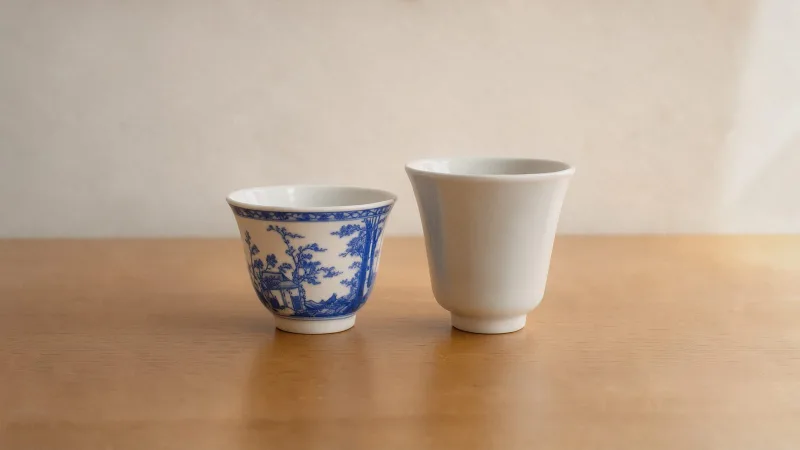
- Made in:
- Jiangxi, Jingdezhen (Fuliang county)
- Body:
- porcelain stone + kaolin
- Imperial factory:
- from 1369
- Water absorption:
- fine porcelain 0.5% at most
- Firing today:
- gas, standard 1320 °C
- Heritage:
- UNESCO, site 1765
A white cup looks like the simplest thing on a tea table, yet it took a thousand years of choosing clay and fire to get a thin, ringing body that does not smell of yesterday’s tea, does not crack under boiling water and lets you read the color of the liquor. Most of what tea drinkers call porcelain was invented or refined in Jingdezhen.
The standard cup shapes were fixed here too, many of them in the kilns of the imperial factory. Today the city turns out everything from decal-printed factory cups to wood-fired work by individual potters.
The two-part body
Jingdezhen porcelain is made from two prepared rocks: porcelain stone (瓷石, “petuntse” to Europeans) and kaolin (高岭土). The word kaolin comes from Gaoling, “high ridge,” an area northeast of the city. Neither is mined in Jingdezhen itself. In 1712 the Jesuit d’Entrecolles watched the raw material arrive by boat, pressed into bricks.1
In the kiln the stone melts into a glassy phase, while the kaolin keeps the piece in shape. That is the binary formulabinary formulaA mix of two rocks: porcelain stone (which melts into the glassy phase) and kaolin (which lets the piece keep its shape in the fire). The kaolin share rose from 10–25% in Yuan and Ming blue-and-white to 30–60% in the Qing. (二元配方), the city’s main technical invention. The proportions changed over time. In Yuan and Ming blue-and-white the kaolin share was 10–25%, in the Qing 30–60%; in imperial porcelain of the early 17th century it rose from about 20% to 50%. D’Entrecolles rated a one-to-one mix as the best grade, four to six as the middle one and one to three as the lowest.
Glaze was traditionally mixed from “glaze stone” and an ash made by burning lime with plant material. On imperial pieces the amount of ash depended on wall thickness: 9–16% for thick walls, 1–10% for thin ones. Making a piece took many steps: throwing on the wheel, two rounds of knife trimming, painting, glazing, and firing in saggars (匣钵), closed refractory boxes. In the Tiangong kaiwu (1637) Song Yingxing reckoned that each piece passed through seventy-two hands.
A dense, vitrified body barely absorbs water, and under GB/T 3532-2022 fine porcelain may absorb no more than 0.5%.2 So a porcelain gaiwan does not carry the smell of the last tea, while the porous wall of a Yixing teapot holds on to aroma.
Qingbai and the first cups
Under the Song, from the 10th to the 13th century, the city’s potters settled on qingbai (青白, “bluish-white”), a thin body under a faintly blue glaze. The city’s name also dates from the Song. During the Jingde era (1004–1007) Emperor Zhenzong named it after his reign title; before that it was called Changnan. Other kilns were active in China at the same time, including the celadon kilns of Yue and Longquan and the court kilns of the Song, but it was Jingdezhen’s white body that everything later was built on.
In 1278, under the Yuan, the Fuliang Porcelain Bureau was set up to handle court orders. According to the Yuan shi it held the lowest, ninth rank. Historians disagree on whether it counts as an “official kiln,” since the court ordered porcelain by decree from several kilns. The imperial factory proper (御器厂, later 御窑厂) was founded in 1369, the second year of the Hongwu reign. It started with 20 kilns and had 58 by the Xuande reign, with the work split among 23 workshops. The standard cup types came from here.
Cobalt and enamels
Blue-and-white (青花). Painters brush the design in cobalt onto the raw body; the piece is then glazed and fired once, at high temperature, in a reducing flame. Under Yongle (1403–1424) potters used imported “sumali” cobalt, whose lines bled like ink. The “sweet white” tianbai glaze and the “press-hand” cup (压手杯) also date from this time. One such cup in the Palace Museum is 4.9 cm tall with a mouth 9.2 cm across.
Copper red. Jihong (祭红) glaze reached its peak under Xuande (1426–1435). The name comes from altar vessels, not from blood sacrifice, as is sometimes claimed. Its color comes from about 0.5% copper, reduced to a colloidal state.
Doucai. Under Chenghua (1465–1487) potters developed doucaidoucai“Contending colors” (斗彩): a cobalt outline under the glaze, filled in with enamels on top of it. The second firing is at a lower temperature. (斗彩). The painter draws a blue outline under the glaze, fills it in with enamels on top after the first firing, and the piece goes back into the kiln at a lower temperature. The “chicken cup,” 4.1 cm tall and 8.3 cm across the mouth, is painted this way. In 2014 one sold at auction for 281 million Hong Kong dollars. Nobody knows exactly how many survive. Estimates run from 17 to 19, and which of them are genuine is itself disputed.
Fencai. The palette with a pink made from colloidal gold was developed in the Beijing palace workshops late in the Kangxi reign and passed to Jingdezhen in the early Yongzheng years (1723–1735). The opaque white in fencaifencai“Powder colors” (粉彩, famille rose): overglaze enamels with a pink made from colloidal gold and an opaque white made with arsenic. (粉彩, famille rose) is made with arsenic, and the pink comes from gold. These enamels lie on top of the glaze, not under it. That matters for a cup: any painting on the inside sits in the tea, so tasting ware usually has a white interior.
Thin walls: eggshell and rice grain
Two techniques are prized as feats of skill, and both are demanding. In bodiless ware (薄胎), or “eggshell,” the wall is pared down with a knife to about 0.5 mm. Potters revived it around 1916, and by 1928 more than 3,300 people were making it. For linglong (玲珑), “rice grain,” holes are cut with a knife in the dry body and filled with clear glaze six or seven times. The holes are cut with a steel lancet; the popular story about rice grains pressed into the clay is a myth.
Pieces like these are fragile and need careful handling, and for everyday brewing there is sturdier ware.
Gaiwans and cups today
A porcelain gaiwan is the basic tool of gongfu cha and of tasting. The standard GB/T 23776-2018 explicitly calls for white porcelain cups of the same size, thickness and color, with a whiteness of at least N 9.5. The oolong cup it specifies is an “inverted bell” of 110 ml, 52 mm tall and 83 mm across the mouth. Under GB/T 3532-2022, cups with a mouth of 60–100 mm count as medium, and tasting cups usually fall into that class.
Jingdezhen’s market is layered: factory ware with decals, workshops that throw by hand and paint quickly, individual artists’ pieces, and reproductions of historical types. In a listing, “Jingdezhen” tells you only where a piece was made, so judge the piece, not the workshop’s address.
How to choose
The main test for hand painting is to turn the cup. A printed motif repeats; a painted one does not. Also look for a decal seam, a halftone dot pattern under a loupe, and color fields with uniformly sharp edges. Chinese factories first tried film decals in 1969 and had switched over to them completely within about a year. Mixed methods, such as a printed outline filled in by hand, are common; they become deception when the seller calls the whole thing “hand-painted.”
Go through a gaiwan point by point:
- A flared rim you can hold without burning your fingers.
- The lid sits inside the mouth and turns without catching.
- The gaiwan does not rock on the table.
- A working volume of 100–120 ml, measured to the lid line, which is about 80% of the nominal capacity.
- A smooth white interior with no bare spots in the glaze or clusters of pinholes.
- A thin, clean rim without a bead of glaze, and a ringing sound when tapped.
- A dense white trimmed foot and a saucer that fits.
“Wood-fired” (柴窑) on a label guarantees nothing on its own. In the past the temperature in a wood kiln varied from about 1320 to 1170 °C across the load, and most pieces came out low grade. Today the standard is gas firing at 1320 °C.
Fakes of old pieces are nothing new. Zhao Ruzhen describes transplanting a marked base from a broken piece onto a new one, rubbing the “fire gloss” off fresh glaze with an abrasive, and swapping a late mark for a Kangxi or Qianlong one. A reign mark on a modern cup dates nothing.
Care and the Japanese branch
Small and medium pieces of fine porcelain have to withstand a drop from 180 to 20 °C without cracking, so pouring boiling water into a room-temperature vessel is safe. Protect eggshell and linglong from knocks. Overglaze enamels sit on the surface of the glaze; otherwise the usual rules of teaware care apply.
In the late Ming, the city’s private kilns made blue-and-white pieces for Japan to suit wabi-cha taste: ko-sometsuke (Tianqi era) and shonzui (Chongzhen era, 1628–1644). The Tokyo National Museum holds a chawan with the shonzui mark. By then China was steeping loose leaf tea, a habit that took hold under the Ming. Europe borrowed Jingdezhen’s binary formula for its own 18th-century hard-paste porcelain, a story told in the history of the European teapot. China’s other great white porcelain comes from Dehua.
Common questions
Why is a porcelain gaiwan better than a clay one?
It does not absorb smell or flavor, so you can brew any tea in it, and the white interior shows the color of the liquor. Clay holds on to aroma, so a clay pot is best kept for one type of tea. The Chazhidao school calls porcelain the best material for white, black and dark tea, and prefers Yixing clay for oolong.
How can I tell hand painting from a decal?
Turn the cup around. A printed motif repeats exactly in size and angle, while two hand-painted leaves are never identical. Also look for a seam behind the handle and under the rim, a halftone dot pattern under a loupe, and color fields whose edges are all equally sharp.
What does “Jingdezhen” on a label mean?
A city, not a grade and not a guarantee of quality. Factory cups with decals and individual artists’ pieces are both made there. A reign mark on a modern cup is a convention and dates nothing.
-
Letter of Father d’Entrecolles, 1 September 1712: gotheborg.com. ↩
-
GB/T 3532-2022 “Household porcelain” (replaced GB/T 3532-2009): bzfyw.com. ↩