Brewing basics
Whatever the method, the same things shape the liquor: how much leaf, which water and how long. What happens before brewing counts too: warming the teaware and storing the dry leaf.
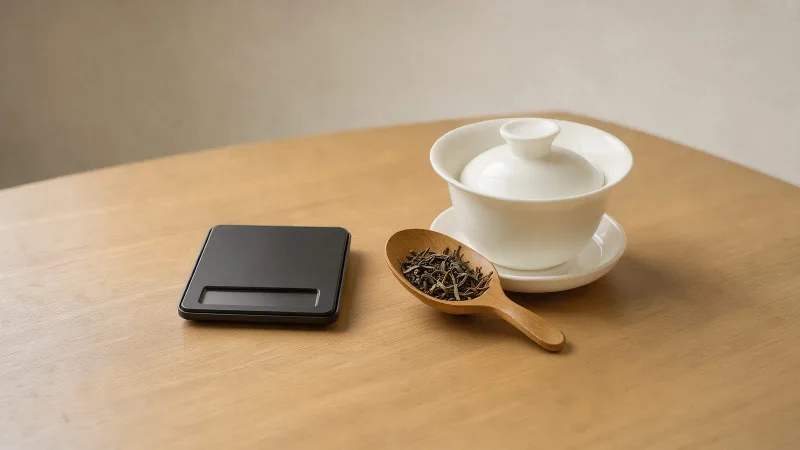
Leaf dose and time work together: more leaf means a shorter infusion. Small, broken leaf releases flavor faster than whole leaf, so it needs a shorter steep. Water makes up more than 99% of the liquor, so its minerals and temperature noticeably change the flavor.
Warming the teaware raises the temperature of the first infusion by a few degrees, and a rinse opens up tightly rolled leaf. How you store tea decides what you start with: dry leaf picks up moisture and stray odors, and loses aroma in light and warmth.
In this section
-
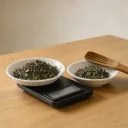 Leaf dose and time
投茶量
How much tea to use and how long to steep it: ISO and GB/T standards, gongfu and Western ratios, why a spoon is a poor measure, and how infusions change.
-
 Water for tea
水
Which water suits tea: hardness and dissolved solids, tap, bottled and filtered water, temperature by tea type, the reboiling myth, Lu Yu's three boils.
-
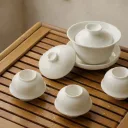 Warming and rinsing
温壶烫杯
Why to warm the pot, gaiwan and cups with boiling water, and which teas need a rinse. Measured temperatures, rinse seconds, and where tea masters disagree.
-
 Storage
存茶
How to store tea at home: green tea cold and airless, oolong by roast level, white tea and pu-erh for aging. Limits from the Chinese standard.
-
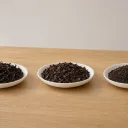 Leaf size
Whole leaf, broken leaf, fannings and dust: what OP, BOP and CTC mean, how particle size changes how fast tea steeps, and why matcha is ground to microns.