Kilns and Firing: Reduction, Wood and Kiln Change
The kiln decides three things: color, body density and glaze character. Iron in the raw materials turns blue-green (celadon) when oxygen runs short and yellow or brown when it is plentiful. Wood firing is prized for ash and unpredictability, but nothing shows it changes how tea tastes.

- Oxidizing atmosphere:
- CO below 2%: iron yellow, body reddish-brown
- Reducing atmosphere:
- CO from 4%: iron blue-green, body gray
- Zisha:
- 1100–1200°C in a dragon kiln, 40–42 h
- Porcelain:
- about 1300°C, water absorption about 0.5%
- Jian bowl:
- above 1300°C, in an electric kiln with pine
- Flavor from wood:
- no verified data
Two cups made from the same clay and the same glaze can leave the kiln looking nothing alike. One is deep gray-green, the other yellow. The difference did not come from the potter's wheel. It came from what happened in the chamber: how much oxygen there was, how hot it got, and how fast it cooled.
For anyone who brews, firing matters for two reasons. It sets the density of the body, which drives the material properties of a pot. And it explains why some pieces are sold as "wood-fired" at twice the price.
Atmosphere: oxidation and reduction
Iron sits in almost every clay and glaze. What it does depends on the air in the kiln.
In oxidation there is enough oxygen to burn the fuel completely. Iron stays ferric and gives yellowish tones, while copper gives green. In reduction there is too little air, so carbon monoxide and hydrogen strip oxygen from the oxides. Iron turns ferrous and shifts to blue-green, and copper goes red.1
A Japanese municipal ceramics lab sets its thresholds by CO content: from 2% the firing is no longer oxidizing, from 4% it is reducing, from 8% strongly reducing, and black smoke appears above 10% CO. The same glaze with 2% iron oxide turns yellow in oxidation and a pale blue celadon in reduction. The body changes with it, from reddish-brown to gray.
In an experiment on an Arita glaze at 1300°C, with no CO the iron stayed ferric and the color was gray-yellow. At 0.5% CO, 85.9% of the iron was ferrous; at 1%, 95.6%; at 4%, all of it, and the color was blue-green. That scale shows why celadon depends so much on the draft.
Glaze color is not a recipe for the clay, and celadon shows it well. Southern Song and Yuan Longquan plum-green glaze contains only 0.90–0.93% Fe₂O₃. Its depth comes from a layer about 1 mm thick and from reduction, not from extra iron.
Temperature: hotter means denser
Firing decides whether clay becomes a body at all. At 700–800°C you get earthenware with water absorption above 10%. Stoneware fires at 1200–1300°C, porcelain at about 1300°C with absorption near 0.5%. Ash glaze melts from about 1250°C.
Teaware covers the whole scale:
- Yixing zisha in a dragon kiln: 1100–1200°C, 40–42 h;
- zhuni, the softest Yixing clay: about 1040°C, no higher than 1060°C, cooled slowly;
- Southern Song Guan ware: about 1220°C in reduction;
- Jian bowls: above 1300°C;
- Longquan celadon: up to 1310°C.
For a teapot the key number here is not temperature but water absorption. GB/T 10816-2024 caps it at 6.0% for zisha teapots and cups and requires the piece to survive a move from 180°C into 20°C water. Reduction is dangerous for zisha: it pulls melt formation down to about 1100°C, and the iron-rich body blackens, bloats and picks up sooty inclusions. So zisha is fired in oxidation, calculated at 1150–1180°C. Porosity in turn affects what a pot does to the brew.
Kilns are not always read in degrees. Orton cones measure heat work: at a 60°C/h climb, cone 6 bends at 1222°C and cone 10 at 1285°C, while at 150°C/h the same cones bend at 1243 and 1305°C. Yixing potters use Japanese SK cones: in a tunnel kiln for zisha, the top sits near 1180°C (SK 2.5) and the bottom near 1150°C (SK 1).
Kilns: from dragon to electric
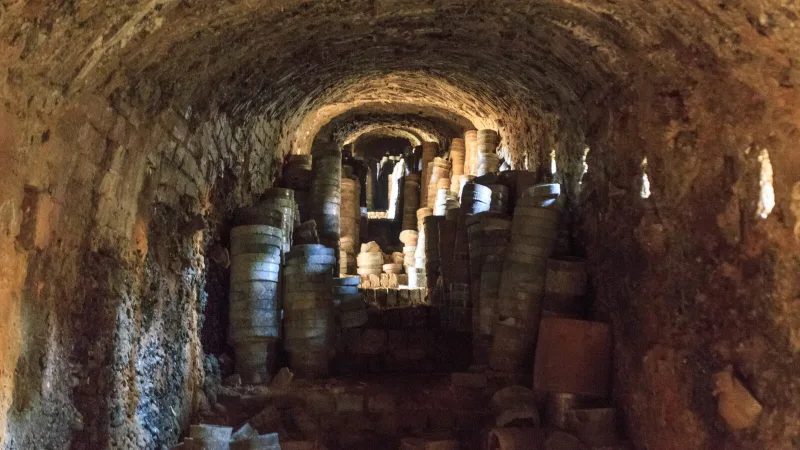
For centuries, potters in South China fired in the dragon kiln, a long brick tunnel on a 10–16° slope with the flame running along the floor. Excavations at Shangyu, Zhejiang, suggest it may have appeared with stoneware back in the Shang, and by the twelfth century some kilns ran past 135 m. They burned pine and bamboo. The Yixing kiln at Qianshu, 43.4 m long, is fired for about 40 hours and reaches 1200°C. One firing there costs, according to its keeper, up to a million yuan.
Kilns heat unevenly, and firers make use of it. At Yixing, small pieces of fat clay go near the head, where they get less heat, and large household ware goes at the tail.
Since the late Ming, Jingdezhen has used the egg-shaped kiln (zhenyao). A single firebox sits at the wide front, the chamber narrows toward the back, and the chimney stands apart. Ware goes in saggarssaggarsRefractory cases that hold the ware during firing. They shield it from ash and direct flame. on a sand floor. A 2020s experiment on a reconstruction recorded the schedule: drying 2–3 hours, oxidizing climb 8–9 hours, reduction 11–12 hours with wood thrown in every 4–6 minutes, 21–24 hours in all.2 The spread reached 150°C along the length and 50°C in height, which is why the hottest zone was given to crackle glazes.
In Japan the anagama is a single chamber where firebox and stacking space are not separated. The noborigama, which came from the Korean peninsula in the Momoyama period, is a row of up to 15 chambers up a slope. The anagama cools fast and its results vary widely. The noborigama heats and cools slowly and uses its heat more efficiently. One kiln at Bizen runs over 50 m.
From the 1950s to the 1990s industry moved to coal, oil, gas and electricity. At Yixing the dragon kiln served zisha until 1957, and oil-fired tunnel kilns arrived in 1973. A modern pushed-slab gas tunnel kiln runs ware through in 14 hours at 1150–1180°C. An electric kiln takes about a day per cycle and leaves no flame marks, so zisha comes out even, though the temperature gap between top and bottom is large. Longquan celadon has been gas-fired since 2000.
Wood came back as a maker's choice
Jingdezhen put its wood kilns out by the mid-1990s, and private workshops later began building small ones. Since 2009, wood firing there has been protected as intangible heritage. Today about twenty wood kilns work among more than a thousand, under 2%. In Taiwan the chaishao movement grew from the Hanbao kiln at Tongluo in the 1970s and the Shuili snake kiln. Earlier potters saw settled ash as dirt: the story goes that one cart of failed vessels was tipped into a stream.
Why fire with wood? Ash lands on the piece and melts into a natural glaze, the flame leaves marks, and the fire side differs from the far side. None of it can be repeated exactly, and that is the point.
No objective benefit for tea has been shown. A kiln master at Wuzhou notes that for plain white porcelain, gas and electricity removed the ash defects. Masters of Longquan and Jian suggest keeping one or two wood kilns for show and firing mostly with gas. Jun masters hold that without wood there is no real yaobianyaobianA change in glaze color and pattern in the kiln, caused by flame, temperature, ash and atmosphere. In the narrow sense it names the spots on Jun glaze..
Yaobian: spots nobody planned
Yaobian (窑变, Japanese 窯変) in the narrow sense names the spots on Jun glaze; in the wide sense it is any change of color and pattern in the kiln. Yixing technologists argue that only a dragon kiln gives true yaobian, because oxidizing and reducing pockets sit side by side in it. Jian bowl maker Sun Jianxing achieved reduction in electric and gas kilns. Jun master Liu Hongsheng calls the kiln the "mother of porcelain" and says wood, coal and gas each give a different-looking glaze. One Jun master rebuilt his kiln and cut wood use from 5 tonnes to 0.5 and the firing from 40 hours to 10.
So "yaobian only from wood" remains an argument among potters, not an established fact.
Jian bowls show the kiln's work best. Their glaze contains 4.10–8.35% iron oxide. Around 1240°C the oxides decompose and release oxygen, bubbles carry iron to the surface, and ε-Fe₂O₃ crystals grow on cooling. According to a Jianyang maker, the glaze seals near 1180°C, oil spots form near 1310°C, and hare's fur appears above 1325°C. An electric kiln cannot create a reducing atmosphere on its own, so he throws resinous pine in by hand.
Reading kiln marks, and what to ask when buying
A few signs worth knowing:
- Flame marks and local shine on unglazed zisha point to direct flame. They do not appear in saggars or electric kilns. Yixing began using saggars in the mid-Ming to remove flame marks.
- A gray break under the glaze with a reddish unglazed foot suggests reduction followed by reoxidation of the surface.
- "Purple mouth, iron foot" on Guan ware, one of the Song kilns: at the rim a thin glaze lets the dark body show through, and the bare foot reddens.
- Zisha from a low-fired, chemically colored body bloats in a dragon kiln and sprouts "needles", which is how a technologist tells it apart.
Faked effects exist too. Glaze applied in advance to imitate ash passes itself off as natural. Refiring a piece upside down muddles the flame marks. Celadon color alone proves neither age nor authenticity: in one kiln, pieces from different spots come out anywhere from green to brown.
Price tells you something too. At one Jianshui workshop a flawless wood-fired jar cost twice as much as the same form from a gas kiln. A Taiwanese potter calls a wood-fired piece his own work only if one person did everything, from clay to firing. Work done on someone else's instructions is collective, and work sent to someone else's kiln is no longer his.
With Japanese ware the same questions apply, adjusted for tradition: at Bizen and Shigaraki the natural ash glaze comes from anagama and noborigama firing. Tokoname and Banko ware is fired quite differently.
Common questions
Does wood firing change how tea tastes?
No verified data says so. Wood firing gives ash glaze, flame marks and a difference between the fire side and the far side, and Taiwanese potters value its texture and color. The sources reviewed did not measure the brew itself, so the safe view is that the effect is visual and tactile.
How can I tell a wood-fired cup from a gas-fired one?
You cannot reliably tell by looking: some potters aim for a wood-fired look in gas and electric kilns. Natural ash glaze comes from ash that settled on its own, while glaze applied in advance to imitate ash tends to look too even. Ask the seller which kiln was used.
Can an electric kiln do reduction firing?
Yes, with a propane burner or fuel thrown into the chamber by hand, as some Jian bowl makers do. The catch is that frequent reduction wears out the heating elements faster.
-
Toki city ceramics laboratory, oxidation and reduction firing, 2023. A municipal source; the CO thresholds reflect Japanese practice. ↩
-
Jiang C., Wu J. et al. Interpreting the firing technology logic of the Jingdezhen egg-shaped kiln through experimental archaeology. npj Heritage Science, 2026. Three full firings on a test kiln that had run over a hundred production firings. ↩