Fair cup (chahai) 公道杯
A vessel that holds the whole infusion before it goes into the cups. Decanting ends the steeping and gives every cup the same strength. It is a recent addition: classical gongfu cha does without one.
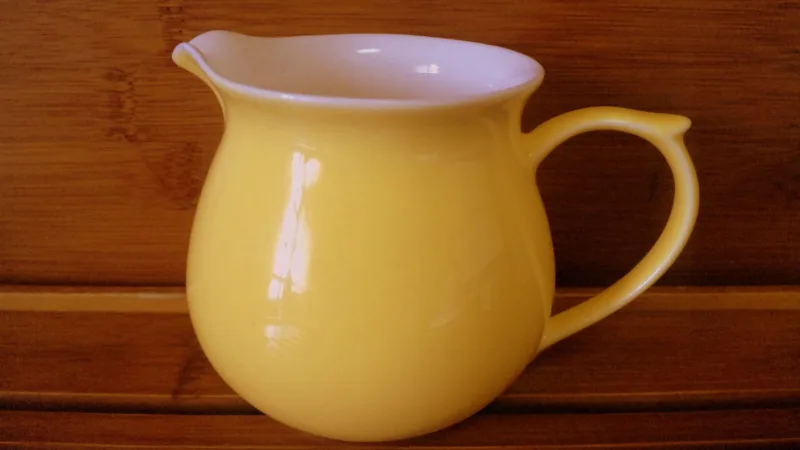

- Names:
- chahai 茶海, gong dao bei 公道杯, fair cup
- Volume:
- 150–300 ml, sized to the brewing vessel
- Material:
- glass, porcelain, less often clay
- Appeared:
- Taiwan, 1970s–1980s
- Used in:
- gongfu cha with short infusions
A chahai (茶海, “sea of tea”) is an open vessel with a spout. You empty the whole infusion into it from the brewing vessel, then fill the cups from it. In mainland China it is more often called gong dao beigong dao beiThe Chinese name of the chahai (公道杯), literally “cup of fairness”. The name first belonged to a wine cup with a siphon that drains all the wine if you fill it past a mark., the “cup of fairness”, because everyone is served from one vessel at one strength. Decanting also ends the steeping, since the leaf is left without water.
The chahai is a newcomer. Classical Chaozhou gongfu cha does without it; it joined the tea set in Taiwan in the 1970s and 1980s. That is why there are several stories of its origin, and why its usefulness is still disputed.
Why it exists
The first pours from a brewing vessel are weaker than the last, and this is easy to check: pour three cups in a row from a gaiwan and compare the color. Pour straight from the vessel and one cup comes out pale, another dark.
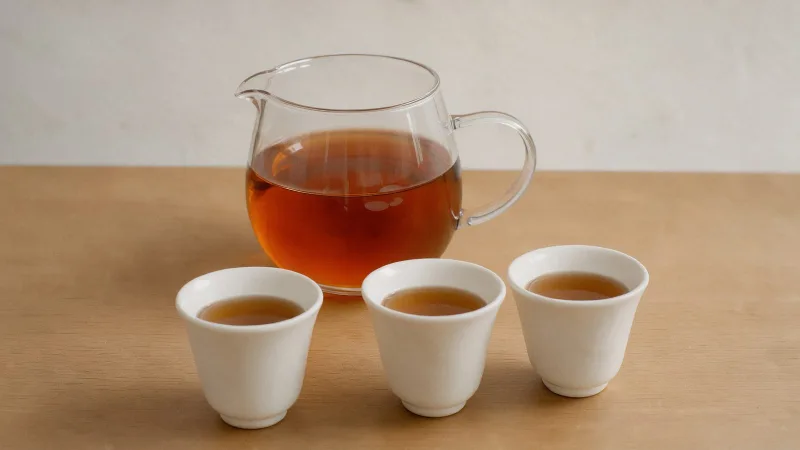
Liquor waiting in the pot for its turn also keeps getting stronger, and by the third cup an oolong or ripe pu-erh starts to turn bitter. A chahai fixes both problems. The whole infusion comes off the leaf in seconds, mixes, and is poured right away. The difference is clearest with teas brewed in many short infusions: oolongs, high-mountain Taiwanese, Wuyi rock teas, dancong, pu-erh, black tea.
A chahai also cools water. For green tea, white tea and young sheng pu-erh, you pour the water into the chahai first and only then onto the leaf. Ricardo Caicedo measured this in Bogotá: water at 91.2°C lost on average 3.4°C on the first transfer, 6.5°C on the second and 8.5°C on the third.1 In Japan this job has its own vessel, the yuzamashiyuzamashiA Japanese vessel for cooling boiling water before brewing green tea. It never holds leaf., which never holds leaf and serves only to cool water. Japanese guides put the drop at 5 to 10°C per transfer.
Where it came from
Chaozhou, where gongfu cha took shape, has no chahai. Tea is poured straight from the pot using two moves, “Guan Gong patrols the city” (circling over the cups, a little into each) and “Han Xin counts his soldiers” (the last, strongest drops shared out equally). Evening out the strength is left to the host’s hand.
Taiwan’s “old men’s tea” also went without an intermediate vessel for a long time. An author from the Chun Shui Tang tea house writes that his father (1912–2006) drank tea from 1949 on, went decades without a chahai and took one up only in old age, when the cups began to burn his fingers.
Sources disagree on where the form came from, and none of the theories is proven. Taiwanese researcher He Jiansheng thinks the pitcher may have arrived during the Japanese period (1895–1945) along with sencha brewing. Global Tea Hut links the chahai to a Japanese way of brewing with two Yixing pots, the second serving as a yuzamashi. A 2013 note in the same magazine is blunter: the vessel was invented in Britain as a cream jug, and a Taiwanese potter adapted it for gongfu cha in the 1980s. Dates vary too, from the early 1970s to the 1980s.
Other facts stand on firmer ground. The Yingge Ceramics Museum names the chahai and the aroma cup (wenxiangbei) as two items missing from classical gongfu cha and ties the new style to the “tea art” (茶藝) movement and the collapse of Taiwanese tea exports after 1971. The Lu Yu Tea Art Center made the chahai part of the standard set. Cai Rongzhang dates its cylindrical chahai to 1981, the full set with a chahai to 1982, a ceramic one with a clean cut-offclean cut-offA spout that stops the stream instantly, with no drop running down the outside wall (断水). to 1984 and a removable strainer for the mouth to 1986.2
Handle or no handle is a matter of fashion. The 1970s favored cream jugs with handles, the 1980s switched to handleless ones, and in 2000 the Yang Xin Tang workshop released glass chahai with handles. Both forms are in use today.
Size, shape and material
A chahai has to hold the whole infusion. Otherwise part of the liquor stays on the leaf and the vessel is pointless. Authors give different numbers but point the same way:
| Brewing vessel | Chahai |
|---|---|
| 80–100 ml | 150–200 ml |
| 100–120 ml | 180–250 ml |
| 130–150 ml | 250–350 ml |
| 180 ml and up | 350 ml and up |
Other sources suggest a margin of 20–50 ml for a 150 ml vessel, or 1.3 to 1.5 times its volume, or as much as 300 ml for a 160 ml gaiwan. A rule of thumb is enough: noticeably larger than the brewing vessel. Stated capacity, actual fill and yield differ, so authors advise against buying a chahai with no margin. Too big is no good either. The liquor spreads in a thin layer, cools faster and pours awkwardly. The Chinese national standard for oolong evaluation follows the same logic, emptying a 110 ml gaiwan into a 160 ml bowl.
Shape comes down to the spout and the handle. The spout can be a sharp lip, like a cream jug’s, or a tube, as on a teapot without a lid. What matters most is a clean cut-off. With a thick rounded lip the tea “hangs” (挂汤) and drips on the table, while a thin sharp edge cuts the stream cleaner. The neck is often a little narrower than the base so a strainer can sit on it. A handle is safer for a beginner. Without one you hold the chahai by its rim, which has to be wide, and that takes practice.
- Glass, including heat-resistant. Shows the color and clarity of the liquor, absorbs no odors and suits any tea. Like all glass teaware, it loses heat faster, and dark teas leave visible streaks.
- White and pale porcelain. Neutral, holds heat better than glass and matches a porcelain gaiwan.
- Celadon and colored glazes. Lovely on the table, but a dark glaze hides the color of the liquor.
- Coarse ceramic and Yixing clay. Warm in the hand, suited to aged and roasted teas. It can absorb odors, so dry it thoroughly.
In China, glassware for food must meet GB 4806.5-2016, which limits lead and cadmium migration. On the label, look for the material, the standard and the allowed temperature swing: a glass rated for hot drinks withstands a swing of 80–120°C. Glass meant for cold drinks should not take boiling water. A Chinese consumer review also warns about lead in some glass chahai.
How to use it
The sequence comes from the Lu Yu program, reduced to a few simple steps. Set the chahai to the right of the pot with its spout facing it, and keep the distance from pot to chahai and from chahai to cups short.
- Warm the chahai and the rest of the teaware with boiling water (about 212°F), then pour it out: cold glass draws heat from the liquor.
- Pour off the whole infusion, down to the last drop. Liquid left behind keeps steeping, and the next infusion turns bitter.
- Pour into the cups at once, holding the spout low.
- With many guests, go around the cups in several rounds, topping up to one level.
- Empty the chahai before the next infusion.
Step three is where speed matters. Based on its own tests, Global Tea Hut writes that the strength stays even if you pour immediately, while liquor left standing separates again. Other authors advise waiting a second so it mixes. Neither side has measured it. Fill the chahai no more than halfway, or it gets too hot to hold.
See preheating and rinsing for how to warm the teaware and rinse the leaf.
When you can skip it
For three cups without a chahai, Erler suggests this order: fill the first and second cups halfway, the third to the top, then top up the second and the first. It is the same circling pour as in Chaozhou, and a guest who likes weaker tea can be given a lighter cup on purpose.
The case against the chahai is simple: each transfer sheds a few degrees, and the hotter the liquor, the more aroma it gives off. Chinese Wikipedia cites a sharper view: for teas that need boiling water, the chahai is mostly for show and cools the liquor. Chun Shui Tang keeps the chahai only in its gongfu set for aged and roasted tea; in its high-mountain two-cup service with the aroma cup, the chahai just cools and carries the second infusion.
For green, white and yellow tea, a glass chahai is a window onto the liquor, and the cooling is a bonus. For oolong, pu-erh and black tea it earns its place with several guests and short infusions. If you drink alone and want the liquor hot, leave the chahai off the table.
Choosing and caring for it
First test the spout’s cut-off: pour water and watch whether the stream ends cleanly or a drop runs down the wall. Then check stability. Look for a flat base, no tall narrow silhouette, and a full chahai you can lift with one hand. Size it to your brewing vessel, not to your guest list.
Care is simple. Rinse glass and porcelain with hot water right after tea, before the film dries. Remove film with a soft sponge, clean the spout with a soft brush, and skip metal scourers, which leave scratches. Dry clay completely, or it will develop a musty smell. In storage, keep the spout and handle, the most fragile parts, from pressing against anything.
Clay and seasoning a teapot are covered under teaware care.
Common questions
Do I need a chahai if I drink alone?
No, but it is handy: you pour the whole infusion off the leaf, so nothing over-steeps while you drink. Experts disagree on its value. Stéphane Erler (Tea Masters) points out that every transfer costs a few degrees, and he teaches on a gaiwan without a pitcher.
What size chahai should I buy?
Larger than your brewing vessel. A 100–120 ml gaiwan or teapot pairs with 180–250 ml, a 150 ml one with 250–350 ml. What matters is that it holds the whole infusion with room to spare.
Is a glass chahai better than porcelain?
Glass lets you see the color of the liquor before pouring and does not absorb odors. Porcelain holds heat longer. Glass is the usual pick for green and white tea, porcelain or ceramic for aged and roasted teas.
-
Ricardo Caicedo, Experiment: How Much does Water Cool when Pouring?, 2012. Water boiled at 91.2°C, room temperature 20°C; in the cup it lost another 2.5–2.9°C per minute. ↩
-
Cai Rongzhang (蔡荣章), 当代小壶茶法茶具发展资料, 2012. Founder of the Lu Yu Tea Art Center and the primary source for this chronology. ↩