Yixing clays: zini, zhuni, duanni 紫砂泥
Yixing zisha is not one clay but five families of ore from Huanglongshan and the hills around it. They differ in iron, firing and shrinkage, and so in how dense the fired body is and how tea brews in the pot.
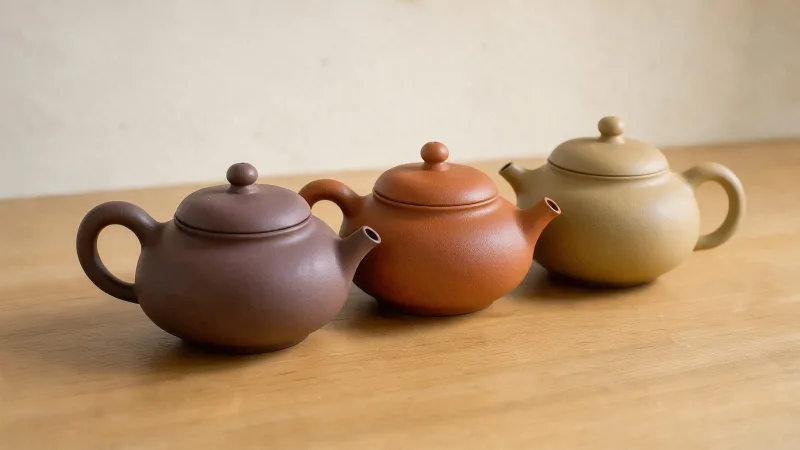
- Mined at:
- Yixing, Jiangsu, Huanglongshan mountain
- What it is:
- iron-bearing siltstone and mudstone, not river silt
- Families:
- zini, hongni, zhuni, duanni, lüni
- Firing:
- 1065–1250 °C, by clay
- Shrinkage:
- zini 10–11%, zhuni 17–30%
The word “zisha” sounds like the name of a single clay, but it covers several ores. Yixing potters recognize five families: zini, hongni, zhuni, duanni and benshan lüni. After firing, each has its own color and density and behaves differently with tea. These are the ores a Yixing teapot is made from.
The geographical indication papers list three families: zini, hongni and benshan lüni. Connoisseurs count five, setting zhuni and duanni apart. There is nothing to settle here: whatever the paperwork says, zhuni and duanni exist in workshops and on the market.
Ore, not clay
Zisha is rock: iron-bearing siltstone and mudstone from an ancient lake basin. Nobody digs it out of a riverbed like potter's silt. The seams are dated to about 350 million years ago (Devonian); the geologist Chen Xiqing places them in the Late Devonian to Early Carboniferous, at about 300 million years.
The main mining district, Huanglongshan near the town of Dingshu, covers only about 2.5 km². The zisha seams are thin, from a few centimeters to a meter, and sit inside a hard rock called jianijianiHard, “armor-like” rock that holds the zini, hongni and lüni seams. Everyday Yixing ceramics are made from it.. Local estimates put zisha at just 3–4% of the mountain's reserves. Potters sort the raw material into baini (white), jiani (“armor”) and nenninenniSoft, “tender” clay close to mudstone. Zhuni lies in its lower layers. (“tender”, soft). Zini, hongni and lüni lie in the jiani, while zhuni comes from the bottom of the nenni at Zhaozhuang and Hongwei.1
Ordinary zini is about 24–36% quartz, 27–31% kaolinite, 23–37% mica and 7–9% iron oxide. That mix already has a filler, a plastic component and a flux, so the ore sinters into a body without additives. After firing, quartz grains and clay aggregates of 300–900 µm leave a “double porosity”: fine pores of 0.5–3 µm inside the aggregates and chains of pores around them.2
From ore to body
Ore does not go straight from the pit to the workshop. First it weathers in the open for weeks or months, then it is crushed, sieved and mixed with water, 15–30% by weight. Potters beat the clay with a mallet until a fresh cut turns glossy, about 20 passes by one account. The body then rests (chenfu) and is wedged again.
Around 1640 Zhou Gaoqi wrote about “growing the earth”: each workshop pounded colored earths, buried them in a pit and kept its blending recipes secret. The current standard for the geographical indication “宜兴紫砂” requires at least 180 days of weathering and at least 90 days of aging. Factories today add magnetic cleaning and a vacuum press and age the clay for 3–6 months. Whether still longer aging helps is disputed. Some say that once the clay is plastic enough, more time does nothing for the brew; others keep to the old rule “the longer, the better”.
The recipe has one more element, tiaoshatiaoshaGrit of already fired clay mixed into the body. The grit barely shrinks, so the whole pot shrinks less.: grit of already fired clay added to the body. The grit barely shrinks and keeps its shape, which cuts shrinkage and warping. That is why modern zhuni often has coarse grains in it.
The five families
Zini
The most abundant ore at Huanglongshan. It fires near 1180 °C and shrinks 10–11%, and its color runs from reddish brown to deep purple. Several named ores belong to the zini group. Dicaoqing comes from the lowest layer of the seam and is recognized by its green “chicken eyes”. Until the 1980s it was considered second-rate, hard to work and to fire; it owes its fame to the choice of one well-known master and to good marketing. Genuine dicaoqing is never bright red or green.
Hongni and zhuni
Hongni comes from shallow red ores. It fires near 1100 °C, shrinks 13–14% and turns orange to red. Zhuni is redder, with a cinnabar tone; it fires at 1065–1080 °C and shrinks 17–25%, up to 30% for some ores. By some data it contains 14–18% iron, though the single sample in Cohen's table showed 8.1%. Shrinkage figures vary just as widely: sources give anything from 17 to 55% without saying whether they mean linear or volumetric.
Because of the shrinkage, zhuni pots are usually small, up to 160 ml, and many small shapes fail in the kiln: only about 60% of small pieces from Xiaomeiyao ore came out sound. That quarry closed in 1997. The line between zhuni and hongni is blurry. One American tea shop describes zhuni as a red hongni that collectors singled out for its color, while the connoisseur Youzi divides hongni itself into “zisha hongni” and “zhuni hongni”. Chaozhou zhuni, used for hand-thrown shoula teapots, is a different clay.
Duanni
A natural intergrowth of zini with lüni (sometimes lüni with hongni), or an artificial blend. It fires at 1170–1180 °C, shrinks about 12% and ranges from golden to gray-green with specks. The name is put down to dialect: in Dingshu “tuan” (团, “lump”) and “duan” (段) sound the same, and the character 缎, “satin”, suited the color.
There is a tale that duanni cracks from brewing. The cracks actually form in the kiln, and tea only makes them visible. Black spots on pale clays (“spitting black”, 吐黑) come from underfiring and a loose body, not from the clay itself.
Benshan lüni
The rarest ore, about 2% of all zisha. Its seams, from a few centimeters to 20 thick, lie under a quartzite “bone” or inside zini, and it has less than 3% iron. It fires at 1180–1250 °C, shrinks 4–8% and comes out pale yellow, the color of “pear skin”, not green. “Emerald lüni” in a shop is a dyed body.
Which clay for which tea
Zisha is unevenly porous: 5–9% at the surface, 9–14% in the middle, 15–17% near the inner wall, about 10% on average. The dense outer skin makes the pot strong and smooth, while the porous interior slows heat transfer and absorbs organic matter from the tea. Zhou Gaoqi advised a pot “small, not large, shallow, not deep”.
That is the basis for pairing clay with tea. A dense, well-sintered clay concentrates aroma, so zhuni goes with yancha and dancong, at 100–140 ml. Zini sits in the middle, an all-rounder for ripe pu-erh, aged sheng, black tea and roasted oolongs, with 150–200 ml for shu. Open duanni and fine-pored lüni suit light teas: green, white, young sheng. Advice differs, though. One American tea shop recommends duanni for ripe pu-erh and strong sheng, while The Chinese Tea Handbook recommends it for green tea and young sheng and advises against it for dark teas. For green tea itself the same handbook prefers a porcelain gaiwan.
Sources disagree about heat too. Some call zhuni the clay that holds heat best, others say it conducts heat and cools “like porcelain”. Either way the practical advice holds: warm a zhuni pot with boiling water before brewing, because it handles sudden temperature changes badly. Preparing and looking after a new pot is covered under teaware care.
Pale, more porous clays pick up more aroma. Two Wuyi oolongs can share a pot, but sheng and shu pu-erh cannot. The same rule applies in gongfu cha: a pot is kept for one category of tea, not for each cultivar.
The ore today, and how not to buy a fake
In April 2005 Yixing stopped issuing licenses on Huanglongshan for three years and declared the mountain a protected zone. On July 13, 2010, the municipal company Huanglongshan Kuangye resumed mining, now taking ore from about 30 m down. The myth that “there is no new ore” goes back to the mine closures of 1997–1999 and ignores current extraction. Since October 1, 2026, a new edition of the Wuxi regulation with “protected subsoil zones” has been in force.3
“Huanglongshan ore” is sold as a brand, and far more of it is on sale than is mined. Deposits cannot be told apart by eye or by bulk chemistry; only trace-element analysis can do that.
A dyed body can easily pass for a rare ore. Jiangponi with an even, “dead” color and no pear skin is usually dyed duanni. If an unfired piece is red, suspect “iron oxide red”: raw zhuni is pale yellow and only turns red in the kiln.
Good zisha is more matte than glossy, and a loupe shows grains of sand in it. Other signs of a fake are listed under Yixing teapot. Next in this section: how a maker shapes the body into a teapot, and the masters who have worked with it for centuries.
Common questions
How is zhuni different from zini?
In iron and firing. Zhuni has more iron (14–18% Fe₂O₃ by some data), fires at 1065–1080 °C and shrinks a lot, by 17–30%. The fired body is thin, dense and cinnabar red. Zini shrinks 10–11%, fires near 1180 °C and comes out darker.
Is it true that real Yixing ore has run out?
No. Mines that had operated since the 1950s were closed one by one up to 1999, and in April 2005 mining on Huanglongshan was halted for three years. It resumed on July 13, 2010, as “protective” extraction. The real argument is about how much of that ore ends up in today’s pots.
Which clay should I pick for a first teapot?
Zini. Its medium porosity suits roasted oolongs, black tea and ripe pu-erh, and guides call it the safe first choice. Zhuni is excellent for aromatic oolongs but calls for more care with boiling water.
-
Hou Jiayu et al., a comparative study of zisha raw material from Huanglongshan, Journal of Ceramics, 2016, 37(4). Paper. ↩
-
Same source: aggregates and double porosity were shown on Huanglongshan samples. Samples from Zhangzhu and Guangde with similar chemistry did not produce such aggregates. ↩
-
Yixing People's Government, October 1, 2026: new edition of the zisha protection regulation; the 2005 moratorium and the 2010 resumption follow Xinhua/CCTV, June 5, 2010. ↩