Tea in Britain and Ireland
Tea reached Britain in the 1650s, and within two centuries it went from a medicine taxed at 119 % to an everyday drink. Britons now drink about 100 million cups a day, nearly all from tea bags and nearly all with milk.
- First mentions:
- London coffeehouses, 1650s
- Duty:
- 119 % until 1784, then 12.5 %
- Main tea:
- black: Assam, Ceylon, Kenya
- Cups per day:
- about 100 million (UK)
- Tea bags:
- 97.5 % of purchases
- With cow’s milk:
- 57 % of drinkers
The story of British tea starts with a tax schedule rather than a cup. While the duty stood at 119 %, tea was for those who could pay, and smugglers supplied everyone else. Everything that now seems British about the drink came after the price fell.
From coffeehouses to a 12.5 % duty
In the 1650s London coffeehouses sold tea as a curiosity. On 25 September 1660 Samuel Pepys wrote in his diary that he sent for a cup of “tee”, a China drink he had never tasted before.1 The leaf came by way of Holland and cost about £2 a pound. When Charles II married the Portuguese infanta Catherine of Braganza in 1662, tea became fashionable at court. The legend that she brought it in her dowry does not hold up: customs records show only sugar in it.
In 1706 Thomas Twining bought Tom's Coffee House off the Strand and began selling tea, and in 1717 he opened the Golden Lyon shop at 216 Strand. By the middle of the 18th century green tea had given way to black with milk and sugar, though sources put the change anywhere from 1720 to the end of the century. Meanwhile the duty climbed to 119 % and made smuggling pay. In 1784 it was cut to 12.5 %, and tea became a drink for everyone.
India instead of China
Until 1834 the East India Company held the China trade. Once the monopoly ended, the company turned to plantations in India. The first Assam tea was auctioned in London in 1839, and in 1888 Indian imports overtook Chinese for the first time. The British palate settled on strong black tea, which stands up to milk.
Consumption kept rising. In 1851 the average Briton got through less than 2 lb of tea a year (about 0.9 kg); by 1901 it was more than 6 lb (about 2.7 kg). Counting the East India Company sales, London tea auctions ran from 1679 until they closed on 29 June 1998. The first Lyons tea shop opened in 1894. The suffragist Margery Corbett Ashby called the ABC tea shops a huge step toward freedom: a respectable woman finally had somewhere to eat alone.
Afternoon tea, high tea and cream tea
In Britain “tea” can mean several different meals, told apart by the hour and by who sits down to them.
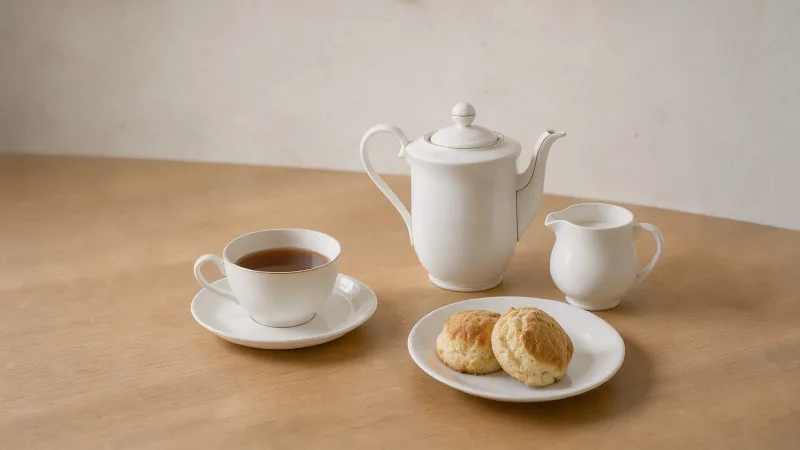
Afternoon tea. A light meal around 4 to 5 p.m., between a midday lunch and dinner at 8 or 9. On the table: bread and butter, small crustless sandwiches, scones, cakes, tea from a pot. It is called “low tea” after the low parlor tables, but no primary source backs up that explanation. The usual story of the Duchess of Bedford goes like this: around 1840 she asked for tea, bread and butter and cake at five o'clock to quiet a “sinking feeling” before a late dinner. It rests on the 1882 memoir of the actress Fanny Kemble, and the English took tea with something sweet or baked in the afternoon before that. Notices of tea gatherings with bread and pastries appeared in Bath, Oxford and Bristol from the 1750s, and in October 1758 the Gentleman's Magazine was already scolding “afternoon tea drinking” as a waste of time and money.
High tea. Despite the name, this is not a dressy afternoon treat. The Cambridge Social History of Britain defines it as a meal of bread, butter and tea with fried fish or meat added, and ties it to working families and the north. It falls between 5 and 7 p.m. In parts of England, and in Wales, Scotland and Northern Ireland, “tea” can simply mean the evening meal around 6.
Cream tea. A scone, clotted cream and strawberry jam. In Devon you split the scone, spread it with cream and put the jam on top. In Cornwall, according to the BBC, it goes the other way: jam first, then cream. “Cornish clotted cream” has been protected as a PDO since 1 October 1998. The cream must contain at least 55 % milk fat, be held at 70–80 °C for at least an hour and cool to 5 °C or below. The Tavistock story of monks in 997 feeding workers bread with clotted cream and strawberry preserves remains a local tradition.
Milk: before or after
In a letter of 16 February 1680, Madame de Sévigné mentions a lady who took milk in her tea, and historians count this as the earliest evidence of the habit in Europe. Around 1670 the grocer Thomas Garway recommended tea “with milk and water” as a stomach remedy. The historian Richard Coulton points out something else: milk and sugar let dealers sell ever worse tea. In 1839 the physician George Sigmond complained that the public liked tea that “could be tasted through sugar and milk”.
Opinions on the order differ.
- Orwell, 1946. In “A Nice Cup of Tea”, written for the Evening Standard, he adds the milk after the tea, with no cream and no sugar, because that makes the right amount easier to judge. His tea is Indian or Ceylon, six heaped teaspoons to the quart (about 1.14 l).
- Royal Society of Chemistry, 2003. The recipe by chemical engineer Andrew Stapley of Loughborough puts the milk in the cup before the tea. Pour milk into hot tea and the milk proteins heat past 75 °C, which spoils the taste.
- Tea bag in a mug. The historian Markman Ellis notes that there is no argument here: no one puts milk in before the bag.
Ellis rejects the story that milk went in first to keep the porcelain from cracking. For almost two centuries Britons drank tea without milk and the cups did not break, and heat resistance is the chief virtue of porcelain anyway. For a long time, though, the order was a class marker. Evelyn Waugh in 1955, and J. B. Priestley before him in 1927, treated “milk in first” (M.I.F.) as a sign of the lower orders. The ISO 3103 tasting standard allows milk before or after.
Loose Assam, one heaped teaspoon (about 2 g) per cup. Fresh soft water that has not been boiled before, poured at a full boil (212°F). Warm the pot first. Steep 3 minutes (range 3 to 4), with the milk already in the cup and white sugar to taste. Drink at 60–65 °C. Past four minutes, tannins come out of the leaf and leave an unpleasant aftertaste. Stapley calls it a myth that the caffeine keeps building minute by minute: most of it comes out in the first. The general method is ordinary Western brewing.2
Pot, mug and tea bag
British recipes are written for black tea only. In 1861 Mrs. Beeton advised one spoon per person “and one for the pot”, warming the pot for 2 to 3 minutes and steeping for 5 to 10. Her blend was 4 parts black to 1 part green. The brown teapot, the urn and the strainer all belong to the British tea table.
Tetley brought tea bags to the British market in 1953. In the early 1960s they made up under 3 % of sales, and by 2007 the share was 96 %; in the UKTIA census of 2022, 97.5 % of tea was bought in bags. The round Tetley bag arrived in 1989, the Brooke Bond pyramid (PG Tips) in 1996.
Hence builder's teabuilder's teaStrong, cheap black tea from a tea bag in a mug, with milk and one or two spoons of sugar.: a bag in a mug, a strong brew, milk, and one or two spoons of white sugar. The earliest written use the authors of Foods of England found is in the Independent of 6 February 1996. The same census gives the commonest routine as bag, boiling water, steep, remove the bag, milk, stir. Some 22 % put milk or sugar in before the bag. Of all drinkers, 57 % add cow's milk, 10 % plant milk and 27 % sugar.
Tea was rationed from 1940, during the Second World War, until 1952. From 1949 the ration was 2 oz (57 g) a person a week, later 2.5 oz, against an estimated 2.9 oz consumed in 1938. On 9 April 1952 the Minister of Food announced that the restrictions would be lifted by the end of the year.
Ireland
Per head, Ireland drinks more tea than Britain. UKTIA ranks it first, and the Irish Times says it is first, second or third in the world “depending on who you believe”. Estimates come to 2.7 to 4 kg per person a year, about 1,300 cups.
Silver teapots of the 1720s show that the gentry took up tea early, but for most people it became the main drink only after the Great Famine. In the 1860s a chest of tea washed up on the Great Blasket and was used to dye petticoats. In 1894 asylum inspectors linked cases of insanity to stewed cheap tea, and the matter reached the House of Commons.
Irish taste took shape in the war. The country lost about 75 % of its supplies almost at once, so the Minister for Supplies, Seán Lemass, set up Tea Importers (Éire) Ltd to buy directly from India. Its successor had to buy in the countries of origin until Ireland joined the EEC in 1973. Irish buyers found dark Kenyan and East African teas, which suited local taste better than the lighter Indian and Sri Lankan teas popular in England. The blends are built on Assam, with Kenya and Rwanda added: Bewley's uses about 15 % Rwandan tea, valued for color and briskness. The leaf is mostly CTC (cut, tear, curl), which makes a stronger liquor.
In the 1950s more than 50 brands of very uneven quality were on sale in Ireland, and Lyons became the first national brand with a consistent taste. In 2014 the market was split between Lyons (36 %), Barry's (27 %), supermarket own brands (15 %) and Bewley's (7 %). Most English speakers “make the tea” or “brew up”; the Irish traditionally “wet the tea”.
Common questions
Should the milk go in before or after the tea?
There is no single rule. In 1946 Orwell advised adding milk after the tea, so you can judge the amount. In 2003 the Royal Society of Chemistry advised milk first, so the milk proteins do not heat past 75 °C. With a tea bag in a mug the question does not arise: the milk goes in after.
What is the difference between afternoon tea and high tea?
Afternoon tea is taken around 4 to 5 p.m. with crustless sandwiches, scones and cakes. High tea is a hearty meal between 5 and 7 p.m. with meat or fish, bread and butter, associated with working families and the north.
Did the Duchess of Bedford invent afternoon tea?
No. People were already taking tea with pastries in the afternoon in the 18th century. Around 1840 the duchess made it fashionable in her circle.