Tea in South Asia: masala chai and its neighbors
Street chai in India dates only from the 20th century: before 1930, over 90% of the crop went abroad. Today an Indian gets through about 840 g of dry tea a year, and Kashmir drinks its own tea, salty and pink.
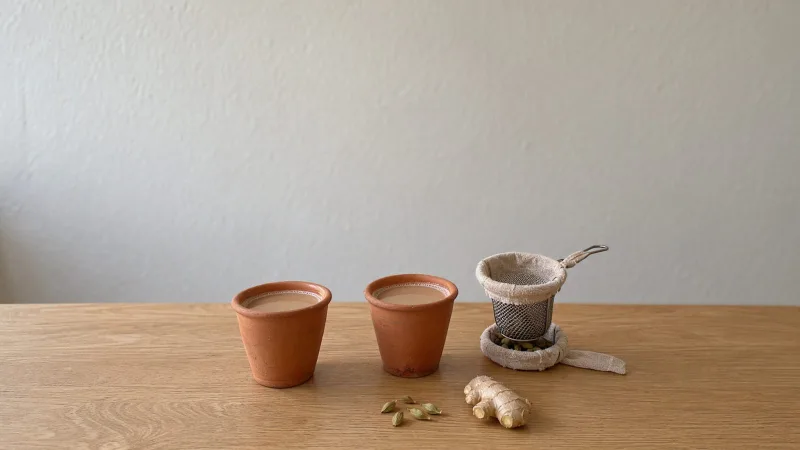
- Method:
- the leaf is boiled, not steeped
- Masala chai:
- black CTC, water and milk, sugar, spices
- Vessels:
- kulhad, small faceted glass, cloth strainer
- Kashmir:
- green leaf with baking soda: noon chai; kahwa without milk
- India per capita:
- ≈ 840 g a year, 2023
- Masala chai took shape:
- between World War I and the 1930s
In South Asia "chai" (chai, cha and chaha simply mean "tea" in the various languages) is a method, not a variety. The leaf is boiled in a pan rather than steeped in a pot. There are four main styles: masala chai with milk, water and spices; Pakistani doodh patti, made with milk alone; Kashmiri noon chai from green leaf and baking soda; and kahwa, which has no milk. All four took shape on the street and on caravan routes, not at court.
How tea reached the street
Until the 20th century, Indian tea was made for export. From 1861 it sold at the Calcutta auction, and at home its drinkers were mostly the Anglophile elite and clerks in British firms. In 1910 the domestic market was put at 8.2 million kg, against 130 million kg bought by Britain. In the northeast tea was known earlier: the Singpho and Khamti had been drinking it for centuries.
Demand at home was built on purpose. The Indian Tea Cess Act of 1903 put a levy on exported tea, and part of the money went into advertising within India. At Howrah station the committee handed out free cups and one-paisa packets. After the price crash of 1929 it became the Indian Tea Market Expansion Board: "tea propagandists" drove vans with a giant teapot, hung enamel signs with instructions and talked factories into tea breaks. By July 1931 the organizers had reported 297,767 brewing demonstrations, and over the 1930s consumption doubled.
What they demonstrated was the British method: boiling water on leaf in a china pot, milk and sugar in the cup. Street vendors had other ideas. A chaiwalachaiwalaA street tea seller (Hindi चायवाला). He boils tea in a pot or pan over an open fire and pours it into glasses and clay cups. would boil the leaf right in milk with sugar and throw in spices. The association objected, since spices and plenty of milk meant less leaf per liter, and masala stalls were inspected and shut down as adulteration. So the British did not teach India masala chai. They fought it.
The second push came from technology. W. McKercher, manager of the Amgoorie estate in Assam, invented CTC ("crush, tear, curl"): two steel rollers turning at a speed ratio of 1:10. Sources give the year as 1930 or 1931.1 The method went mass-market in the 1950s, and the historian Gautam Bhadra links it to the roadside stall boom of the 1960s: cheap granules are easy to boil. A kilogram of CTC yields about 550 cups of 114 ml, against 275 for orthodox leaf.
The consumption figures show how it worked out. In 1951 India drank 73 million kg (202 g per head); by 2003 the total was 714 million kg, and in 2023 about 1,197 million kg, or 840 g per person (about 925 g in cities, about 797 g in villages).
Masala chai: what goes in the pan
The base is black CTC, which makes up over 80% of India's domestic output. The granules brew a dark liquor that milk and sugar do not drown. The spices vary: ginger, cardamom, cinnamon, clove, black pepper, plus lemongrass in Maharashtra.
Put half a cup of water and half a cup of milk in a pan and add sugar to taste. Grate in ginger and add chai masala: ginger, cardamom, lemongrass, clove, cinnamon. Bring to a boil, add 1 tsp of loose black tea and simmer until as strong as you like. Strain. Or boil the spices in water first, add the tea, and pour in the milk only after straining.
The ancient part is the Ayurvedic tradition of spiced decoctions, kadha. Masala chai as a street drink is younger, and the claim that it is thousands of years old is a myth.
Masala chai has smaller cousins. Bengal's lebu cha skips the milk and takes lime, black salt and plenty of sugar. In Assam people drink ronga sah, black tea without milk, sometimes with ginger and cardamom. Kerala's sulaimani is brewed with clove, cardamom, cinnamon and lime, and the Parsis add lemongrass and mint. Pakistanis love doodh patti: black tea and sugar boiled in milk alone, no water, until thick. The country imports nearly all its tea, mostly Kenyan CTC.
Mumbai: cutting chai and the Irani cafes
In Mumbai tea is called cutting chaicutting chaiThe Mumbai "half": half a glass of strong milk tea in a small faceted glass about 10 cm (4 in) tall.. A cutting is a half portion: roughly half a glass of strong milk tea with ginger and cardamom. It is served only in glass, a small faceted one about 10 cm tall, never in china or clay. Nobody agrees on where the name comes from. Maybe the glass was split among friends, maybe Gujarati traders cut their guests' portions because of tea bills, or maybe people simply drank halves so they could have tea more times a day.
One stallholder in Lower Parel reckoned on 400 glasses a day: 22 liters of milk, 1 kg of tea, 5 kg of sugar. That is an order of magnitude, not a recipe. In the amruttulya tea houses of Maharashtra the tea is poured from a height through a cloth strainer to raise foam.
The Irani cafes are a story of their own. They were run by Zoroastrians and Shia Muslims from arid Yazd and Kerman, and the Dinshaw Maneckji fund (1854) helped Zoroastrians of Iran move to Bombay. Iranian immigrants were used to tea without milk, sipped through a lump of sugar, but in the cafes they switched to the British-Indian taste: the leaf simmers for hours in sweetened water in a samovar while whole milk reduces beside it. Bun maska, a buttered roll, comes on the side. Between 1920 and 1960 Mumbai had more than 400 such cafes; by 2015 about 30 were left.
The kulhad
The kulhadkulhadA cup of fired unglazed clay with no handle and no decoration. In Bengal it is called a bhar. (kulhar, in Bengal bhar) is a cup of unglazed fired clay without handle or decoration. Potters throw it on a wheel, so there is no standard size: in some places it is a wide-mouthed cone, in others a pot-bellied cup with a narrow neck. The clay is porous and soaks up some of the liquid. Indian Railways' 2004 tender required a kulhad to hold 180-200 ml, but a former Railway Board chairman claimed that of 150 ml poured in, about 100 remained.
The earliest known mention of tea in clay cups is in a sketch by Amritalal Basu, "Pintu Goes to the Theatre" (1926). Railway ministers brought the kulhad back to stations by decree: George Fernandes in 1989, Nitish Kumar in 1994, Lalu Prasad in 2004. In 2004 a kulhad cost 55 paise in Delhi and 32 paise in Calcutta, against 7-10 paise for a paper cup. A year later vendors in Bihar kept kulhads "for show," and tea in clay cost a rupee more than in plastic. Railway workers complained that shards lodge in the ballast and weaken the support under the ties. In November 2020 Piyush Goyal announced that tea would be served in kulhads at all stations in the country.2
The kulhad is made to be thrown away and returns to the soil. That is why it has lasted longer in Calcutta than in the rest of India, where plastic, glasses and steel tumblers pushed it out.
Kashmir and northern Pakistan: green tea with soda
Tea reached Kashmir from China through Ladakh long before the British plantations: pressed bricks came over the Changthang passes and Leh, the best grades via Yarkand. Around 1835 the traveler Carl von Hügel wrote down a full recipe for shir chai, as the Pandits call noon chai: 5 cups of water, 1 cup of leaf, 1 tablespoon of baking soda. Boil for about 10 minutes, add 2 cups of cold water, boil another 10 minutes, add 5 cups and simmer for another half hour. Strain through cloth, salt with rock salt, whip, and pour in 4-5 cups of boiled milk.
Noon chai is still made the same way. Leaf and soda boil for about an hour until the brew turns burgundy, ice water "kills" it, milk goes in, and the cook aerates it for a long time with a ladle. The concentrate should be the color of "pigeon's blood." People drink it several times a day with bread, kulcha or girda, and the Bakarwal herders brew it on the move. Noon means "salt" in Kashmiri. Nobody knows for sure where noon chai came from: from Yarkand along the Silk Road, or from Tibetan butter tea with soda.
Kahwa is a different drink, made for guests and feasts: green tea without milk, with sugar or honey, saffron, cinnamon, cardamom and almonds. It is poured from a samovar into small cups: Pandits use a bronze khos, Muslims a porcelain chinipyala. Day to day, though, Kashmir drinks noon chai.
In Peshawar people drink qehwa in the Qissa Khwani bazaar, the "street of storytellers," where caravan men reportedly waited for the city gates to open, listening to tales over tea. In a Peshawar teahouse a pot for about two cups cost around 50 rupees in 2025. In Baltistan breakfast comes with pawu-cha, "salty tea": green leaf, salt, milk, sometimes homemade butter or apricot oil.
Seven layers in Bangladesh
In Srimangal, Sylhet, Romesh Ram Gour of the Nilkantha Tea Cabin makes tea in seven layers, sometimes ten. The known ingredients are condensed milk, cinnamon, clove, Srimangal green tea and three black teas; Gour keeps the proportions secret. You can order from two to seven layers at 10 taka a layer; seven cost 75 taka. The layers stay separate because they differ in density. In 2012 Prime Minister Sheikh Hasina tried the tea.
The sweet milk teas of East and Southeast Asia work differently.
What to check at the shop
Under FSSAI regulations, tea in India must be free of added colorants. Dyes found in tea, according to the Tea Board, include Bismarck brown, Prussian blue, turmeric, indigo and graphite. You can check at home. Rub a pinch between your fingers: dye leaves a bright smear. Drop some tea in cold water: if the water colors at once, the tea is dyed. A magnet will pick up iron filings. Dry CTC granules from different estates look identical, so expensive tea is often cut with cheap lowland tea.
Common questions
How is masala chai different from ordinary tea with milk?
The leaf boils right in the water and milk, often half and half, with sugar and spices: ginger, cardamom, cinnamon, clove, pepper. The tea is usually black CTC, which quickly gives a dark, strong liquor that stands up to milk and sugar. The British way is to pour boiling water over the leaf in a pot and add milk and sugar in the cup.
Why is Kashmiri noon chai pink and salty?
Green leaf boils with baking soda for about an hour until the liquor turns burgundy; then it is shocked with cold water or ice, and milk goes in. The color comes from polyphenols, which act like a pH indicator in an alkaline brew. Real noon chai contains no dye, and the salt goes in at the end. Outside Kashmir, "pink tea" is often sweet and colored.
Can a kulhad be reused?
It is meant to be thrown away: unglazed clay absorbs liquid, and a broken cup biodegrades. Sizes and shapes vary, and a 2004 Indian Railways tender specified a kulhad at 180-200 ml.
-
The year is given as 1930 (KKHSOU, Wikipedia) and 1931 (Goodricke, National Geographic). ↩
-
The Guardian reported 7,000 stations, but Goyal himself then spoke of about 400 stations with kulhads and a plan to cover all. See India Today. ↩