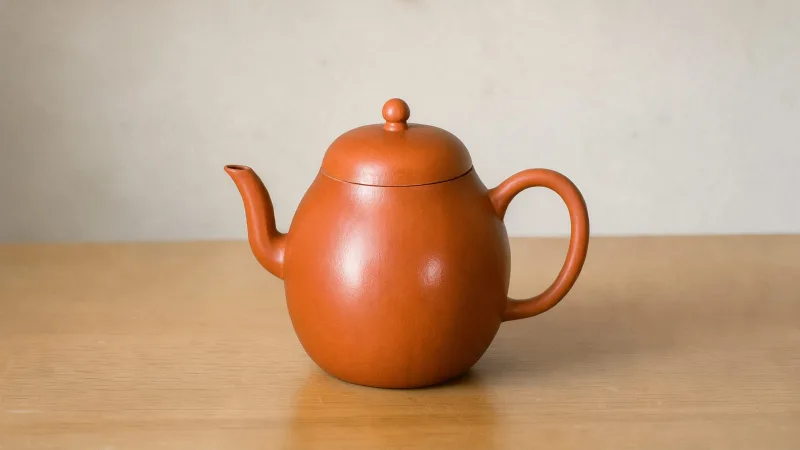
Chaozhou hand-pulled teapot (shoula) 潮州手拉朱泥壶
A thin-walled unglazed teapot of iron-rich red clay, thrown on the potter’s wheel in Chaozhou rather than built from slabs. It is made for Phoenix dancong and Chaozhou gongfu cha.
- Made in:
- Chaozhou, Guangdong; center in Fengxi
- Clay:
- zhuni, Fe₂O₃ at least 6%
- Shaping:
- thrown on the wheel, ~60 operations
- Firing:
- about 1100 °C, 12–18 h
- Size for gongfu cha:
- 90–150 ml, ideal 110 ml
- Status:
- national intangible heritage, 2014
Put a Yixing and a Chaozhou teapot side by side and you may not see the difference at first. Both are red, both unglazed, both hold about 100 ml. But one was built from slabs of clay, and the other was pulled up by hand on a spinning wheel. The shoula hu (手拉壶, “hand-pulled pot”) comes from Chaozhou in eastern Guangdong, and its whole shape is built around one way of drinking tea: Chaozhou gongfu cha with Phoenix dancong.
In 2014 the craft of making Fengxi hand-pulled teapots entered the fourth national list of intangible cultural heritage of China (no. VIII-98). Its center is the town of Fengxi, and from there workshops spread to the Xiangqiao and Chao’an districts. In 2021 the “Chaozhou shoula zhunizhuni“Cinnabar clay”: iron-rich red clay. In Chaozhou it is dug in a protected zone of 14 towns and districts. teapot” received protected geographical indication status, which means only a pot of local clay, shaped by hand, may carry the name.1
Red zhuni clay
The clay is dug in Fengxi, Fengtang and Fuyang, within a protected zone of 14 lowland towns and districts across two districts. Mount Phoenix is not one of them, although English-language shops often say it is. Raw, the clay is earthy yellow or purple-red, fine and plastic, with at least 6% iron oxide (Fe₂O₃). It turns red in the kiln, hence the local name “red clay,” zhuni (朱泥).
Before shaping, potters crush the clay, slake it in water, sieve it through a fine mesh, let it settle and knead it by hand. Then it rests, covered, in a ceramic vat for at least two years. The potter Lai Tongfa told a Japanese buyer that he uses clay aged 30 years himself and gives his students nothing less than ten years old.
The pots are fired unglazed at about 1100 °C, continuously for 12–18 hours. Those are the figures in the geographical indication document; other sources give different ones. Imen, who writes a tea blog, gives 1160–1180 °C. Accounts of how the clay behaves differ as well. The potter Xie Hua puts shrinkage above 20% (about 15% for Yixing zisha, he says), Imen at roughly 12%, and the standard specifies only water absorption, at 2–8%. None of these sources cites lab measurements, so all one can say for sure is that the body is dense and watertight but not vitrified.
How the pot is pulled
The craft involves “almost 60 operations.” The main steps:
- The potter sets a lump of aged clay on the wheel and pulls up the body with the fingers: pinch, press, then raise the wall in a curve or straight up.
- The rim and base are trimmed with a knife, and the outside is smoothed with a bamboo rib.
- The lid is pulled the same way, then flipped on the wheel and trimmed to fit the mouth.
- The potter shapes the knob and pierces an air hole with a needle.
- The spout is rolled hollow around a bamboo stick; the handle is rolled out and attached.
- Finally the surface is burnished with a horn rib or coated with tushuitushuiA slip (上土水): a thin coat of iron-rich clay brushed onto the dried body before firing. slip of iron-rich clay.
The form follows from the wheel. The body is small and thin, and the lid presses down into the mouth, so the rims are narrow and the lid has a tall wall. The base is made with a single press. The telltale sign is inside: visible finger marks on the wall, which the geographical indication requires. A Yixing pot is built from slabs, so it shows joins there instead of a spiral.
The familiar “wheel in Chaozhou, slabs in Yixing” holds for the 20th and 21st centuries but not for the whole history. Yixing knew the wheel too: according to a 1937 book, potters from the Shunzhi to the Daoguang reign formed bodies by “modeling and turning on the wheel.” And the Chaozhou pot started out as an imitation of Yixing ware. Until the mid-Qing, local potters mostly copied famous models, and in the Republican years they coated pots in red slip to pass them off as Yixing. According to the National Palace Museum in Taipei, such pots are often a different color inside and out.2
Masters and workshop marks
The dating is shaky. Li Bingyan, director of the Chaozhou kiln museum, says shoula pots appeared in the late Ming and flourished by the mid-Qing, while the heritage register dates an independent style only from the mid-Qing. The register names small round pots with Qianlong and Jiaqing seals from the former Qing palace collection as the earliest, but no museum catalog record for them could be found.
From there the story is one of families. Wu Yingwu founded Yuanxing in 1847, the Xie family founded Junhe in 1860, and the Zhang family’s Anshun appeared in the late Qing. In the 1930s pots went out to Southeast Asia, and from 1937 the Japanese occupation ruined Fengxi. After 1949 the masters were brought into cooperatives, mold casting spread in the 1960s, and in the 1970s porcelain with decals took over the market, so shoula pots were all but forgotten. The craft came back in the 1980s. In 1983 a seventeen-year-old Xie Hua revived the Junhe mark, and that same year Wu Ruishen made the first “pear skin” pot with sand mixed into the clay. Since then there have been two lines: thin and smooth, and thicker and rough with sand. A craft once handed down to “sons, not daughters” now takes outside students, and the number of makers has grown, to anywhere from over a thousand to 2,000–3,000 depending on the count. Other lines of masters, and Yixing’s part in the story, are covered in the history of Yixing teapots.
Which teas, and how to brew
The Chaozhou gongfu standard names the shoula as the main brewing vessel, at 90–150 ml with an ideal of 110 ml, paired with white porcelain cups of 25–35 ml. The thin wall heats up quickly and cools just as fast once the lid is off, and a pot this small lets you drink each infusion hot before it stews. A Japanese seller adds that for steeps longer than a minute, a thick-walled Yixing pot may do better.
The shape is matched to the leaf. The usual advice is a low, wide pot for long twisted leaf and a tall, round one for rolled oolongs. The same seller also recommends a rounded bottom that lets the water swirl. A Chaozhou pot is traditionally packed tight with leaf, a high leaf ratio for a concentrated liquor. The shop Path of Cha recommends these pots for young white teas and teas with a “green” profile, but not for delicate green tea.
A dancong producer suggests this schedule for a 110 ml pot: 7–10 g of leaf, water at 95–100 °C (203–212 °F), nearly boiling. The first infusion is a rinse. After that the times go up and down: infusions 1–10 run 0 to 15 seconds, 11–20 run 5–10 seconds, 21–30 run 5–20 seconds. Up to 30 infusions in all. Adjust to the leaf, the season and your taste.
For other types of tea, the sources give no parameters for this pot specifically; general guidelines by type are in gongfu cha. A new pot needs less preparation than a Yixing one. Imen suggests rinsing it, soaking it for 20 minutes in room-temperature water, scalding it and brewing a tea you don’t mind wasting; she advises against boiling it. In Chaozhou the pour should be fast, long, round and unbroken, and the last drops are shared out among the cups, a move called “Han Xin counts his soldiers.” Xie Hua disagrees. A good spout, he holds, leaves no drops, and he has reworked his spouts so the pot empties completely.
How to choose, and avoid a cast pot
Masters and the standard name several checks:
- The “three points on one linethree points on one lineThe rule 三点一线: spout, handle and lid knob sit on one straight line.” rule. Spout, handle and knob sit on one straight line. The old test: set the pot upside down on a table with the lid off; the mouth, spout and handle should all rest flat.
- A tight lid. Fill the pot with water, cover the hole in the lid with a finger and tilt it. Nothing should drip. The standard requires the lid to stay in place with the pot tilted to 70°.
- The pour is fast and steady, the pot light in the hand, and its center of gravity stable.
- Finger marks inside. No spiral means it was most likely not thrown.
- Joins. Spout and handle blend into the body with no visible seams.
Fakes come in two kinds. The first is mold casting: souvenir pots are often assembled from a thrown body with a cast spout and handle, using clay bought in Yixing. The second is tinted clay. Lai Tongfa won’t use zhuni with red iron pigment, since it brightens the color but hurts the taste. So “the redder, the better” does not hold. Imen notes that what gets faked more often is not the clay but the master’s name, especially the Wu family’s, whose pots sell for tens of thousands of dollars.
Care
A thin-walled pot does not take sudden temperature changes well, so don’t boil it or put it over a flame. The standard tests only a single swing from 160 to 20 °C without cracking. After a session, throw out the leaf, pour off what is left and let the pot dry with the lid off. Otherwise treat it like any unglazed clay; the general rules are in teaware care. Older people in Chaozhou pour tea over a warm pot and roll it between their palms, and over time the surface takes on a shine “like jade.” The tea matters too. One pot is best kept to one type, and Imen keeps separate pots for her dancongs. For the parts of the pot itself, see teapot anatomy.
Common questions
How is a Chaozhou teapot different from a Yixing one?
In the way it is shaped, and in the wall. A Yixing pot is traditionally built from slabs of clay, while a Chaozhou pot is thrown on the wheel, so its wall is thinner and spiral finger marks stay on the inside. The clay is different too: red zhuni from around Fengxi.
Can I brew any tea in a shoula?
You can, but the pot was designed for dancong and other fragrant oolongs. One shop also recommends it for young white teas, though not for delicate green tea. Like any unglazed pot, it is best kept to one type of tea.
How can I tell a hand-pulled pot from a cast one?
Look inside, and look at the spout. A thrown pot has finger marks on the inner wall. The standard calls for the spout to be rolled by hand on a bamboo stick, while souvenir pots often have a cast one. Be wary of a vivid red, too: it can come from pigment added to the clay.
-
CNIPA announcement no. 444 of August 20, 2021, with the appendix “Protection requirements” (zone, clay, technology, firing, water absorption): cnipa.gov.cn. A 2021 Chaozhou Daily article gives 2018, but the primary document is the announcement. ↩
-
National Palace Museum (Taipei), as reported in a review of its exhibition: ARTouch, 2018. ↩