Western brewing: teapot, tea bag, infuser 西式冲泡
A little leaf, a lot of water, one long steep. It is how Britain drinks tea, what the tea bag was designed for, and how most people make a mug at their desk.
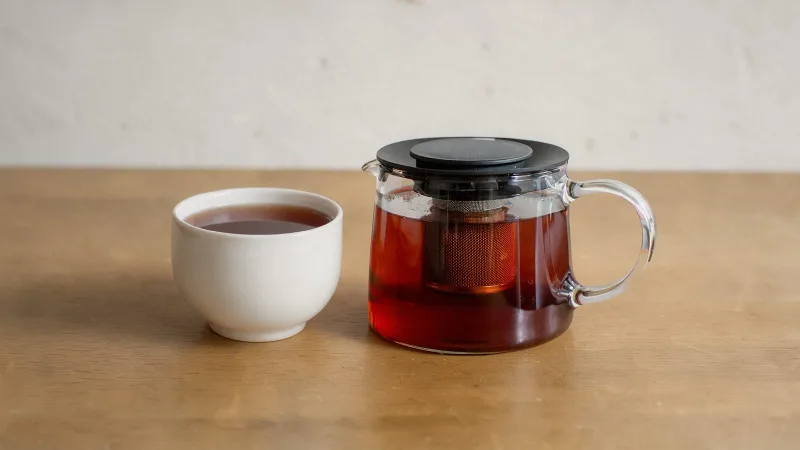
- Leaf:
- 2–3 g per 150–250 ml
- Time:
- 2–5 minutes, CTC bag about a minute
- Steeps:
- usually one, sometimes two
- Vessel:
- teapot 300–1000 ml, mug, infuser
- Origin:
- Britain, 17th–19th centuries
Western brewing means a single steep. You put 2–3 g of leaf per serving into a 300–1000 ml teapot or a mug, add water, wait a few minutes and separate the leaf from the tea. The usual routine has no second or third infusion and no steeps timed in seconds. The method took shape in Britain between the 17th and 19th centuries, built around black tea and a porcelain teapot.
What sets it apart from gongfu cha is the ratio. Gongfu uses roughly six times more leaf per 100 ml and steeps it many times for a few seconds each; here the leaf is steeped once, for a long time. So a mistake in time or temperature cannot be fixed afterwards. The tea is either right or bitter.
Where it comes from
In 1660 Samuel Pepys noted his first cup of "Tee (a China drink)" in his diary. The first European teapots were modeled on coffee pots, and from the late 17th century most English silver teapots were pear-shaped. The Dutch East India Company shipped red Yixing teapots to Europe, and English potters began to copy them.
By the end of the 18th century black tea had overtaken green in Britain, and the habit of adding milk took hold. In 1935 William Ukers set out the rules the Japanese call "golden": good leaf, a warmed pot, a measured portion, freshly boiled water, the right time. The tea bag came later. Tetley launched it in Britain in 1953, and by 2007 bags made up 96% of the market.
What goes into a cup
Flavor comes down to three variables: the amount of leaf, the water temperature and the time. The vessel's job is to hold heat and let you take the leaf out on time.
Teapot. Porcelain, earthenware, glass or silver. Iron is best avoided: tannins react with it, and the liquor darkens and loses flavor. The Royal Society of Chemistry (2003) recommends ceramic and notes that metal sometimes leaves an aftertaste.
Leaf. Wet leaf swells to 4–5 times its size and needs room; in a tight bag or a small strainer it brews poorly. For loose leaf, use a basket infuser or simply pour through a strainer.
Warmth. A tea cosytea cosyA fabric or felt cover that traps air around the teapot, so the liquor cools more slowly. of fabric or felt traps air around the porcelain and slows cooling. Japanese instructors say liquor poured into a second warmed pot stays hot for 20–30 minutes. None of the sources measure how much heat a cosy actually saves.
Water. Fresh water, drawn for just the volume you need.
Teapot and loose leaf
- Boil only as much water as you need. The Japan Tea Association says to wait for bubbles the size of a coin.
- Warm the pot and the cups. A quick rinse is not enough: the Royal Society of Chemistry advises filling at least a quarter of the pot with boiling water and leaving it for 30 seconds.
- Measure 2–3 g of leaf per cup (more on ratios in How much tea, how long). For fine leaf that is a spoon with a small heap, for large leaf a big heap.
- Pour vigorously while the water is still boiling and put the lid on at once. Orwell wrote in 1946 that the pot should be taken to the kettle, not the other way round.
- Steep for the time in the table below, with the cosy on.
- Stir gently. Hard stirring adds astringency.
- Pour through a strainer, going round the cups so the strength evens out, down to the last drop. The Japanese call it the "golden drop".
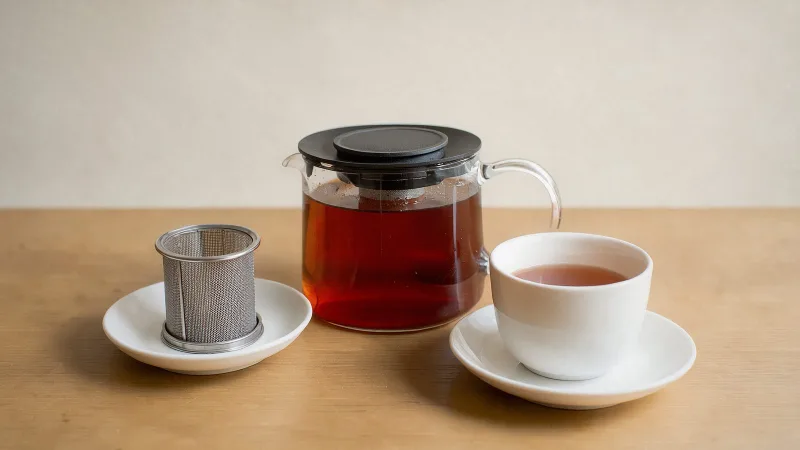
Warm the pot and cups. 2.5–3 g of leaf per 150–160 ml of water, water just off the boil (up to 100 °C, or 212 °F). Large leaf 3–4 minutes, small leaf 2.5–3. Lid on, cosy on, pour through a strainer.
To keep the tea, decant all of it into a second warmed pot. The leaf stays behind in the first, so the tea stops steeping and stays hot for 20–30 minutes.
The tea bag
Bags are convenient, but they brew differently from loose leaf. In lab tests the paper slowed caffeine extraction by about 29%. Loose leaf swelled fully in 40–45 seconds and bagged leaf in two minutes, and in the first 30 seconds the loose leaf released 9.8 times as much1.
Advice on timing varies:
- Japanese instructions: put the bag in a warmed cup (150–160 ml), cover with a saucer, and steep 2 minutes for a bag of leaf or 40 seconds to a minute for CTCCTCFinely granulated black tea, usually sold in bags. It releases flavor faster than whole leaf.. Do not squeeze it, as that adds astringency.
- Yorkshire Tea suggests 4–5 minutes and one gentle squeeze against the side of the mug.
- In a study by Indian researchers, most people took the bag out in under two minutes.
Bag paper is made from plant fibers, and about 1% of the bag's mass is plastic for heat-sealing the edges: polypropylene, nylon, increasingly PLA. "Silk" pyramids made of nylon or PET release billions of plastic particles into a cup at 95 °C. If that matters to you, choose paper bags or an infuser.
Time, temperature and ratio by type
The figures come from specialist tea shops and the UK Tea & Infusions Association. For oolong and pu-erh, the temperature for the specific tea is a better guide.
| Type | Leaf | Water | Time |
|---|---|---|---|
| Black, large leaf | 2.5–3 g per 150–160 ml | 100 °C | 3–4 min |
| Black, small leaf | 2.5–3 g per 150–160 ml | 100 °C | 2.5–3 min |
| Black, CTC in a bag | 1 bag per 150–160 ml | 100 °C | 40 s – 1 min |
| Assam, Ceylon, Kenyan | one spoon per cup | 90–98 °C | 3–4 min |
| Chinese green | 3–5 g per 240–480 ml | 77–85 °C | 2–3 min |
| White | 3–4 g per 240–480 ml | 85–90 °C | 2–3 min |
| Oolong | 3–5 g per 240–480 ml | 82–99 °C | 2–3 min, sometimes up to 5 |
| Pu-erh | 3–5 g per 240–480 ml | 93–99 °C | about 3 min |
Rinse oolong and pu-erh for about 5 seconds before brewing. The sources reviewed give no everyday Western figures for yellow tea or for dark teas other than pu-erh, so brew those gongfu style.
Lab standards are a separate matter. ISO 3103 calls for 2 g per 100 ml of boiling water and a 6-minute steep for black tea, 5 minutes for whole-leaf green. It is meant for comparing batches of tea, and a good cup is beside the point.
Strength, bitterness and milk
Adjust strength with the amount of leaf and keep the time within the table. Longer does not mean stronger: caffeine comes out first, then the slow high-molecular tannins, and the tea turns bitter. Nor does a longer steep give you more caffeine, since most of it is out within the first minute.
There is no agreed order for milk. ISO 3103 and the Royal Society of Chemistry (2003) put milk in first. Orwell and the UK Tea & Infusions Association (for a mug) add it after. Historians reject the popular story that milk went in first to keep the porcelain from cracking. Britons drank tea without milk for almost two centuries, and porcelain was prized for its heat resistance. The Japan Tea Association recommends plain milk, cold or at room temperature, not coffee creamer.
M. Francl, author of the book "Steeped", suggests a pinch of salt in the cup: sodium ions make bitterness harder to taste. It is a contested trick, but worth one cup to try.
Which teas suit it
The method is geared to large-leaf and broken black tea. Orwell insisted on Indian or Ceylon, and ISO 3103 is written mainly for black tea. Small particles and CTC release flavor faster. When particles shrink from 850–1000 to 500–600 microns, the rate constant rises 2.2-fold. That is why a CTC bag needs a minute and large leaf 3–4.
Green, white and light oolong are brewed Western style too, with cooler water and shorter steeps. Many sellers recommend gongfu for complex oolongs and pu-erh. Brewing expensive leaf weak in a big pot is a false economy.
Drinking from a glass rather than a cup? See glass and grandpa style.
Common mistakes
- A cold pot. It pulls heat from the water, and the liquor comes out dull.
- Boiling water on green and white tea. Delicate leaf scalds and turns bitter.
- A bag forgotten in the mug. Tannins drown out everything else.
- A cramped strainer. The leaf cannot open, and the liquor is weak however long it steeps.
- An iron pot. Tannins darken the liquor and spoil the flavor.
- A spoon instead of a scale. A spoonful of leaf weighs differently depending on its shape, and strength swings from cup to cup.
Common questions
How much tea goes into a teapot, and how much water?
Aim for 2–3 g of leaf per cup of 150–250 ml. Weigh it: how much a spoon holds depends heavily on the shape of the leaf. The British habit is one spoon per cup and one more "for the pot", which makes the tea stronger.
How long should a tea bag sit in the mug?
Advice ranges from 40 seconds to 5 minutes. A CTC bag needs about a minute, a bag of larger leaf 2–3 minutes, and British producers suggest 4–5. Start at two minutes and adjust to taste.
Milk first or tea first?
There is no single rule. ISO 3103 and the Royal Society of Chemistry say milk first; Orwell and the UK Tea & Infusions Association say tea first. McGill found no scientific study that settles it. For a bag in a mug, most advice is milk last.
-
B. S. Joshi, A. W. Patwardhan et al., "Swelling and infusion of tea in tea bags", J. Food Sci. Technol. 54 (8), 2017, PMC5502043. ↩