Shenping: Professional Tea Evaluation in China 审评
In China, tea is judged under GB/T 23776-2018: 3 g of leaf in 150 ml of boiling water, 4 to 6 minutes, white porcelain and a fixed order of steps. The point is to compare a sample with a standard and catch defects, and pleasure has nothing to do with it.
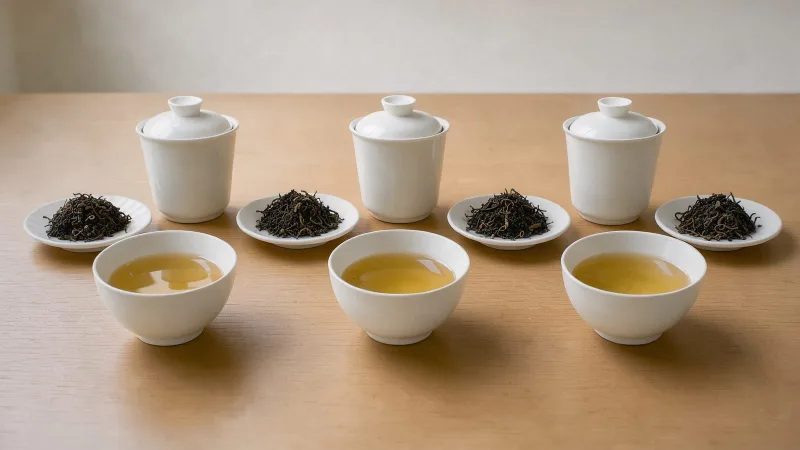
- Standard:
- GB/T 23776-2018, in force since June 1, 2018
- Basic brew:
- 3 g in 150 ml, 1:50, boiling water
- Time:
- 4–6 minutes in a single cup
- Oolong:
- 5 g in 110 ml, three infusions
- Factors:
- five for crude tea, eight for refined tea
- Vocabulary:
- GB/T 14487-2017, 417 terms
Shenping (审评) is China's standardized sensory evaluation of tea. A trained taster looks at the dry leaf, smells it, tastes the liquor and examines the infused leaf, then reaches a single verdict: what grade the tea is, whether it matches a sample, and whether it has defects. The method is set out in a national standard, and in China it is the basis for accepting batches, setting prices and judging competitions.
The roots go back to export inspection in Shanghai in the 1930s, where a committee approved standard samplesstandard samplesPhysical tea samples that a batch is compared against. They come as purchasing, processing and trade samples, and a trade sample carries a number. every year and tea that fell below them could not leave the country. After 1950 a single method was taught to inspectors from several cities, and from 1954 numbered trade samples let buyers close deals without shipping tea back and forth. The method's first national edition was GB/T 23776-2009. The current one, GB/T 23776-2018, was approved on February 6, 2018, and a review in 2021 kept it in force.1
For the international side, ISO 3103 and professional cupping in general, see tea tasting. Shenping is the Chinese system.
The room and the gear
The room has its own standard, GB/T 18797-2012, adapted from ISO 8589. It calls for at least 10 m², north-facing windows, neutral white walls and a light gray floor, daylight lamps of 5000–6000 K over the tables, 15–27 °C and no more than 70 % humidity. The air must be free of smells. The lighting figures, 1000 lux on the dry table and 750 lux on the wet one, come from the 2009 edition, and they could not be checked against a second source.
Tasters split the work into dry evaluation of appearance and wet evaluation of liquor and infused leaf, with a separate table for each. The dry table is taller (800–900 mm), with a matte black top that makes pale leaf stand out. The wet table is lower (750–800 mm) and white, for reading liquor color and infused leaf.
The ware is neutral white porcelain, and every piece in a set matches in size, thickness and shade. The cup has a lid with a small hole, and three serrated notches on the rim opposite the handle let the taster pour off the liquor without lifting the lid. Which set is used depends on what is being judged:
| What is judged | Cup | Bowl |
|---|---|---|
| Crude tea (毛茶) | cylinder, 250 ml | 440 ml |
| Refined tea (成品茶) | cylinder, 150 ml | 240 ml |
| Oolong | inverted bell, 110 ml | 160 ml |
The 110 ml oolong bell is the same gaiwan you see on gongfu tables. The rest of the kit is plainer and more precise: a square 230 mm tray for dry leaf, a sample divider with 4 or 6 cells, scales reading to 0.1 g, a timer accurate to the second, a spoon of about 10 ml. The same water goes into every cup of a batch, and it has to meet the drinking water standard GB 5749. For how hardness changes the cup, see water chemistry.
How a sample runs
It starts with sampling. Crude tea is drawn from at least 8 points in the pile and divided down to two portions of 100–200 g, one to work with and one in reserve. Next comes appearance. The taster spins the tray so the tea sorts itself into a top layer, a middle and a bottom, and also weighs crude tea in the hand to judge the body of the leaf.
Then comes "opening the soup" (开汤, kāi tāng), the infusion itself. Conditions by type:
| Type | Leaf and water | Time | Infusions |
|---|---|---|---|
| Green | 3 g in 150 ml | 4 min | 1 |
| Black, white, yellow | 3 g in 150 ml | 5 min | 1 |
| Strip-style oolong | 3 g in 150 ml | 5 min | 1 |
| Ball-rolled oolong and granules | 3 g in 150 ml | 6 min | 1 |
| Oolong in a gaiwan | 5 g in 110 ml | marks at 2, 3 and 5 min | 3 |
| Loose dark | 3 g in 150 ml | 2 min, then 5 min | 2 |
The water is always at a full boil. The cylinder cup also allows 5 g in 250 ml, which keeps the 1:50 ratio. Pressed tea steeps 2 to 5 minutes the first time, depending on how tightly it was pressed. With oolong the second infusion matters most, while the first and third inform the overall judgment. Dark tea is read across two infusions: color from the first, aroma and taste from the second.2
The order never changes: liquor color, aroma, taste, infused leaf. Tasters smell the aroma three times, hot (cup at about 75 °C), warm (about 45 °C) and cooled. They taste at about 50 °C, slurping about 5 ml from a spoon. Last, the leaf is turned out onto a white tray and topped with water so it floats, then judged by eye and by touch.
All this is a long way from gongfu cha. The strong, long brew is deliberate: it drags out everything that should not be there, such as poor processing, staleness and impurities. Nobody would call the result pleasant, but two samples sit side by side under identical conditions. Time and temperature change the liquor so much because of how extraction works.
Factors and scores
Crude tea is judged on five factors: appearance, liquor color, aroma, taste, infused leaf. Refined tea has eight, adding shape, color, evenness and cleanliness of the dry leaf to liquor, aroma, taste and leaf. Tenderness does not get its own factor; it is folded into shape and appearance. Each factor comes with its own checklist: hue, depth, brightness and clarity for liquor; type, strength, purity and persistence for aroma; intensity, body, softness against astringency, purity and freshness for taste.
Results are tallied in three ways, each answering a different question.
Grade. The sample is set against a range of standard samples and graded separately on appearance and on inner quality. The final grade is the average of the two.
Conformity, seven steps. Each factor is scored against the standard sample or the contract sample on a scale from +3 ("clearly better") to −3 ("clearly worse"), where 0 means equal. The scores are added up, and a −3 on any factor, or a total of −3 or below, means "does not conform". This is how batches are accepted.
Quality, 100 points. Competitions and rankings use this scheme. Samples are coded, so tasters do not know where they came from. Each factor is scored out of 100 and multiplied by a weight that depends on the type of tea. Green tea is weighted appearance 25 %, liquor 10, aroma 25, taste 30, leaf 10. Oolong gets 20, 5, 30, 35 and 10, so taste and aroma account for more than half. Pressed tea has used 20, 10, 30, 35 and 5 since 2018. No free full text of the 2018 weight table turned up, so the weights for other types come from the 2009 edition and the list of amendments, and they are worth checking against the original.
Tasters work alone or in a panel of an odd number, at least three. The head taster scores first, the others adjust, and disputes go to a vote. The final score is the average, and with five or more tasters the extreme scores are dropped. Ties are broken by comparing taste, appearance, aroma, liquor color and leaf, in that order.
The taster's words
Tasters describe tea in the fixed terms of the GB/T 14487-2017 vocabulary, 417 of them, so that "fresh" means the same thing to every judge. The vocabulary also names the defects the method exists to catch: "green smell" (青气), stuffiness (闷气), staleness (陈气), mold (霉味). For how to use it and how it lines up with Western flavor wheels, see the language of taste.
Regional standards tune the general scheme to local tea. The Guangdong draft for Phoenix Dancong uses 4 g in 110 ml with infusions of 1, 2 and 3 minutes, because, according to the judges, 5 g at 2, 3 and 5 minutes makes this tea's liquor too concentrated. Fujian's 2023 group standard for aged tea adds two new factors, "purity of aging" and "degree of aging". Since 2015 Taiwan's Tea Research and Extension Station has run a five-level taster certification with a pass mark of 70.
The profession and the weak spots
The tea taster (评茶员, occupation code 6-02-06-11) judges the quality and grade of tea by color, aroma, taste and shape. The 2019 skill standard sets five levels, from beginner to senior technician. The exam covers theory and practice (with a panel at the two top levels), and the pass mark is 60. One of the basic skills is "paired-cup matching" (双杯找对): out of several cups, pick the two that hold the same tea. In the 2022 classification the profession was renamed 评茶师, master taster. The standard also sets everyday requirements for the taster: eyesight of at least 5.0, a food-industry health card, no cosmetics and no smoking.
The people who write the standards point out the system's weak spot themselves: the written norms are nearly complete, but physical samples are scarce. According to 2024 data, five of the 19 national sensory standard samples issued remain in force, among them Longjing, tuocha and Wuyi rock tea.
Two caveats to finish. Shenping does not replace your own taste: it is a tool for comparison, and a tea that scores well may simply not appeal to you. Nor do scores carry over between schemes: "90" on a competition's 100-point scale and "+2" on the acceptance seven-stepseven-stepA scale for comparing a sample with its standard: from +3 (clearly better) through 0 (equal) to −3 (clearly worse). It is used to accept or reject a batch. scale answer different questions.
Common questions
How is shenping different from ordinary gongfu brewing?
It is not brewing for pleasure. The standard calls for a strong 1:50 ratio and boiling water for 4 to 6 minutes, and oolong in a gaiwan gets 5 g in 110 ml, with infusions timed in minutes rather than seconds. Brewed that hard, the leaf shows its flaws, and two samples can be compared fairly.
Do tasters have to spit?
No. The standard lets tasters either spit the liquor out or swallow it. They take about 5 ml in a spoon and slurp it, so the air spreads the liquor across the tongue.
Do you need a state license to evaluate tea?
The 2018 text calls for a state-issued taster certificate. Since late 2020, though, such qualifications have been off the national list, and skill certificates now come from employers and accredited bodies. Certificates issued earlier remain valid.
-
Record of GB/T 23776-2018 "茶叶感官审评方法" on the SAMR standards platform: std.samr.gov.cn. ↩
-
Y. Liu, L. Luo, L. Zeng. Guidelines for Sensory Evaluation of Tea: Traditional Chinese Method and QDA. AgriFood, 2025. DOI. ↩