Feng Huang Dan Cong 凤凰单丛
An oolong from Fenghuang Mountain in eastern Guangdong. Every bush here smells a little different, and the teas are named for their aroma: honey and orchid, gardenia, osmanthus, ginger flower.

- Province:
- Guangdong, Chaozhou, Fenghuang Mountains
- Garden altitude:
- from 500 m; Mount Wudong 1391 m
- Cultivar:
- Fenghuang Shui Xian bushes
- Oxidation:
- medium
- Dry leaf:
- long, dark, twisted lengthwise
- Taste:
- flowers, honey, fruit; slight bitterness, long sweetness
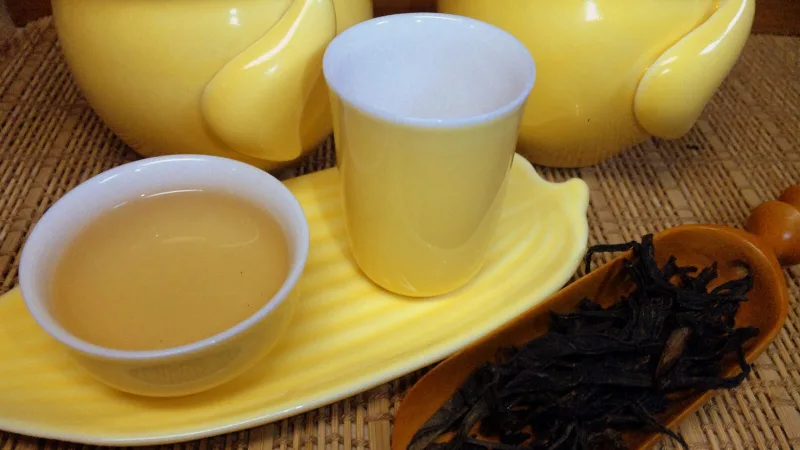
Feng Huang Dan Cong (凤凰单丛) is an oolong from the Fenghuang (“Phoenix”) Mountains in the east of Guangdong Province. The dry leaf is long, dark brown with an oily sheen, twisted lengthwise into tight strands. Dan cong is famous for its aroma. Whether it smells of flowers, honey or almond depends on the bush and on the processing, and each tea is named for its scent.
The Fenghuang Mountains
The mountains lie north of the city of Chaozhou, in Chao’an District. Tea gardens start at about 500 m, and the most famous ones are on Mount Wudong, 1391 m high. Fog hangs there most of the year, winter comes early, spring cold lingers, and the bushes grow slowly. Locals say Wudong never has three sunny days in a row, and you won’t find a hundred paces of flat ground.
Legend says the last emperor of the Southern Song fled from the Mongol armies through these mountains and was served tea made from the local leaf on the way. The tea was nicknamed “bird’s beak” (鸟嘴茶) for the shape of the leaf, and the old bushes are still called Song Zhong (宋种), “Song lineage”. The oldest on record was the Song Zhong No. 1 bush in the village of Lizaiping on Wudong, at about 1150 m, said to be more than 600 years old1. It died in 2016, but it had long since been propagated from cuttings.
One bush, one aroma
Dan cong means “single bush”. The Fenghuang gardens grew from seeds of a local cultivar later named Fenghuang Shui Xian (凤凰水仙). Every seed-grown bush comes out slightly different, so tea makers began to pick and process each notable plant on its own. In Chaozhou they say: “one tree, one aroma” (一树一香).
The best bushes were later propagated from cuttings. This gave rise to whole gardens of a single aroma, such as Ba Xian (“Eight Immortals”). Cuttings from one mother bush were planted on different slopes, and the tea from each slope came out a little different.
Today only the leaf of famous old bushes is processed separately. The rest is picked from bushes of one type in one garden, or from one family’s plots, and made as a single lot. The name on the pack gives the aroma type and the place, while prices under one name can vary tenfold or more depending on altitude, the age of the bushes and the skill of the tea maker.
Ten aromas
Dan cong is grouped by xiang xingxiang xingAroma type: dan cong teas are grouped and named by it. There are ten canonical types., or aroma type. There are ten canonical types:
- Mi Lan Xiang (蜜兰香): honey and orchid, the most common and the easiest to grasp from the first cup;
- Huang Zhi Xiang (黄枝香): gardenia, a classic heavy floral aroma;
- Zhi Lan Xiang (芝兰香): orchid, higher and cooler than Mi Lan Xiang;
- Gui Hua Xiang (桂花香): osmanthus;
- Yu Lan Xiang (玉兰香): magnolia;
- Ye Lai Xiang (夜来香): tuberose;
- Jiang Hua Xiang (姜花香): ginger flower;
- Mo Li Xiang (茉莉香): jasmine;
- Xing Ren Xiang (杏仁香): almond;
- Rou Gui Xiang (肉桂香): cinnamon.
The cinnamon dan cong has nothing in common with Wuyi Rou Gui beyond the spice in its name; the cultivar, province and processing all differ.
Ya Shi Xiang (鸭屎香), “duck shit aroma”, is not among the ten, although it is now one of the best-selling dan cong teas. It smells of flowers and honey.
The aroma of a dan cong hits you at once, but connoisseurs look past it for shan yunshan yunMountain rhyme: the dense, long aftertaste that marks dan cong from old bushes high in the mountains., the dense mineral aftertaste of tea from old bushes on high slopes. Tea from young lowland gardens can have a bright aroma but a shorter finish.
How it is made
The best tea comes from the spring harvests, starting in April after the Qingming festival. Toward evening, once the heat eases, the leaf is withered in the sun for 20–30 minutes and then cooled indoors. Next comes peng qingpeng qingShaking, Chaozhou style: the leaf is tossed and rubbed in bamboo trays so the edges bruise and start to oxidize.: tea makers toss the leaf in bamboo trays or turn it in drums until the edges bruise and begin to oxidize. They repeat the shaking five times or more, with rests in between, and the work runs through the night.
Then they fix the leaf with heat, roll it into long strands and dry it. The last step is roasting in several rounds, from light to heavy. A light roast keeps the flowers; a heavy one pushes the aroma toward honey and baked fruit. After roasting the tea is left to rest, as Wuyi rock oolongs are.
How to brew
Chaozhou is said to be the home of gongfu cha, and dan cong is brewed by its rules: plenty of leaf, water at a full boil, infusions of a few seconds. Local tea masters are generous with leaf, filling a third to half of the brewing vessel, and drink a strong, slightly bitter liquor. They prize a bitterness that quickly turns sweet. If you are new to it, you can use less leaf.
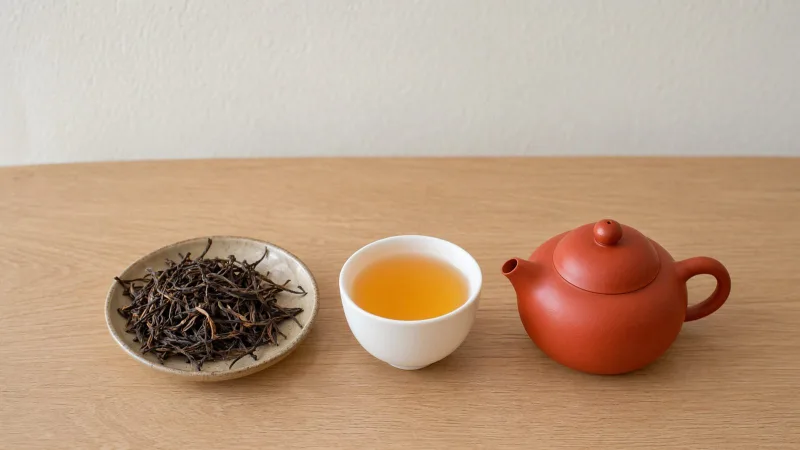
A thin-walled porcelain gaiwan works best: the white glaze shows off the color of the liquor, and the lid traps the aroma. Smell the inside of the lid after each infusion; the scent changes from cup to cup.
6 g of leaf per 100 ml, water at 95–100 °C (203–212 °F). Rinse the leaf and drain at once. Keep the first three infusions, the most aromatic ones, to 5–8 seconds each. After that add 3–5 seconds each time and drain the liquor to the last drop into a fair cup. A good dan cong lasts 10 infusions or more, ending on sweetness and a mineral note.
Dan cong is louder and sharper than Tie Guan Yin, but lighter and more floral than Da Hong Pao.
Common questions
Is dan cong really picked from a single bush?
It used to be, and the leaf of famous old bushes is still processed that way. The rest of dan cong is picked from several bushes of one aroma type in one garden, so the name on the pack tells you the type and the place, not a single plant.
Why is Ya Shi Xiang called “duck shit aroma”?
It smells of flowers and honey. Local stories say the garden owner chose the name on purpose so neighbors would not go after his cuttings. Today it is one of the best-selling dan cong teas.
Why does dan cong taste bitter?
Most often because the infusion ran too long. The aroma comes out of the leaf within seconds, and bitterness catches up by 10–15 seconds. Pour off the first infusions after 5–8 seconds and drain the liquor to the last drop. A slight bitterness that quickly turns sweet is normal for dan cong.
-
Baidu Baike, article “潮州凤凰单丛茶” (Chaozhou Fenghuang dan cong tea), section on cultivars. ↩