Scales, thermometers and timers
Three numbers make a brew repeatable: grams of leaf, water temperature and seconds. Weigh the leaf, because a spoon can be off by a factor of three. A 0.1 g scale and a timer are enough, and not every tea needs a thermometer.
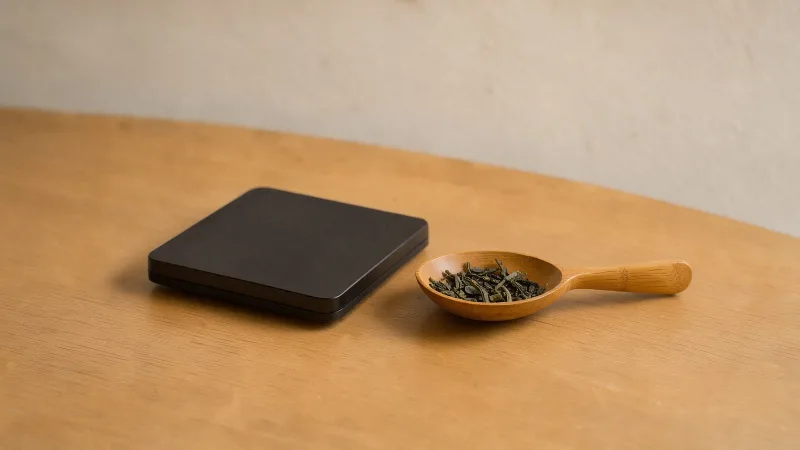
- Scale:
- 0.1 g resolution for gongfu, 0.01 g for doses under 3 g
- A spoon of tea:
- 1.7 to 3.5 g of loose leaf, up to 15 g of dense cake
- Thermometer:
- probe with the sensor in the tip, error within ±1 °C
- Timer:
- accurate to the second; the starting point matters
- ISO 3103:
- 2 g per 100 ml, tolerance ±2 %
Ask why yesterday's oolong beat today's, and the answer is usually in three numbers nobody wrote down: how many grams of leaf went into the gaiwan, how hot the water was when it hit the leaf, how many seconds it steeped. Measuring tools are there so you know those numbers.
What follows covers what to measure and how precisely, which tools do the job, and when you can skip them. How much leaf to use for a given volume of water is covered under leaf ratio, and the right temperature for each type under water.
Leaf: weigh it, do not scoop it
The most common mistake at home is the teaspoon. Members of a tea forum measured the same sencha with three different spoons and got 1.72, 1.85 and 1.93 g. A level spoon of another tea weighed 1.75 g, a heaped one 2.75 g. The Tokyo Tea Cooperative gives rough figures for the Japanese spoon: slightly heaped about 2 g, heaped about 3 g, a tablespoon 5 to 6 g, a chami scoop 6 to 7 g.
With pressed tea a spoon is useless. The tea shop white2tea gives an example: a spoon of loose leaf is about 3 g, a spoon of dense cake up to 15 g, and the two look almost the same.
You do not have to throw the spoon away. Calibrate it. For each tea, weigh a level spoon, a heaped spoon and a full one once, and write the figures down. After that you can measure by spoon as long as the tea and the spoon stay the same.
Tea measures are older than scales. In Lu Yu's Classic of Tea (8th century) the measure 则 is made of shell, copper, iron or bamboo, and the text glosses it like this: "a measure is a gauge, a norm, a limit." The first recorded dose is a "square-inch spoon" of powder per sheng of water, and anyone who likes it weaker uses less. Under the Song the spoon stopped being a measure: Cai Xiang in the Record of Tea asks for a heavy spoon for whipping, ideally gold. The 茶则 scoop is one of the "six gentlemen" among the tea tools.
Scales: what to look for
For gongfu and everyday brewing a 0.1 g step is enough, and it is what the Chinese tasting standard GB/T 23776-2018 requires. A readabilityreadabilityThe step in which a scale shows weight: 1, 0.1 or 0.01 g. It is not the same as accuracy. A scale can show hundredths and still be off by tenths. of 0.1 g means an error of up to ±0.05 g, which on a 3 g dose is about 2 %, exactly the ISO 3103 tolerance. For doses under 3 g, or samples weighed side by side for comparison, get a 0.01 g scale.
More digits on the display do not mean more accuracy. Under NIST rules the extra digit on a scale must look visibly different, so as not to create a false impression of precision. Check the stated tolerance instead: a 200 g pocket scale with a 0.01 g step is typically good to ±0.02 g once calibrated with a reference weight.
In practice:
- Put the scale on a firm, level surface away from drafts and wait for a stable zero.
- Place an empty gaiwan or tea boat on the platform, taretareThe zeroing function. Put an empty gaiwan on the scale, press TARE, and the display shows only the weight of the leaf you add. the display with the TARE button, then add the leaf.
- Do not weigh the gaiwan with water in it: vessel plus water can exceed a pocket scale's limit by 100 to 200 g, and overloading damages the sensor.
- After a move, or every few months, check the scale with a weight. Gravity differs slightly from place to place.
The easiest way to find your vessel's volume is to fill it with water and weigh it. At room temperature, 1 ml of water weighs about 1 g.
Temperature: where and with what
A thermometer matters less than you might expect, because the number on the kettle and the temperature in the cup are different numbers.
In TeaDB's measurements (2026), boiling water in a 75 ml porcelain vessel was at 90.6 °C right after pouring, 85 °C after a minute and 76.7 °C after five. In a preheated vessel the readings at the same points were 96.1, 90.6 and 79.4 °C. An underfilled large pot cooled to 57.2 °C. Akira Hojo measured unheated pots made of the same clay: after a minute the water was at 79 °C in a 100 ml pot and at 85 °C in a 300 ml one. Volume and preheating affect the water temperature more than the accuracy of the instrument does.
That sets the priorities. For oolong, black tea and pu-erh brewed near boiling, preheating the vessel and filling it all the way matter more. Stephane Erler of Tea Masters wrote back in 2005 that a thermometer, scale and stopwatch go against the spirit of gongfu cha and get in the way of learning by feel. The shop white2tea and the tasting standards take the opposite view and treat the scale as the basis of repeatability. Both are right as long as you keep the goals apart: learning taste, or reproducing a result. For test brews Erler himself recommends a fixed 3 g dose, as at the Dongding competition.
Japanese green tea works differently. For gyokuro, water at 95 to 98 °C is cooled by pouring it through a series of vessels: into the kyusu at 70 to 75 °C, into the cups at 60 to 65 °C, into the yuzamashi at 45 to 55 °C. Each pour lowers the temperature by a known amount, so technique can stand in for the thermometer. That technique is the basis of brewing sencha and gyokuro.
Which thermometer to buy
Get a digital probe with the sensor in the tip, one that gives a reading in under 10 seconds. A dial bimetal thermometer averages over a 50 to 76 mm stem and needs at least 5 cm of depth, and a 100 ml gaiwan rarely holds that much water. An infrared thermometer reads only the surface. Steam in the beam's path and shiny metal distort the result, and on metal the error can reach tens of degrees.
You can check any thermometer at home. Fill a glass with crushed ice, add water, stir, put the sensor in at least 5 cm deep without touching the walls or bottom, and wait half a minute. It should read 0 °C. Boiling water is a worse test: it is 100 °C only at standard pressure and with distilled water, tap water boils 1 to 3 °C lower, and in the mountains lower still. Write down the offset and apply it every time.
Treat the display on an electric kettle with the same caution. In an America's Test Kitchen test most models heated the water 2 to 5 °F (1 to 3 °C) below the set point, and the best held within ±1 °F for half an hour. Check the readout against your own probe once.
Time: where to start counting seconds
The Chinese standard GB/T 23776-2018 allows a clock timer or a sand timer accurate to the second. For gongfu, any kitchen timer on a phone or a watch with a second hand will do.
The harder question is when to start counting. The Wuyi standard DB35/T 1545-2015 for rock oolong specifies 5 g in 110 ml and infusions of 20/30/45 s, not counting the time to pour in and out. The Guizhou standard DB52/T 1495-2020 specifies 15 to 30, 10 to 30 and 10 to 40 s for 5 g in 150 ml, counted from the start of the pour. You cannot compare the figures directly, since a slow pour out of the pot adds a few seconds of contact to a short infusion. Pick a starting point and keep it the same for every infusion. Infusion times themselves are laid out under gongfu cha.
For Western brewing, ISO 3103 gives 6 minutes for black tea, 5 for leaf green and 3 for fine green. In a GB/T gongfu tasting of oolong in a 110 ml gaiwan the marks are 2, 3 and 5 minutes from the start, not the length of each infusion1.
Refractometers and TDS meters
Both instruments come from coffee and water treatment. A tea refractometer such as the ATAGO PAL-Tea measures the refractive index in percent Brix: a range of 0 to 25 %, a step of 0.01 %, accuracy of ±0.10 %, temperature compensation from 10 to 100 °C, and a price of around 460 dollars. A TDS pen measures the electrical conductivity of water and converts it to ppm with a fixed factor, 0.5 or 0.7. It does not register non-ionic substances such as sugar.
For water a TDS pen is useful because it shows total mineral content. For what else matters in brewing water, see water chemistry. In tea liquor both instruments produce a number with no tea scale to read it against. The sources have no reliable data on the typical Brix of a home brew, so it is unclear whether ±0.10 % is precise enough for it2. Tea strength is judged by taste.
What to buy for your style
| Style | Scale | Thermometer | Timer |
|---|---|---|---|
| Gongfu, oolong and black tea | 0.1 g step, 4 to 5 g per gaiwan | not needed, preheating matters more | seconds, phone or watch |
| Gongfu, pu-erh and dark tea | essential, a spoon is useless | not needed | seconds |
| Western brewing | 0.1 g step | only for green | minutes |
| Japanese green tea | 0.1 g step | probe or pouring technique | seconds |
| Tasting to a standard | 0.1 g step | not required | to the second |
The figures of 4 to 5 g for oolong and black tea, 6 to 7 g per 90 to 100 ml gaiwan for rolled oolong and 1 g of pu-erh per 15 ml of water come from white2tea's own practice. If you buy one tool at a time, start with a kitchen scale with a 0.1 g step, then a timer, then a probe for Japanese green tea.
Wipe the scale with a dry cloth, keep it away from water and store it covered. Wash the probe in hot soapy water without submerging the whole thing, and check it in ice if you drop it.
Common questions
Do I need a scale if I have always brewed by eye and liked the result?
No. A scale matters when you want to repeat a taste or work out why it slipped. It saves the most tea with pressed pu-erh and with leaves of different density. For your usual blend in your usual mug you can skip it.
Which thermometer should I buy for tea?
A digital probe with the sensor in the tip and a response time under 10 seconds. A dial bimetal thermometer averages over a 50 to 76 mm stem and is useless in a 100 ml gaiwan. An infrared one reads the surface, not the water.
Why does the thermometer say 95 °C when the water in the cup is cooler?
It measured the water in the kettle. An unheated vessel takes 5 to 10 °C off the water in the first seconds. Preheating the gaiwan and pot matters more than an accurate instrument.
-
GB/T 23776-2018, "Methodology for sensory evaluation of tea," clause 5.3.2.2. The marks of 2, 3 and 5 minutes are counted from the start, so the infusions themselves run about 2, 1 to 2 and 2 to 3 minutes. ↩
-
ATAGO PAL-Tea specifications: atago-usa.com. The typical liquor TDS figures that shops quote (0.8 to 2.2 %) come without a method and are not used here. ↩