Care, collecting and safety
Teaware lasts a long time if you wash and dry it properly. An old piece gets checked for authenticity before you buy it, and a new painted one for what its glaze can release into the tea.
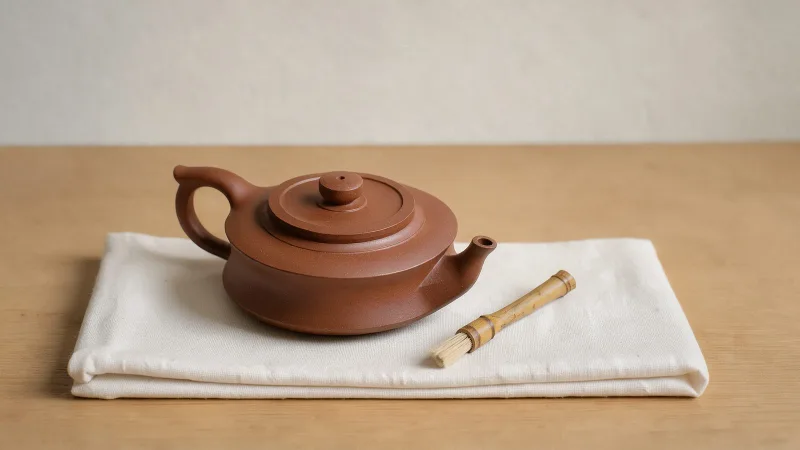
Porcelain and glass can be washed with soap and a sponge, but unglazed clay gets plain water only. Zisha pores take in tea and detergent alike: under GB/T 10816-2024 the clay may absorb up to 6% water. Raising a teapot, or yang hu, comes down to drying it every day: empty the leaf, rinse the pot and dry it with the lid off, and rest it for a few days after 10–15 days of use.
Collecting starts with attribution: when, where and by whom a piece was made, and whether the inscription is genuine. A mark on the base proves nothing. Age is read from the body, glaze, foot and shape, and the most commonly faked detail is the potter's seal. Prices can be enormous: a Chenghua "chicken cup" sold for HK$281.24 million in 2014.
Teaware safety is judged by what leaches into the water. The risks are lead and cadmium in glazes and overglaze enamels, especially with hot or acidic liquids, and zisha dyed with barium, manganese, cobalt and chromium. In a sample of 32 pieces, zisha from pure ore released no lead. Limits vary widely: Chinese and ISO standards allow up to 0.5 mg/L of lead from a cup over 24 hours, the EU directive up to 4.0 mg/L.
-
 Teaware care
养壶
How to wash and dry teaware, open a new Yixing teapot, build patina, clear odor and scale, and whether it is safe to drink from kintsugi repairs.
-
 Collecting
How to read marks on porcelain and Yixing pots, what fakes look like, what maker titles mean, why Japanese hakogaki boxes matter and what drives prices.
-
 Teaware safety
Lead and cadmium in glaze and overglaze, dyed zisha, pewter, glass and electric kettles. Chinese, EU and US limits, and how to check teaware at home.