Green tea 绿茶
The largest type of Chinese tea. Heated within hours of picking, the leaf stays green.

- Oxidation:
- minimal: fixation stops it
- Key step:
- fixation (sha qing) right after picking
- Main provinces:
- Zhejiang, Anhui, Jiangsu, Sichuan, Guizhou
- Harvest:
- spring; tea picked before Qingming costs most
- Liquor color:
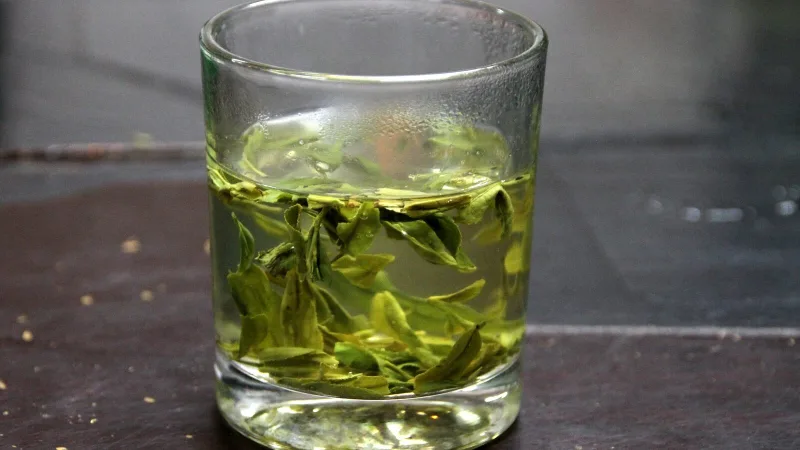
- pale yellow with a green tint
- Flavor:
- fresh, grassy; nutty in wok-fired teas
China makes more green tea than any other type, about half of its harvest. Of the six types it has the palest liquor and the freshest, grassiest flavor, because the leaf is fixed before it can darken.
Processing
The process is short. The leaf withers for a few hours and is then fixed, rolled and dried. The key step is fixation, sha qingsha qingFixation: a short heating of the fresh leaf. The heat destroys the enzymes, and the leaf stops oxidizing. (杀青, "kill-green"): heat destroys the enzymes, and oxidation stops almost as soon as it begins. Rolling sets the shape. Longjing is pressed flat against the sides of the wok. Other teas are twisted into spirals, like Bi Luo Chun, or shaped into needles and pellets.
Pan-firing, baking and steaming
Chinese tea scientists classify green tea by how it is fixed and dried:
- chao qing (炒青), pan-firing in a wok: a toasty, nutty note; Longjing belongs to this group;
- hong qing (烘青), drying with hot air: a softer flavor; Huangshan Mao Feng is dried this way, and jasmine tea is made from the same base;
- shai qing (晒青), drying in the sun: the raw material for sheng pu-erh;
- zheng qing (蒸青), fixation with steam: rare in China, but almost all Japanese tea is made this way.
Freshness and storage
Drink green tea in the year it was picked. The most expensive is spring tea picked before the Qingming festival in early April, known in China as ming qianming qian明前, "before Qingming": tea picked before the Qingming festival in early April. (明前). After six months somewhere warm the aroma fades, and the liquor turns yellower and flatter. Store your supply in the fridge in a tightly sealed bag, and before opening, let the bag warm to room temperature so condensation does not form on the leaf.
How to brew
Boiling water scalds the tender leaf and draws out bitterness, so let it cool to 75–85 °C, toward the lower end for bud teas. Brew in a glass or in a gaiwan with the lid off, so the leaf does not stew. Soft water makes a sweeter cup.
Green tea most often turns bitter from water that is too hot and steeps that run too long. Before switching to another tea, cool the water by 5 degrees and shorten the steep.
-
 Longjing
龙井
Longjing, the flat green tea of Hangzhou: where it grows, how it is fired by hand in a wok, how pre-Qingming tea differs from later picks, how to brew it.
-
 Bi Luo Chun
碧螺春
Bi Luo Chun, the green tea of the Dongting hills on Lake Tai: gardens among fruit trees, hand-firing in a wok, downy spirals and brewing water first.
-
 Huangshan Mao Feng
黄山毛峰
Huangshan Mao Feng, the green tea of Anhui's Huangshan mountains: sparrow's-tongue buds, golden fish leaf, basket drying over fire, a soft orchid taste.