Liu Bao 六堡茶
A dark tea from the hills of Cangwu county in eastern Guangxi. The leaf sweats in a pile, then gets packed into bamboo baskets and aged in damp caves, which gives a red, mellow liquor with wood and sweetness.

- Province:
- Guangxi, Wuzhou, Cangwu county
- Raw material:
- local variety, a bud with two or three leaves
- Processing:
- dui men, wet piling, steaming
- Form:
- bamboo baskets, bricks, loose
- Aging:
- at least six months before sale
- Liquor:
- wood, betel nut, sweetness
Liu Bao (六堡茶) takes its name from Liubao township in Cangwu county, part of the city of Wuzhou in eastern Guangxi. It is a dark tea: the rolled leaf sweats in a pile, goes into a second, wet pile at the factory, and is then steamed, packed tight into bamboo baskets and aged. The characters 六堡 mean "six forts".
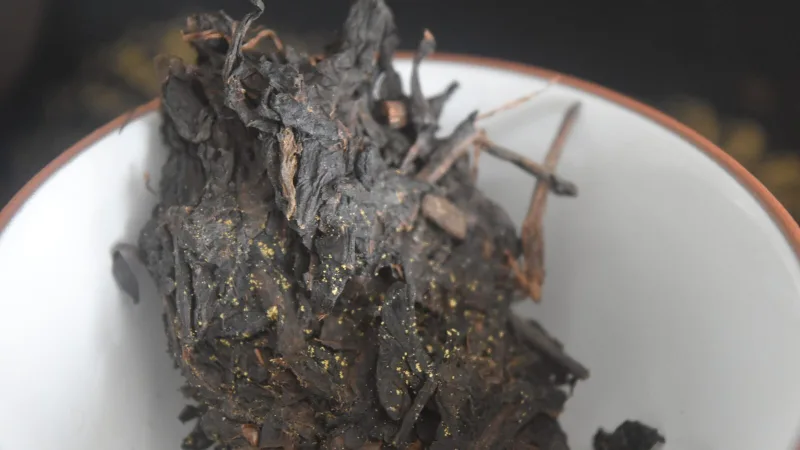
The dry tea is black-brown with a sheen. The liquor is clear and red, the flavor soft and long. People in Guangxi sum up good Liu Bao in four words, hong, nong, chen, chun ("red, thick, aged, mellow"), and add binlang xiangbinlang xiangBetel nut aroma, named for the nut of the areca palm: a sweetish, woody note by which people in Guangxi recognize good aged Liu Bao., the aroma of betel nut.
The hills of Cangwu
The tea grows on the hills around Liubao, along mountain streams, in country known for frequent fog and hot, humid summers. The bushes are a local population with medium-sized leaves, larger than those of Fujian varieties and smaller than the Yunnan large-leaf variety used for pu-erh. Pickers take a bud with two or three leaves.
Other counties in Guangxi make Liu Bao now too, but the old varieties and the best villages are still in Cangwu. China added its processing technique to the national list of intangible cultural heritage in 2014. A national standard for Liu Bao (GB/T 32719.4-2016) followed in 2016 and took effect on January 1, 2017.
The tea boat road
A Cangwu county gazetteer from the late 17th century praises the local tea for a thick flavor that stays with you until the next morning. Chinese sources commonly say that under the Jiaqing emperor (1796–1820) Liu Bao was counted among the twenty-four famous teas of the country.
These mountains had hardly any overland roads, so the tea went by water. Boats and rafts carried it from the Liubao stream to the Xi River, down the Xi to Guangzhou, and on to Hong Kong and Southeast Asia. The route is known as the "ancient tea boat road".
In the late 19th century, workers from Guangdong and Guangxi left for the tin mines of Malaya, and Liu Bao went with them. Miners in Ipoh brewed it in big cauldrons at the mine entrance, believing dark tea protected them from heat and damp. The cheap grades were drunk at the mines, the expensive ones served in restaurants. Malaysia still prizes old Liu Bao, and many famous baskets from the last century turned up there.
In 1954 the private tea houses of Wuzhou were closed, and a state factory took over buying and processing.
Two piles
Processing starts in the village. The leaf is fixed over moderate heat and rolled, then left for dui mendui menSweating in a pile: the rolled leaf is heaped, covered with a damp cloth and left overnight, turning yellow and losing its grassy smell. A village step that comes before drying.: heaped, covered with a damp cloth and left overnight. By morning it has yellowed to a coppery color, and the grassy smell has turned sweetish. After a second rolling the leaf is dried, traditionally in bamboo baskets over pinewood fires. The result is mao cha, the half-finished tea.
The rest happens at the factory. Workers sort the mao cha, blend batches, sprinkle the leaf with water and heap it 60–80 cm deep into a wet pile, which warms up to 40–60 °C. When the inside reaches 58–60 °C, they turn it. It is called a cold pile because the leaf is not steamed beforehand. The pile sits until the leaf turns reddish brown and a mellow smell appears.
The finished leaf is steamed, packed into baskets while still hot and left to cool.
Baskets and caves
The baskets are woven from bamboo. One used to hold 40–50 kg of tea, packed tightly at the edges and more loosely in the center to leave room for air. Today Liu Bao comes in small baskets from half a kilo up, in bricks, in cakes and loose.
Once pressed, the tea goes off to age. The Wuzhou factories kept their baskets in caves and old air-raid shelters, where it is cool and damp. Under an industry rule, the first stage runs at 80–90 % humidity and 22–28 °C, the second in a dry warehouse, and together they last at least 180 days1. Over that time the bitterness and the smell of the pile fade. Sometimes "golden flowers" appear on the leaf: yellow colonies of the same fungus that grows in the fu zhuan bricks of Anhua.
Dating an old basket is hard. The tea was aged in Wuzhou, repacked in Hong Kong and again in Malaysia, and every firm used its own label codes.
Liu Bao and pu-erh
Both are dark teas, both are pressed and aged, and shu pu-erh often gets compared with Liu Bao. They differ more than it seems. Pu-erh mao cha is dried in the sun, while Liu Bao mao cha sweats in a pile back in the village and is dried over fire. At the factory, Liu Bao gets a shorter, cooler pile than shu. Aging in damp caves, on the other hand, is part of the processing itself rather than something left to the buyer.
Liu Bao tastes lighter than shu, with less earth and more wood, dried herbs and sweetness. There is also a "green" Liu Bao made without a pile, in imitation of sheng pu-erh. Nobody knows yet how it will age.
How to brew
Liu Bao needs water at a full boil. A thick-walled Yixing teapot works well, since it holds the heat between infusions. Leaf from a basket is loose and bulky, so use a round vessel that gives it room to unfurl. Brew it gongfu cha style, with short infusions and many of them.
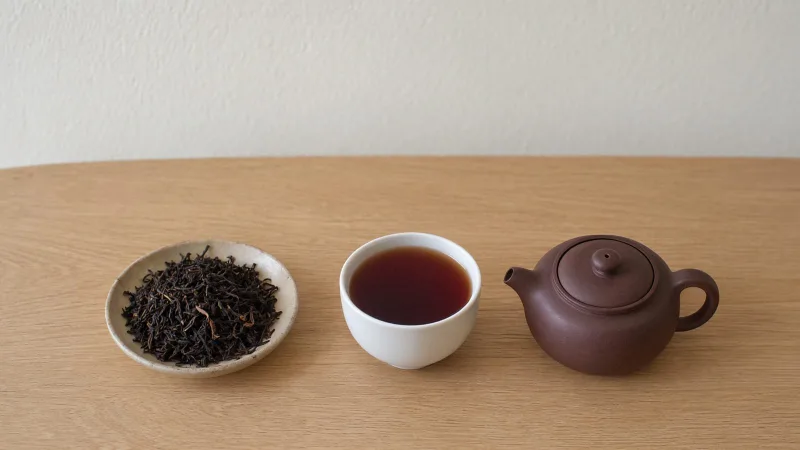
5 g per 100 ml, water at 100 °C (212 °F). Warm the pot and cups. Rinse the leaf: pour boiling water over it and discard after 5 seconds. Give the first infusion 15–20 seconds, pour off the next two or three almost at once, then add 10–15 seconds each time. The leaf lasts 8–10 infusions. Afterwards you can drop the spent leaf into boiling water and simmer it for 3–5 minutes.
Boiling Liu Bao is an old Malaysian habit. A pinch of leaf per liter of water sits over a low flame, and you top up the water as you drink. That suits everyday tea; old baskets are better brewed gongfu style.
Common questions
Why does new Liu Bao smell like a cellar?
That is the smell of the warehouse: the tea spent months in a damp basement or cave. It usually fades within a few weeks if you open the basket and keep the tea somewhere dry, away from other odors. Rinse it before brewing; old tea sometimes needs two rinses.
How is Liu Bao different from shu pu-erh?
Liu Bao is made in Guangxi from a local medium-leaf variety and dried with heat, not in the sun. Its pile is shorter and cooler than the one for shu, and aging in damp caves is part of the processing. The liquor is lighter than shu pu-erh, with more wood and less earth.
What are the yellow specks on Liu Bao leaf?
Small bright yellow specks inside a clump are "golden flowers", the same fungus found in the bricks of Anhua. A fluffy coating with a musty smell is mold, and that tea must not be drunk.
-
T/LPTRA 2-2023 "Rules for aging Liu Bao tea", a standard of the Liu Bao Tea Research Association of Wuzhou. ↩