Tea customs of Yunnan's peoples
In the mountains of Yunnan, people roast tea leaf in a clay pot over the fire pit, then pour boiling water over it. The Bai turn this into a three-course ritual, the Lisu whisk it with butter, and the Dai and Lahu pack the leaf into bamboo.
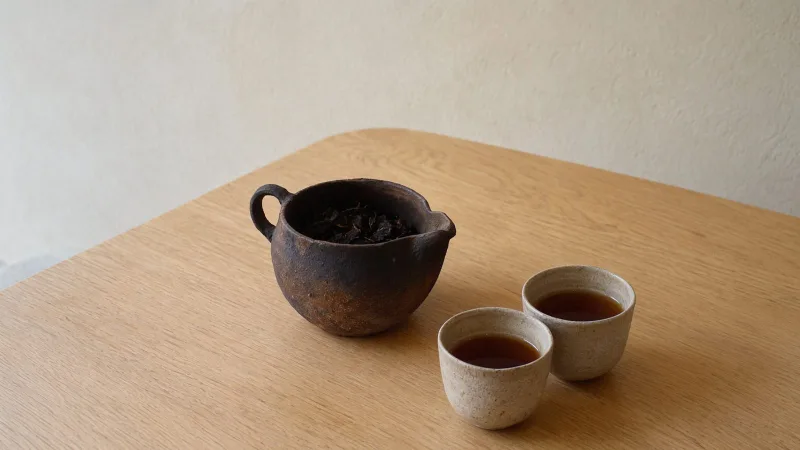
- Where:
- Yunnan, southwest China
- Base method:
- roasted tea 烤茶 kǎochá: leaf toasted in a pot, then covered with boiling water
- Pot:
- 150–220 ml, 2–3 g of leaf per 200–220 ml
- Best-known ritual:
- Bai three-course tea, Dali
- Heritage status:
- national list 2014; UNESCO element 2022
- Other forms:
- bamboo tea, buttered tea, tea in liquor, tea salad
Yunnan is home to many peoples, and for nearly all of them tea starts at the fire pit. They do not brew the leaf straight away. They roast it first and only then add water, and the tea that comes out smells of bread and caramel, with a softer bitterness. After that each people goes its own way, with butter, nuts, honey, liquor or bamboo.
Roasted tea at the fire pit
The fire pit, huǒtáng 火塘, sits at the center of the house, and it is where people boil water and roast tea. The basic method is the same for every people1. The cook warms an empty pot by the fire, adds the leaf and shakes it nonstop until it yellows and smells toasty. Then in goes boiling water, and the pot hisses and foams. After a few minutes of simmering, the tea is poured into cups.
The names vary. The Dai say "fire pot tea" 火罐茶, the Blang 土罐茶, the Naxi 煨罐茶, the Hani 土锅茶, the Lahu 火焯茶, the Yi 罐罐茶. Some reverse the order: they heat the pot, pour in the water and only then drop in the leaf.
The pot is small. Souvenir pots from Dali hold 200–220 ml and stand 8 cm tall; those from the Qujing area hold 150–160 ml. One seller recommends 2–3 g of leaf per 200–220 ml. The Bai prefer local ceramics because the clay is porous, holds heat well and survives water hitting the scorched pot. Cold water is another matter, and it will crack a hot pot. For ways to heat one, see heat sources.
Everything depends on the fire. Over-roast the leaf and the tea turns bitter and astringent; under-roast it and the aroma never comes through. If the pot stays silent when the water goes in, the result is "mute tea" 哑巴茶, and no host serves that to a guest. In Nanhua County, where the Yi drink roasted tea, the first infusion is the strongest and most bitter, the second and third are the best, and from the fourth or fifth on the pot is "nursed like medicine".
The Blang of Jingmai Mountain say that raw leaf from old trees is "cold" and that fire takes the coldness away. That is how the Blang themselves explain the custom.
Bai three-course tea
The Bai live around Dali, and their ritual is summed up as "three courses, six rules, eighteen actions" (三道、六则、十八序). Its core is the three courses, each with its own taste and meaning.
Bitter tea 苦茶. This is the roasted tea itself: the leaf is shaken over coals at least a hundred times, until it darkens without charring. It is also called "thunder teathunder teaThe name covers different drinks: for the Bai it is the first, bitter course; for the Lisu, tea with butter and a red-hot pebble; for the Limu, roasted tea poured into bamboo." 雷响茶 and "hundred-shake tea" 百抖茶. It stands for the hardship that life begins with. The cups are poured small, and the tea is amber.
Sweet tea 甜茶. Cane sugar syrup, walnut slices as thin as paper, often shavings of rushanrushanBai cow-milk cheese 乳扇 rǔshàn: thin sheets dried over coals and cut into strips. cheese, and sesame. Some families add honey. After the bitterness comes sweetness.
Aftertaste tea 回味茶. Honey, Sichuan pepper and cinnamon, and for many also ginger. It stands for memories of a life lived. Pepper and cinnamon were chosen partly for wordplay: in the Bai language "spicy" sounds like "kin" and "numbing" sounds like "rich", so the third cup also wishes a guest a close family and prosperity.
The cup is offered with both hands at brow level. The guest passes the first cup to the eldest in the house, serves the others, and drinks last. Nobody fills a cup to the brim: "full wine is respect, full tea is an insult" (酒满敬人,茶满欺人). On ordinary days the Bai drink plain roasted tea at the fire pit and save the three courses for guests, weddings and festivals.
What is in the cup is disputed
Sources disagree on what goes into each course. According to the official entry in the intangible heritage list, the second course has only walnut and sugar, with honey optional. People in Dali mention cheese and sesame, and a 2022 TV report describes a syrup of ginger, brown sugar and licorice cooked on bitter tea for about 40 minutes. Some put the third-course spices in the cup and pour tea over them, others first simmer them in a pot for about 10 minutes. Even the tea for the first course varies: "green tea from the Cangshan mountains", loose or broken tuocha from the Xiaguan factory, or plain sun-dried green. It seems there never was a single recipe.
How old are the three courses
Oral history traces the ritual to receptions of envoys at the court of the Nanzhao kingdom (738–937). No document supports this. The earliest written record is from the 9th century. In the Manshu, Fan Chuo writes that in Yinsheng, tea is picked haphazardly, and that the Mengshe, the ruling clan of Nanzhao, boil it with pepper, ginger and cinnamon. There is no mention of three courses.
The second record is Xu Xiake's travel diary of 1639. On the fifteenth day of the first month, at a temple on Jizu Mountain, monks "poured tea for amusement: first plain, then salted, then honeyed"2. The teas are different, and the Bai do not appear. The entry is now cited as the ritual's forerunner, though what the diary describes is a monastery festival.
Official recognition is recent. In 2014 "Tea customs (Bai three-course tea)" entered China's national list of intangible cultural heritage, and in 2022 it became part of the UNESCO element "Traditional tea processing techniques and associated social practices in China". Three-course tea is one of that element's six Yunnan entries.
Thunder tea, liquor, butter
"Thunder tea" means different things to different peoples, and it is easy to mix them up. For the Bai it is the first, bitter course; for the Lisu it is tea with butter; for the Limu it is roasted tea poured into fresh bamboo.
Lisu of Nujiang. They boil 750 g of water in a large pot, roast pressed tea in a small one, pour the boiling water over it, simmer for 5 minutes and strain. Two or three pots of this tea go into a churn with butter, roasted ground walnuts and peanuts, salt or sugar, and an egg. Last goes in a pebble heated in the fire, with a hole drilled through it, and it "thunders" in the churn. The whole lot is pounded with a pestle and drunk hot. Other whisked and pounded teas include Tibetan butter tea and lei cha.
Naxi of Lijiang. "Dragon fights tiger" 龙虎斗: tea is roasted in a clay pot to dark yellow and boiled down "like medicine". The cup is half filled with corn liquor, sometimes set alight, and the hot tea goes into the liquor, not the other way round. The cup crackles, which is taken as a good sign. Pepper is sometimes added, and the drink is taken as a home remedy for colds.
Yi of Pu'er. A piece of pressed tea is roasted until it crackles, boiled for about 5 minutes and salted, which gives "salt tea" 盐巴茶. Pu'er here is the prefecture, not pu-erh tea.
Wa. The leaf is roasted on a thin iron sheet or a stone slab (sources differ) and then boiled in a kettle.
Bamboo
Two quite different teas are both called bamboo tea, and the name does not tell them apart.
The first comes from the Dai of Menghai: 竹筒香茶, "la-do" in Dai. The makers describe it like this:
- raw material: 0.25 kg of first-grade spring sun-dried maocha, or tender sets of one bud and two or three leaves, fixed in a wok and rolled;
- steaming: over a 6–7 cm layer of soaked glutinous rice, through cheesecloth, for 15 minutes;
- bamboo: one-year-old "sweet" bamboo, opening 5–6 cm, length 22–25 cm; the tea is tamped with a stick and the mouth closed with a bamboo leaf or paper;
- drying: over coals at about 40 cm, turning every 5 minutes until the bamboo goes from green to brown-yellow;
- brewing: break off a little and cover with boiling water for 5 minutes.
No fermentation is involved: neither scientific nor official descriptions of roasted or fixed bamboo tea mention any. In 2023 the technique of Dai bamboo tea was added to the heritage list of Xishuangbanna Prefecture.
The second kind is for the road. In the field or on a hunt, the Dai and Lahu cut a fresh bamboo joint, boil spring water in it, drop in tea and boil it for another 5 minutes. The Limu of Yongde pour roasted tea into fresh bamboo and knock on it with a stick.
A third route leads somewhere else entirely. The Jingpo pack wilted, rubbed leaf into bamboo, seal the mouth with clay and bury it for two or three months. That makes it a sour tea, like laphet and miang.
If someone offers you "bamboo pu-erh", ask what is inside. A search of the national database found no national or provincial standard for bamboo tea (as of October 2026), and it counts as pu-erh only if it meets GB/T 22111-2008.
A salad and other guests
The Jino eat their tea rather than drink it. They rub fresh, tender leaf by hand, put it in a bowl with citron leaf, garlic, wild star anise, chili and salt, add meat or vegetables and cover it all with unboiled or cooled boiled water. The mix changes with the season: ant eggs, bamboo shoots, crab, mushrooms, more than a dozen additions in all. The dish is 凉拌茶, in Jino "la-you".
Tea manners vary from people to people too:
- Lahu. Before drinking, the host flicks tea into the fire with his fingers as an offering to the spirits. The cup is handed over with both hands and raised slowly from below, with eye contact.
- De'ang. An ordinary guest gets "welcome tea" from the big pot. For family and close friends the host roasts fresh leaf on a wok lid, then in a small pot, gives the guest the first infusion and drinks only the second himself. A dear guest is seen off with bamboo tea, everyone sipping in turn from one joint. A marriage proposal comes with a packet of tea.
- Blang, Jingmai. Over roasted tea at the fire pit, the Blang reconcile neighbors, choose bridegrooms and teach the young.
The sour leaf of the Blang and De'ang, Tibetan butter tea and red Dian Hong are other teas and other conversations.
Common questions
What is Bai three-course tea?
A ritual from Dali in which a guest gets three cups in a row. The first is bitter, made from roasted tea; the second is sweet, with walnut slices and sugar; the third has honey, Sichuan pepper and cinnamon and is called aftertaste tea. The usual reading is hardship first, then sweetness, then memories of a life lived.
Can I make roasted tea at home?
Yes. You need a small clay pot, a fire and boiling water. Heat the pot dry, add 2–3 g of leaf per 200 ml, shake it over the heat until the leaf yellows and smells toasty, and pour boiling water in at once. Never pour cold water into a hot pot: it will crack.
Is bamboo tea pu-erh?
Not necessarily. The bamboo may hold wok-fixed leaf, which by processing is closer to green tea, or pressed sun-dried maocha. It counts as pu-erh under GB/T 22111-2008 only if the raw material and processing meet that standard.
-
Liu Yan, Zhou Hongjie, Kong Baohua (eds.), "Green Health: Chinese Pu'er Tea", chapter "Tea as Drink": daowen.com. ↩
-
Xu Xiake, "Travel diary of Yunnan" (滇游日记), entry for the 15th day of the first month, 1639: xuxiakeyouji.com. ↩