Asian milk teas: from Hong Kong to bubble tea
Five street milk teas descend from British tea with milk and sugar, but they are made with cheap fine-cut leaf and canned milk and strained through a cloth bag. Bubble tea was born in Taiwan in the 1980s, and the courts never settled who made it first.
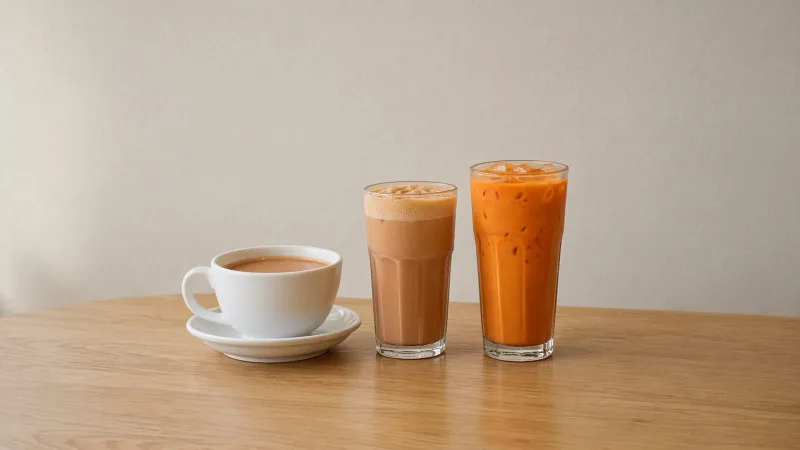
- Hong Kong:
- evaporated milk, tea “pulled” through a sock
- Malaysia, Singapore:
- teh tarik: condensed milk, poured from height
- Thailand:
- cha yen: condensed and evaporated milk, ice
- Myanmar:
- laphet-yay: tea, evaporated and condensed milk, 5:1:1
- Taiwan:
- foam tea from 1983, bubble tea from 1986–1987
- Heritage:
- Hong Kong list 2017, Malaysian breakfast culture UNESCO 2024
The British taught Asia to drink black tea with milk and sugar, and then every city made the habit its own. In the heat people added ice, money stretched only to the dust left over from grading, and fresh milk spoiled fast, so canned milk took over. The result is five different drinks with one ancestor.
What they have in common
The method is much the same everywhere. A strong brew of fine-cut black leaf (broken, fannings or dust) is strained through a cotton bag on a metal ring. Then the tea is “pulled”, meaning poured from a height, and mixed with canned milk. Everyone filters, since the bag strains the grit out of cheap leaf, and pouring from a height raises a foam and cools the tea.
Canned milk comes in two kinds. Evaporated milk is unsweetened and rich, so you can pour in plenty. Sweetened condensed milk sweetens the tea at the same time and softens the astringency of the dust. The leaf is always black, but never the same: a blend of Ceylon grades in Hong Kong, dust in Malaysia, a ready-made Thai mix with food coloring, Shan tea in Myanmar. The model for all five is British milk tea.
Hong Kong: silk-stocking tea
The British brought tea with milk and sugar to the colony after 1842, but until the Second World War it was served only in expensive Western restaurants. The local version took shape in the 1950s. The government licensed a great many plain eateries, bing sutt (冰室) and dai pai dong (大牌檔), and cooks began to buy cheaper, stronger leaf, strain it through thick cotton and swap fresh milk for canned. Dockworkers needed the calories. In the 1960s the drink moved into the cha chaan teng (茶餐廳) cafes and grew milder to suit office workers.
Lan Fong Yuen (蘭芳園) says its owner Lam Muk-ho invented silk-stocking tea and yuenyeung in 1952. The first claim is generally accepted; the second is not. By a 2011 account Lam sewed the bag by hand from heavy white cloth after a nylon one let dust through. The name “silk-stocking milk teasilk-stocking milk teaHong Kong milk tea strained through a cotton bag. The name comes from the bag’s color and shape; no stocking is involved.” is usually explained by the bag’s color and shape. Other stories point to a mistake by dockworkers at the Sham Tseng pier, or to the silky texture.
There is no single recipe: masters guard their proportions as trade secrets, and sources disagree. Roughly, it goes like this. Cooks blend the grades, set the bag of leaf in a pot and pour boiling water over it, 96–98 °C according to Wikipedia, 100 °C according to a contest champion. They cover the pot and let it “bake” over heat for anywhere from a few minutes to 12 (Wikipedia again). Then they lift the pot and pour the tea in a stream into the bag, “hitting” it. The champion advises three or four hits, the HK Memory archive says “at least three”, and Lan Fong Yuen counts eight “hands” of two pours each. Afterwards the tea sits at the edge of the stove near 96 °C without boiling. Evaporated milk makes up about 30 % of the volume.
Overdoing it backfires. Pour from too high and the tea cools, dust shakes loose from the bag and the flavor turns rough. Good tea is golden, with no grassy smell or slimy feel, and it “clings to the cup” (掛杯). Rich evaporated milkevaporated milkUnsweetened canned milk, more concentrated than fresh, so it dilutes tea less. Sweetened condensed milk is a different product. sometimes leaves a brown skin on top.
Orders follow a set vocabulary: 熱奶茶 hot, 凍奶茶 iced, 茶走 (cha jau) with condensed milk instead of sugar, 鴛鴦 (yuenyeung) tea with coffee, three parts coffee to seven of tea for a dark roast. The technique entered Hong Kong’s first intangible heritage inventory in 2014 (480 items) and the first Representative List on 14 August 2017 (20 items). Macau has a similar tradition, where one variant is brewed in a clay pot (瓦煲奶茶).
Malaysia and Singapore: teh tarik
Teh tarik means “pulled tea”. Tamil Muslim vendors sold it at the gates of rubber plantations, hence the word mamak, “uncle”. According to the BBC, the Chinese brought black tea to Malaya in the 1830s, South Indian street vendors developed the pouring after 1850, and milk and sugar arrived almost a century later. After 1945 good leaf was scarce, so sellers turned to sarabat, the dust left over from grading, and masked its bitterness with condensed milk. Wikipedia dates the stalls to the 1870s, so the timeline is loose.
The menu in a Singapore kopitiamkopitiamA Malaysian or Singaporean coffee shop, from Malay kopi, “coffee”, and Hokkien tiam, “shop”. They also serve teh tarik and teh C. is wider, since these coffee shops were founded by Hainanese who had cooked for Europeans. The oldest working Hainanese coffee shop in the city is the former Kheng Hoe Heng on Killiney Road, dating from 1919. You build an order from words: teh with condensed milk, teh O with sugar and no milk, teh C with evaporated milk, kosong with no sugar, peng with ice, halia with ginger. In Malaysia you ask for kurang manis, “less sweet”. The “C” stands either for “fresh” in Hainanese or for Carnation, a brand of evaporated milk, and nobody agrees which. Singapore and Malaysia both claim the drink. UNESCO inscribed “Breakfast culture in Malaysia” (nasi lemak, roti canai, teh tarik) on the Representative List in 2024, after it entered the national inventory in 2022.
A shop that sells tea dust suggests 1½ tablespoons of dust per serving and 250 g of water at 95–98 °C (203–208 °F). Steep for one minute, then pour through the tea sock about ten more times until the taste turns astringent. Add 2 tablespoons each of condensed and evaporated milk and pull between two mugs 4 or 5 times, at least 50 cm apart. Stalls use roughly 150 ml of base to 50 ml of water.
The leaf is usually called “grade B”: cheap fine-cut tea whose astringency holds up under sweet milk.
Thailand and Myanmar
Thailand. The Siamese drank tea hot and unsweetened, according to the French diplomat Simon de la Loubère, who wrote at the court of King Narai (1656–1688). Condensed milk went on sale in 1893 and the first ice factory opened in 1903, so by the 1920s coffee shops served iced tea with milk. Sources differ on who imported the milk: Thai entrepreneurs or Nestlé. At home the drink is simply called “tea”; “Thai tea” is what foreigners call it.
Cha yen (ชาเย็น) is made from a ready-made Thai mix that contains flavorings and food coloring. The orange comes from the dye listed on the package, though some vendors use safflower. Red soil has nothing to do with it, since iron oxide does not dissolve in water. The Serious Eats recipe has you stir 32 g of mix into 480 ml of boiling water, let it stand 5 minutes, stir again and strain through cloth, squeezing it out. Add 15 g of sugar, 60 ml each of condensed and evaporated milk and a pinch of salt to the warm tea. Chill for about an hour and pour over ice, with evaporated milk floated on top. Street vendors pour it into a bag of ice. Without milk the same tea is cha dam yen.
The dyes are a real concern. In November 2024 the consumer magazine Chalat Sue tested 20 tea mixes: all contained synthetic colors, 17 contained more than one, and half had no ingredient list on the label. Sunset Yellow FCF is allowed in finished flavored tea up to 100 mg/kg, and the JECFA acceptable daily intake is 0–4 mg per kg of body weight.
Myanmar. Before colonial rule people drank green tea, and it still sits free on every teahouse table (yay nway gyan). From the late 19th century Indian settlers opened kaka hsaing shops serving strong tea with milk and sugar, and teahouses grew out of them. Laphet-yay is simmered with a pinch of salt for 15–30 minutes, mixed with milk at about 5:1:1 (tea, evaporated, condensed) and pulled like teh tarik. Orders go by codes: pon hman is standard, cho seint sweet and rich, kya seint strong and rich, gate sone (“last stop”) strong with no milk. There are more than twenty variants. In Myanmar tea is also eaten, as the fermented leaf laphet.
Spiced Indian masala chai is made differently: it is simmered in a pot rather than pulled.
Taiwan: foam, tapioca and a dispute
In Taiwan milk tea turned cold and “hand-shaken” (手搖飲). On 20 May 1983 Liu Han-chieh opened the Yangxian tea shop (陽羨茶行) in Taichung, the future Chun Shui Tang (春水堂). He brought a shaker from Japan and whipped tea, sugar and ice into a froth, and so “foam black tea” (泡沫紅茶) was born. By the company’s account, more than ten iced-tea shops were soon operating within a hundred meters.
Bubble tea (珍珠奶茶, zhenzhu naicha) was the next step. Tapioca pearls are 粉圓 in Chinese. The Hanlin tea house (翰林茶館) in Tainan says late 1986; Chun Shui Tang says it tested the drink in 1986 and began selling it in 1987, crediting employee Lin Hsiu-hui. Another version has the idea coming from night markets under the influence of Malay cendol. In 2006 and 2007 Tainan courts heard Hanlin’s reputation lawsuit against Chun Shui Tang and rejected it. They did not rule on who invented the drink, so the line “the court named X the inventor” is wrong.1
At Chun Shui Tang, staff shake tea, creamer and cane sugar with ice and pour it over pearls about 8 mm across. The ratio of tea, ice and foam is 7:2:1, and cooked tapioca is kept no longer than three hours. By the mid-1990s the drink was on tea house menus across the island, and once machines that seal the cup with film arrived, it became a takeaway drink.2
Taiwanese bubble tea came under suspicion twice. In 2012 a German newspaper reported carcinogens in the pearls, but the state of North Rhine-Westphalia tested 84 samples and found no styrene, no acetophenone and no brominated compounds. In 2013 maleic acid turned up in starch products in Taiwan: two of 25 samples of tapioca and taro balls in Taipei contained 194.81 and 43.31 ppm. By 5 June 392 t of product had been recalled, by 21 June about 623 t of contaminated food and raw material, and the share of positive samples fell from roughly 40 % to under 10 %. Tapioca reached Japan in three waves: in 1992 as a dessert, in 2008 with Taiwanese chains, and again from 2018.
How to choose and order
To make Hong Kong tea at home you need a blend of fine grades, evaporated milk and a bag. Teh tarik is simpler, since dust and condensed milk will do. Cha yen from a Thai mix takes about an hour, including chilling.
There are no national standards for these drinks, masters keep their recipes secret, and sources give different times, hit counts and temperatures for Hong Kong tea. So judge by the result: the tea should be rich but not bitter, the milk should not drown the leaf, and the bag should be replaced when it wears out.
Common questions
Why is Hong Kong milk tea called “silk-stocking” tea?
Because of the bag. The cotton filter darkens with tea and looks like a stocking in color and shape. There are other explanations: dockworkers in the 1950s supposedly got the name wrong, and a champion of Hong Kong’s milk tea contest points to the silky texture. The tea is never brewed in a real stocking, which would not survive the heat or the weight.
How is teh tarik different from masala chai?
Teh tarik is made from tea dust and condensed milk, with no spices, and “tarik” means “pulled”: the tea is poured between vessels from a height until it foams. Masala chai is simmered with milk and spices on the stove, a separate South Asian tradition.
Who invented bubble tea?
Nobody knows. The Hanlin tea house in Tainan dates the drink to late 1986, while Chun Shui Tang in Taichung says it tested the drink in 1986 and sold it in 1987. Tainan courts rejected Hanlin’s reputation lawsuit in 2006 and 2007 without deciding who came first.
-
APPI News, “Who invented bubble tea? Chun Shui Tang, Hanlin and the court rulings”, 4 September 2026: https://appi.news/articles/bubble-tea-who-invented-it/ ↩
-
Edward Jones, “Who invented bubble tea?”, Taipei Times, 13 November 2018: https://www.taipeitimes.com/News/feat/archives/2018/11/13/2003704115 ↩