Sencha, gyokuro and hojicha: how to brew Japanese green tea 日本茶
Gyokuro wants water at 50 °C, hojicha wants a rolling boil. Three numbers decide the rest: leaf, water and seconds. Every tea is brewed the same way, in a kyusu with water cooled in the cups.
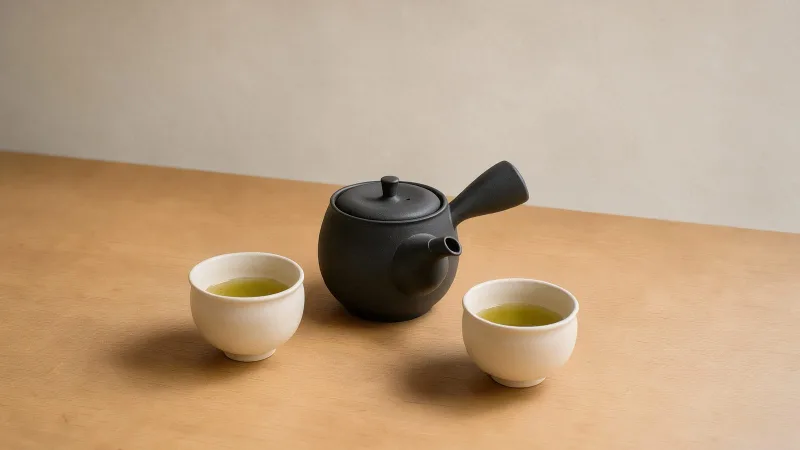
- Vessel:
- kyusu, houhin or shiboridashi
- Gyokuro:
- 50–60 °C, about 3 g per 20 ml
- Sencha:
- 70–90 °C, 2 g per 60–90 ml
- Hojicha:
- boiling, 30 seconds
- Infusions:
- two or three, each shorter
Japanese leaf tea is brewed differently from Chinese green tea: less leaf per infusion, cooler water, a longer steep. Temperature depends on the type and the grade, not on the country. Gyokuro takes 50–60 °C, top-grade sencha about 70 °C, everyday sencha 80–90 °C, and bancha, hojicha and genmaicha take water straight off the boil.1
The routine is shared by every tea; what changes are the numbers and how you handle the second infusion. You brew in a kyusu, houhin or shiboridashi. Powdered tea is whisked instead, and that is how matcha is made.
Which tea, which water
Sencha is steamed, rolled and dried. Deep-steamed sencha (fukamushi) is steamed twice as long, so the leaf is finer and brews in 30 seconds. Gyokuro grows under shade for about 20 days before harvest, while kabusecha is shaded for roughly a week. Hojicha is sencha or bancha roasted over high heat; genmaicha is tea blended with roasted rice.
Temperature follows the chemistry. Early, shaded leaf has more amino acids; late leaf grown in full sun has more catechins. Sakamoto and colleagues found that theanine is almost fully extracted at 70 °C, while catechin extraction climbs sharply from 70 °C. That is why gyokuro and top-grade sencha are brewed cool, for sweetness and umami, and hojicha and bancha hot, for the roast aroma.
Two popular claims are wrong. One says catechins only come out above 80 °C. In fact free catechins dissolve even in 50 °C water; only the ester catechins, the astringent ones, resist cool water. The other says cold water leaves tea caffeine-free. Caffeine comes out at 20 °C too.2
Soft water is best, boiled for a few minutes with the lid off so the chlorine escapes.
Brewing in a kyusu
Pot size, water per person and leaf go together. For gyokuro, use the smallest kyusu, 90 ml, with 40 ml cups. For top-grade sencha, 250 ml and 100 ml; for everyday sencha, 600 ml and 150 ml; for hojicha and bancha, 800 ml and 240 ml.
- Bring the water to a boil.
- Pour it into the cups until they are eight tenths full. This measures out the water for your guests and warms the cups.
- Put the leaf in the kyusu.
- Once the water in the cups has cooled to the right temperature, pour it into the kyusu, close the lid and wait. Don't shake the pot.
- Serve with a rotating pour (mawashi-tsugimawashi-tsugiRotating pour: the cups are filled a little at a time, back and forth, until strength and volume match in all of them.): cups 1, 2, 3, then 3, 2, 1, until all the cups match.
- Pour out every last drop.
- Tap the kyusu with your palm so the leaf settles in an even layer, and leave the lid ajar.
Instead of a yuzamashi, you cool the water in the same cups. Each transfer takes off about 5–10 °C. Sources give both figures, since a lot depends on how heavy the vessel is. The Hibiki-an tea house offers an easy ladder to remember: boiling water straight into the kyusu is about 90 °C, through one cup 80, through two 70, through three 60.
Draining to the last drop isn't about neatness. Water left in the kyusu keeps steeping the leaf and spoils the second infusion.
Leaf: 2–3 g. Water: from 50 °C for gyokuro to boiling for hojicha (212 °F), cooled by pouring through cups. First infusion: from 30 seconds to 2.5 minutes, depending on the tea. Pour off to the last drop; the second infusion is hotter and shorter.
Numbers by type
The All Japan Tea Federation gives its figures per person, and they match Shizuoka Prefecture's table. Treat them as a starting point, not as rules.
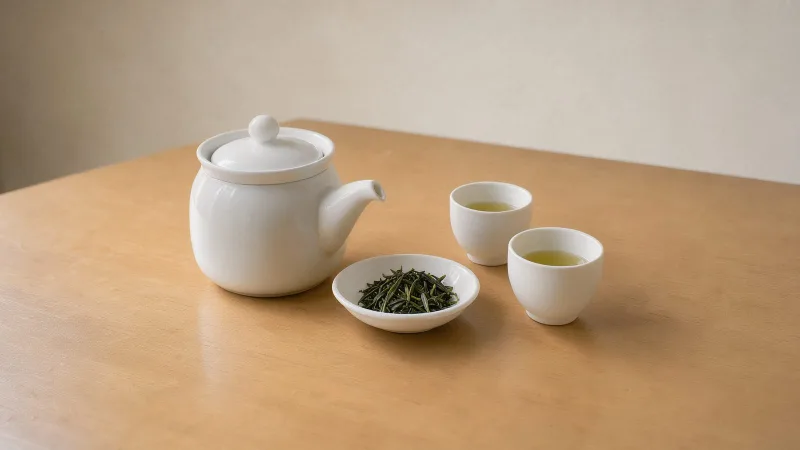
| Tea | Leaf | Water | Temperature | First infusion |
|---|---|---|---|---|
| Top-grade gyokuro | 3 g | 20 ml | 50 °C | 2 min 30 s |
| Standard gyokuro | 3 g | 20 ml | 60 °C | 2 min |
| Top-grade sencha | 2 g | 60 ml | 70 °C | 2 min |
| Standard sencha | 2 g | 90 ml | 90 °C | 1 min |
| Fukamushi sencha | 2 g | 90 ml | 90 °C | 30 s |
| Bancha | 3 g | 130 ml | boiling | 30 s |
| Hojicha | 3 g | 130 ml | boiling | 30 s |
| Genmaicha | 3 g | 130 ml | boiling | 30 s |
Boiling water for hojicha is not dogma. American guides suggest 79–85 °C for up to 90 seconds, while Japanese organizations call for boiling water and 15–30 seconds. Advice on fukamushi varies widely too, from 70 to 90 °C. The one point everyone agrees on is time: about 30–45 seconds.
Gyokuro
Gyokuro is brewed with little water and a lot of leaf. One Japanese shop starts at 4 g per 50 ml and goes up to 10 g for the top grade. In Kyoto some brew it as low as 40 °C for about a minute, and then it tastes of dashi broth. That is the point: the field is shaded for exactly this density.
A houhin of 100–200 ml with a strainer at the spout suits this tea, along with cups of 20–40 ml. A shiboridashi is smaller still, often up to 100 ml, and has no strainer: a narrow gap under the lid holds back the leaf.
Second and third infusions
The leaf is already open, so the second round gets hotter water and a shorter steep. Shizuoka suggests about a third of the first time: 10 seconds for sencha, 30 for gyokuro. Other Japanese sources say 30 seconds, and Hibiki-an says 40–50. The sources genuinely disagree, so let taste decide. A third infusion can take nearly boiling water and a longer wait.
Bancha and hojicha give most of what they have in two infusions, and then it's time for new leaf. Don't top up the old leaf with fresh.
Between infusions, leave the kyusu lid ajar so the wet leaf doesn't stew. After the first infusion, look inside: if the leaf has opened fully, you steeped it too long.
Where this routine comes from
Until the mid-18th century, Japanese leaf tea was made the Chinese way: pan-fired, rolled and sun-dried. Tradition holds that in 1738 Nagatani Soen of Ujitawara combined steaming with hand rolling on a heated table and produced "aosei sencha", the ancestor of today's tea. Historians consider this account solid but not beyond dispute.
Gyokuro appeared in the 1830s. In 1834–1835 several craftsmen processed shaded shoots by the Nagatani method, so no single inventor can be named. The firm Yamamotoyama gives the credit to the sixth Yamamoto Kahei and the year 1835. Hojicha is linked to 1920s Kyoto, when merchants began roasting stems and coarse leaf over charcoal. The dates vary, though: Kaga bocha from Kanazawa is earlier still, from 1902.
What to know when buying
"Fukamushi" on a package has a fixed meaning under the labeling standard: steamed twice as long as usual. "Asamushi" has no definition in the standard; it is a trade term, and every producer draws the line differently. Steaming time and grade have nothing to do with each other: expensive and everyday tea alike can be steamed briefly or for a long time.
This causes a common mix-up. English-language guides tell you to brew fukamushi cooler and asamushi hotter. Japanese tables go by grade instead: 70 °C for the top grade of both kinds and 90 °C for the standard grade.
With genmaicha, the rice matters more for quality than the leaf. The popped grains, called "popcorn", are there for looks and don't change the taste.
An old trick: shizuku-cha
At the Hoshino Tea Museum in Fukuoka, gyokuro is brewed in a lidded cup: 3 g of leaf, 20 ml of water at body temperature, two minutes. You sip through the gap under the slid-back lid. The second and third rounds use 20 ml of 60 °C water for 15–20 seconds, the fourth a full cup of 80 °C water. Afterwards the leaf is eaten with soy sauce or salt. Sources differ on the first water: one says body temperature, another 45 °C.
Common questions
Why is gyokuro brewed with such cool water?
Shaded leaf is rich in amino acids and umami, which come out first at 50–60 °C, while the bitter catechins are slow to follow. Boiling water brings out the bitterness and buries the sweetness. The very top grades are brewed as low as 40 °C.
How do you cool water without a thermometer?
Pour the boiling water into cups, then from the cups into the kyusu. Each transfer cools it by roughly 5–10 °C. Boiling water poured straight into the kyusu is about 90 °C, through one cup 80, through two 70, through three 60.
How many times can you brew Japanese tea?
Sencha and gyokuro give two or three infusions; hojicha and bancha give most of what they have in two. Make the second and third hotter and shorter than the first, since the leaf is already open.
-
Shizuoka Prefecture, "おいしいお茶の入れ方": https://www.pref.shizuoka.jp/kensei/introduction/soshiki/1002123/1041029/chanomiyako/1040637/1027281.html; All Japan Tea Producers Federation, https://www.zennoh.or.jp/bu/nousan/tea/katsuyou03.htm. ↩
-
Horie H., Ujihara T., Kohata K., "Elution of Major Tea Components in Tea Infusion," Tea Research Journal 91 (2001): https://doi.org/10.5979/cha.2001.91_29. At 20 °C more than 70% of the caffeine is extracted in 20 minutes. ↩