Dian Hong 滇红
Black tea from the Yunnan large-leaf variety, with golden buds. The liquor is copper-red, honeyed and sweet, with gentle astringency.

- Province:
- Yunnan, Fengqing County
- Raw material:
- Yunnan large-leaf variety
- Oxidation:
- full
- Made since:
- 1939
- Dry leaf:
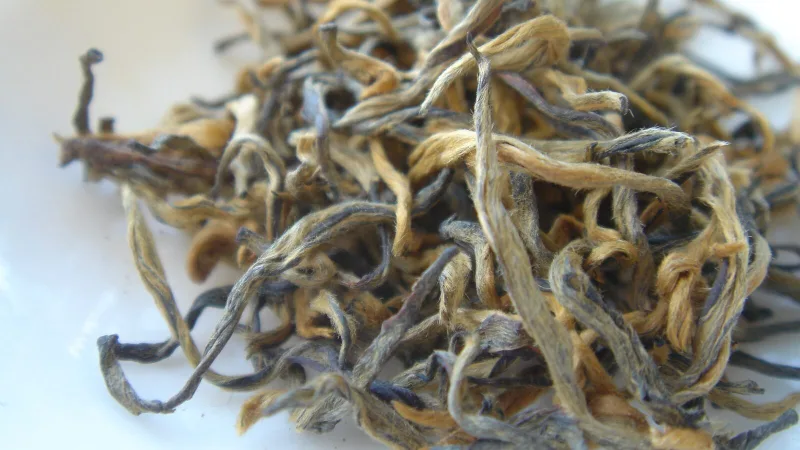
- twisted, with golden buds
- Liquor:
- honey, malt, dried fruit
Dian Hong is a black tea from Yunnan. The name joins Dian, the ancient name of the province, and hong, "red". It was first made in Fengqing County, Lincang Prefecture, in the west of the province.
The leaf comes from the Yunnan large-leaf variety, da ye zhongda ye zhongLarge-leaf variety of the tea plant, the Yunnan form of assamica: big, fleshy leaves and buds in thick down.. Its leaves are big and fleshy, and its buds are covered in thick down. After oxidation the down turns gold. This is jin haojin haoGolden down: the fine hairs on the buds, which turn gold during oxidation and drying., "golden down", and it makes Dian Hong easy to recognize even in the dry leaf.
Since the 1930s
For centuries Yunnan made pu-erh and sun-dried green tea. Black tea arrived late.
In 1938 the tea specialist Feng Shaoqiu came to Shunning County, as Fengqing was then called. He made trial batches of black tea from the local large-leaf variety, and in 1939 the first shipment of Dian Hong went to London via Hong Kong. Fengqing is still the main area for this tea, though it is now also made in Pu'er, Baoshan and Xishuangbanna prefectures.
How it is made
For gongfu Dian Hong, pickers take a bud with one or two leaves; for Jin Ya, only buds, the best of them picked in spring. First the leaf is withered until it loses some moisture and goes soft. Rolling then breaks the cells, sap comes to the surface, and oxidation begins.
In a warm, humid room the green leaf turns copper-red within a few hours. Drying stops oxidation and sets the gold color of the buds.
Unlike green tea or oolong, Dian Hong skips fixation, so oxidation runs to completion. That is where the liquor gets its color, and why it has no grassy notes.
Large leaf and golden buds
The large-leaf variety gives a dense, full liquor: its leaf holds more polyphenols than the small-leaf varieties of eastern China, such as those used for Anhui's Qimen. The same raw material yields several kinds of Dian Hong.
- Jin Ya, "golden buds": buds only, covered entirely in golden down. The softest and sweetest, with almost no astringency.
- Gongfu Dian Hong: whole twisted leaf with buds. The classic version, with both honey and astringency.
- Broken: finely cut leaf for tea bags and blends.
The gold in the dry leaf tells you how many buds it holds. The more gold, the softer the flavor and the higher the price.
Flavor and aroma
The liquor is copper-red, with a golden ring at the edge of the cup. The aroma brings honey, malt and baked sweet potato, the flavor dried fruit, and more deeply oxidized batches move toward cocoa. The astringency is gentler than in Indian Assam tea, and the sweetness comes through without sugar.
Dian Hong is rarely bitter. Bitterness usually means the water was too hot or the infusion too long, and a single adjustment fixes it.
Pu-erh is made from the same large-leaf raw material, and tasting ripe (shu) pu-erh next to Dian Hong shows how much comes down to processing. Microbial fermentation takes the leaf toward earth and wood; oxidation by the leaf's own enzymes gives honey and dried fruit.
Keep dry Dian Hong in a closed jar, in the dark and away from strong-smelling food. Black tea keeps better than green, but its honey aroma is brightest in the first year after harvest. After that, malt and dried fruit remain.
How to brew
A 120 ml gaiwan and short infusions, gongfu cha style, work best. Pour each infusion straight into a fair cup so the leaf doesn't overbrew. The water should be soft and fresh: in hard water black tea forms a film on the surface and the flavor goes flat.
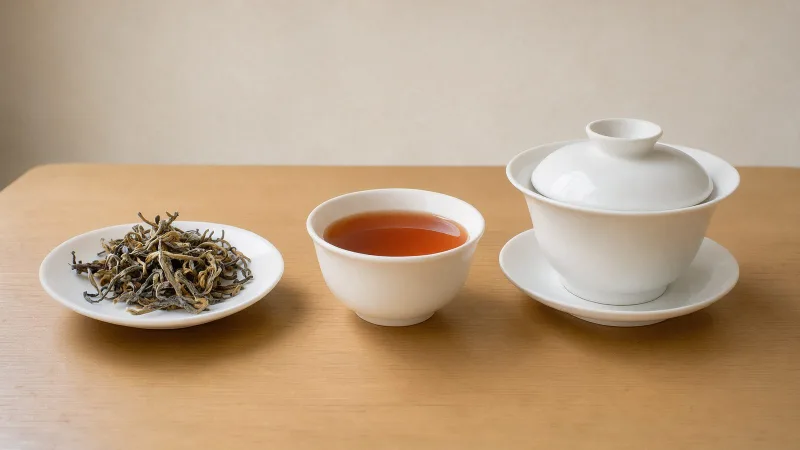
5 g of leaf per 120 ml, water 90 °C (194 °F), 85 °C for Jin Ya. First infusion 10 seconds, each one after that 5 seconds longer. The leaf lasts 5–7 infusions. For a Western teapot, use 3 g per 250 ml and steep 3–4 minutes.
Jin Ya buds are easy to overheat: boiling water pulls out their sweetness fast, and bitterness right after it. Gongfu Dian Hong handles hotter water and longer infusions, which makes it a good place to start.
Common questions
Why does Dian Hong have golden buds?
The buds of the large-leaf variety are covered in thick down. During oxidation and drying it turns gold. The more gold in the dry leaf, the more buds it contains and the softer the liquor.
How many times can you brew Dian Hong?
In a 120 ml gaiwan with 5 g of leaf at 90 °C you get 5–7 infusions. In an ordinary teapot you brew the leaf once or twice, 3–4 minutes each time.
Can you drink Dian Hong with milk?
Yes. The dense liquor of the large-leaf variety holds its own against milk. Use gongfu or broken Dian Hong; Jin Ya is best drunk straight.