Tea in Iran and Afghanistan
Iranians drink only black tea: a strong brew steeps in a guriguriA small teapot (Persian qūrī). It sits on a ketri or samovar and holds a strong brew that is cut with hot water later, in the glass. over boiling water, each glass is cut to taste with hot water, and people hold the sugar in their mouths. Afghans also drink green tea, with cardamom.
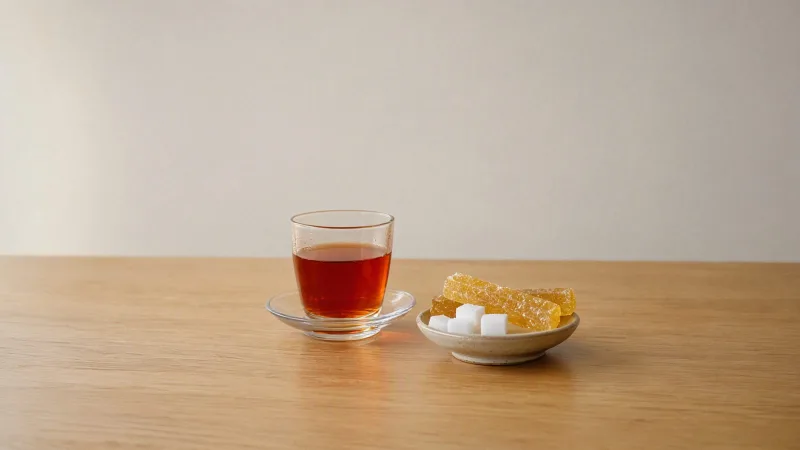
- Tea in Iran:
- black, no milk
- Method:
- strong brew in a guri, diluted with hot water in the glass
- Vessels:
- guri, ketri or samovar, estekan on a saucer
- Sugar:
- qand-pahlu: a lump in the mouth, tea sipped through it
- Home-grown tea:
- Gilan and Mazandaran, since the early 20th century
- Afghanistan:
- green and black, with cardamom, from piala bowls
In an Iranian home a ketri of boiling water sits on the stove, and a small teapot rides on top of it. The host pours a little strong brew into the bottom of a glass, fills it up with hot water, and sets a lump of sugar on the saucer. Nobody is going to stir it in.
The guri on the ketri: kit and method
Black tea is brewed in a guriguriA small teapot (Persian qūrī). It sits on a ketri or samovar and holds a strong brew that is cut with hot water later, in the glass., a small lidded pot. It stands on a ketri, an ordinary kettle, or, in the north where Russian influence is stronger, on a samovar, where steam from the central pipe warms the pot from below. The samovar itself brews nothing; it just keeps the water at a boil. Russian tea drinking works on the same two-step principle.
People drink from an estekan, a tulip-shaped glass set on a saucer called a nalbeki. Estekans come in sets of six, and a set is a standard part of a dowry, along with the samovar, ketri and guri. The “kamar-barik” (“thin-waisted”) glass pushed out the early cylindrical ones and later gained a gold rim and band.1
Use fresh cold water: Iranian recipes say water boiled many times makes the tea “lifeless”.
- Warm the guri with boiling water and pour it out.
- Add black tea: about 1 teaspoon per glass, 2 tablespoons for six.
- Pour in boiling water: to 1/3–1/4 of the pot according to Tehran Times, almost to the top in Menujat recipes.
- Set it on the ketri or samovar over low heat for 10–15 minutes. It must not boil. Some sources give 15–30 minutes for small-leaf Iranian tea and 30–45 for long leaf (galam).
- Pour a little brew into the glass and top up with hot water to a deep color (por-rang) or a pale one (kam-rang).
A brew left for more than about half an hour turns bitter and dark; it counts as spoiled, and a fresh pot is made. The sources give spoons, not grams, so the amounts here stay in spoons. As with Russian zavarka, one guri lets everyone at the table drink tea at the strength they like.
Sugar: qand, nabat and the signals of etiquette
Sugar here is part of the method, not an extra. Drinkers put a lump of qand in the mouth and sip the tea through it. This is qand-pahluqand-pahluDrinking tea with a lump of sugar in the mouth (“sugar on the side”): the lump goes in the cheek and the tea is sipped through it. In Fars the same habit is called deshlemeh., “sugar on the side”. In a 1970 survey, 82% of Iranians drank it this way, averaging 8–9 glasses a day. People preferred chipped lumps to factory sugar, which melted too fast. Sugarloaves (kalleh-qand) were broken up with a small adze called a qand-shekan.
Some regions do it differently. On the Caspian coast and in Kurdistan sugar goes into the glass. In Gilan and Mazandaran people crumble dried lime into the glass, in Fars they squeeze in fresh lime juice. The Baluch Dashtiari near the Pakistani border add milk. Tea comes with nabat, rock candy on a string or stick, often saffron-flavored, and with thin pulaki candies. Dissolved in tea, nabat is a home remedy for stomachache.
Glasses also carry messages. An estekan turned upside down and covered with the saucer means “no more”. In some places, when a suitor comes to propose, the girl's family sets two glasses in front of him to say no. The Qajar-era traveler Colliver Rice noted that a third glass was a polite hint to leave. Herders and farmers in Semnan never pour a guest's tea into a cold glass: they rinse the estekan in warm water first.
From coffee to tea: the qahveh-khaneh
Persia drank coffee until the first half of the 19th century. Coffeehouses appear in sources under Shah Abbas I (1587–1629). In Isfahan they ringed Maydan-e Shah square: vaulted halls with a pool and raised platforms along the walls. Abbas had mullahs keep an eye on them because people talked politics there too much. Storytellers recited the Shahnameh, and in the month of Muharram they staged the martyrdom of Imam Hussein.
In the first half of the 19th century the country switched to tea almost overnight. Rudi Matthee ties this to the price and availability of the drink and to whether the drinkers lived in the north or the south. In 1850 the prime minister Amir Kabir received two tea sets with silver samovars from the French government and another from a Russian merchant, and gave an Isfahan craftsman a monopoly on samovars. After Amir Kabir fell, the craftsman was made to return the money. The name qahveh-khaneh, “coffeehouse”, stayed with the teahouse: among Tehran's coffeehouses under Naser al-Din Shah only one really served coffee.
Around 1929 Tehran had about 711 coffeehouses. Then came radio (1940) and television, the storytellers faded, and so did coffeehouse painting, in which Hossein Qollar-Aqasi and his pupil Mohammad Modabber painted scenes from the Shahnameh for teahouse walls. In 2011 UNESCO put naqqali, Iranian dramatic storytelling, on its list of intangible heritage in need of urgent safeguarding, citing the decline of coffeehouses as one of the causes. Today a coffeehouse offers a water pipe and tea made “the Russian way” over a samovar, and rarely any coffee.
Home-grown tea from Gilan
Iran imported Indian tea until Mohammad-Mirza Qajar, Kashef al-Saltaneh (1865–1929), went to study tea growing in India. He stayed from November 1898 to July 1900, brought back about 3,000 Assam seedlings with seeds, and planted them near Lahijan. Iranica dates the planting to 1902, other studies to 1900, and it describes the export of the plants as smuggling. By 1903 Lahijan had 300,000 bushes, but growth was slow: 100 ha in 1920, about 800 ha in 1931.
Things picked up once the first tea factory opened (1932) and the research station at Lahijan followed (1934). Planted area grew from 1,220 ha in 1932 to 7,000 in 1941 and 24,000 in 1968. Today Gilan and Mazandaran produce 90% of Iranian tea, and three eastern districts of Gilan (Lahijan, Langarud and Rudsar) account for about 75% of the plantings. Lahijan has the mausoleum of Kashef al-Saltaneh and the National Tea Museum, with 532 registered objects.
Local grades have their own names. Sargol is the bud and top leaves, momtaz “select”, shekasteh broken, galam a long wiry leaf with stalk, hakeh dust for tea bags. Spring-flush tea, bahareh, is prized for aroma. But these names are not standardized, and “momtaz” from two factories can differ a lot.
Iran does not grow enough. According to a 2024 estimate by the head of the Iran Tea Organization, the country drinks about 100,000 t a year and produces about 30,000 t. In 2026 the agency put import needs at roughly 50,000 t. One known fraud is spent tea leaves, dried and passed off as fresh tea. The standard INSO 623 bans any colorants or flavorings in plain black tea.
Afghanistan: piala, cardamom and the sweetest first cup
Afghanistan grows no tea: a 1960s attempt in the Kunar valley failed for lack of rain. Tea used to come from China via Bukhara, as green tea, and in the 20th century India became the main supplier. The habit took hold earlier than in Iran: in 1831 Alexander Burnes wrote of Kattagan that “nothing is done here without tea”.
Afghans drink both green and black. Green, chai sabz, counts as “cold” and is drunk mostly in summer; black, chai siyah, is “hot” and wintry, though many drink it all year. Tea is served in a teapot, a chainak, and drunk from small handleless bowls called piala. Helen Saberi also describes istakhan glasses and Chinese or Japanese porcelain. Cardamom is added either as seeds sprinkled into the poured tea or as a lightly crushed pod dropped into the pot.
The piala is first rinsed with tea, then granulated sugar goes in and the tea is poured over it. Sugar is not added again, so the first refills are sweet (chai-e shirin) and later ones turn more bitter (chai-e talkh). A guest gets a very sweet first cup: the more sugar, the greater the honor. Anyone who has had enough turns the cup over; otherwise the host keeps pouring. In winter tea comes with gur, lump cane sugar, and with noql, sugared almonds, chickpeas or apricot kernels.
For weddings and engagements, qaymaq chaiqaymaq chaiAfghan festive tea made from green leaf with baking soda, milk, sugar and cardamom, topped with qaymaq, thick clotted cream. is brewed from green leaf. Saberi's recipe calls for 6 teaspoons of tea to 680 ml of water, boiled for about 5 minutes, then a quarter teaspoon of baking soda and a couple more minutes on the heat. The brew is poured from a height between two pots over ice until it turns dark red, and after the milk (280 ml) it goes pink. It takes 4–8 spoons of sugar and 1–2 of cardamom, and each cup gets two spoons of qaymaq on top. Milk tea is an exception here: shir chai is common only in the Pamir.
An Afghan teahouse is called a samavar, not a “coffeehouse”, and has the same boiler. In the late 1970s Kabul had 182 tea merchants and Kandahar 89. Farther north, tea is drunk in the chaikhana, from a piala, while Iran's neighbors in Turkey and Azerbaijan have customs of their own. The Iranian tradition rests on black tea.
Common questions
Why do Iranians hold sugar in the mouth instead of stirring it in?
It is simply the custom: in a 1970 survey, 82% of Iranians drank tea this way. A hard lump melts slowly, so sweetness comes with every sip. Factory-refined sugar dissolved too fast, so people kept chipping lumps off the sugarloaf. On the Caspian coast and in Kurdistan, sugar goes straight into the glass.
Do Iranians drink tea with milk?
No. The exception is the Baluch Dashtiari near the Pakistani border. In Afghanistan milk tea is also rare: qaymaq chai is made for weddings and engagements, and salty shir chai is common only in the Pamir.
Why is an Iranian teahouse called a “coffeehouse”?
Coffee was the main drink of Persia until the first half of the 19th century, and teahouses inherited the name: qahveh-khaneh. Today such a place usually serves no coffee, only a water pipe and tea from a samovar.
-
Iranica derives “estekan” from the Russian stakan. The Iranian encyclopedia of folk culture gives another version: the word is Iranian, from dustakan (“cup of wine”), passed into Russian in the 16th century and returned to Persian in the 18th and 19th. The sources disagree. See Encyclopaedia Iranica, “Čāy (Tea)”. ↩