Huangshan Mao Feng 黄山毛峰
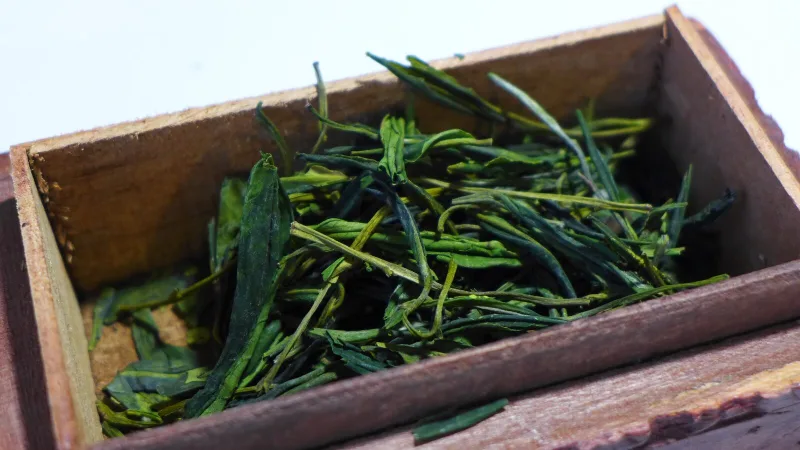
Anhui's leading green tea is picked on the slopes around the Huangshan mountains. The leaf is fired briefly in a wok and finished over a fire in bamboo baskets, so the flavor is soft and sweet, with a note of orchid.

- Province:
- Anhui, Huangshan prefecture
- Processing:
- hong qing: fixed in a wok, dried over fire
- Plucking:
- a bud with one or two leaves
- Leaf shape:
- straight, slightly curved, downy
- Harvest:
- Qingming to Guyu, top grade earlier
- Taste:
- soft, sweet, orchid and chestnut
Huangshan Mao Feng (黄山毛峰) translates as "Downy Peaks of the Yellow Mountain". Huangshan is a mountain range in southern Anhui. Mao feng describes the leaf itself: buds in white down, with tips as sharp as mountain peaks. It is the province's best-known green tea and a model of hong qinghong qingA green tea that is fixed in a wok and then dried with hot air or over a fire instead of being finished in the wok. Its flavor is softer, without the toasty note.. The leaf spends only a short time in the wok and is finished over a fire. Wok-fired Longjing and Bi Luo Chun smell of hot metal; Mao Feng is softer and more floral.
Huangshan and old Huizhou
The Huangshan mountains have been a UNESCO World Heritage Site since 1990, and the highest peak, Lianhua, rises to 1864 m. Tea grows below the rocky summits, on the slopes and in the valleys around them. There is mist almost every morning, the town of Tangkou gets about 2000 mm of rain a year, and the soil is acidic, on weathered rock.
These lands once formed Huizhou prefecture. Huizhou merchants carried salt and tea across China, and from the 18th century they also shipped tea abroad. The prefecture's chronicle traces local tea back to the Jiayou years of the Song dynasty (1056–1063) and places its heyday in the Longqing years of the Ming (1567–1572)1.
Under the standard, tea from the whole of Huangshan prefecture may be called Huangshan Mao Feng: the Tunxi, Huangshan and Huizhou districts and the counties of Shexian, Xiuning, Yixian and Qimen. It is a large industry. In 2022 the prefecture harvested 45,000 tonnes of tea2. Within the prefecture the most prized are small zones right by the mountains, above all Fuxi township and the town of Tangkou at the southern entrance to the reserve. The bushes there are mostly local and seed-grown.
Xie Zheng'an and 1875
Mao Feng is younger than Longjing and Bi Luo Chun. It is credited to Xie Zheng'an, a native of Caoxi village in Shexian county, now part of Fuxi township. He was born in 1838 into a tea family and ran a tea shop called Xie Yuda. Around 1875, in the first years of the Guangxu reign, he began picking a bud with one leaf on the high slopes, processing it in a new way and taking it to Shanghai. The downy tea with sharp bud tips came to be called mao feng, and, after its home, Huangshan Mao Feng.
In Anhui his method is retold in four short phrases: fire in the wok, roll lightly, dry the damp leaf, cover with a round sieve and finish drying. In 2008 the technique was added to China's national list of intangible cultural heritage. In 2022 it became part of the nomination for traditional Chinese tea processing, which UNESCO inscribed on its list.
Wok, basket, fire
The fresh leaf is spread thin and left to wither for several hours, then fixed in a deep wok about 50 cm across. With one hand the master quickly tosses the leaf and scatters it over the walls so it heats evenly, and scoops out every last leaf, since anything left behind will scorch. The heat is high at first, then lowered.
Next comes the step that sets Mao Feng apart from its neighbors. The top grade is barely rolled: the leaf is squeezed by hand a few times right in the wok, and that is all. Plainer leaf is rolled lightly between the palms for a minute or two after the wok. The bud stays whole, and the down stays on.
Drying takes two stages. First the leaf goes into bamboo baskets set over braziers and is dried quickly on high heat. Each wok serves four baskets, and the heat drops from the first basket to the last. Then several batches are combined and slowly finished at 60 °C under a round bamboo sieve. While still hot, the finished tea goes into tin canisters, which are then sealed.
In wok-fired tea the aroma comes from the heat of the metal; in hong qing it comes from slow drying. That is why Mao Feng lacks Longjing's toasty note. Its liquor smells of orchid and fresh chestnut, and it tastes sweet.
Sparrow's tongue and fish leaf
Top-grade leaf is straight, slightly curved, and shaped like a sparrow's tongue. Its color is ivory with a hint of green, and the buds are downy. At the base of many shoots sits a small yellow leaf, yu yeyu ye"Fish leaf": the first small leaf at the base of a spring shoot. In Huangshan Mao Feng it is golden yellow and marks an early picking.. In Anhui it is called the "golden flake" and is read as a sign of early spring picking. Mao Feng makers prize it, while sorters of Bi Luo Chun pick it out.
There are six grades: three tiers of top grade and three ordinary ones. Top grade is picked around Qingming (April 4–5), a bud with a barely opened leaf. Ordinary grades come closer to Guyu, around April 20, with one or two leaves or more. Their leaf is larger with less down, and the flavor is plainer and stronger.
The liquor is clear, pale yellow with a green tint. Steam rises over the hot glass, and descriptions of this tea call it "mist over the peak". The taste is soft and sweet, almost without bitterness, with a light coolness in the finish.
Tea from neighboring provinces also turns up under the name. It gives itself away with an even, bright green color, bare buds without the fish leaf, and a price too low for an early picking.
How to brew
People often brew Mao Feng in a glass or a white porcelain cup: 2–3 g per glass, water at 80 °C, two or three top-ups. The leaf is light and loose, and if you drop it onto water it floats for a long time. So pour in a third of the water first, add the tea, and top up once the leaf is wet. Dense Bi Luo Chun, by contrast, is scattered onto a full glass.
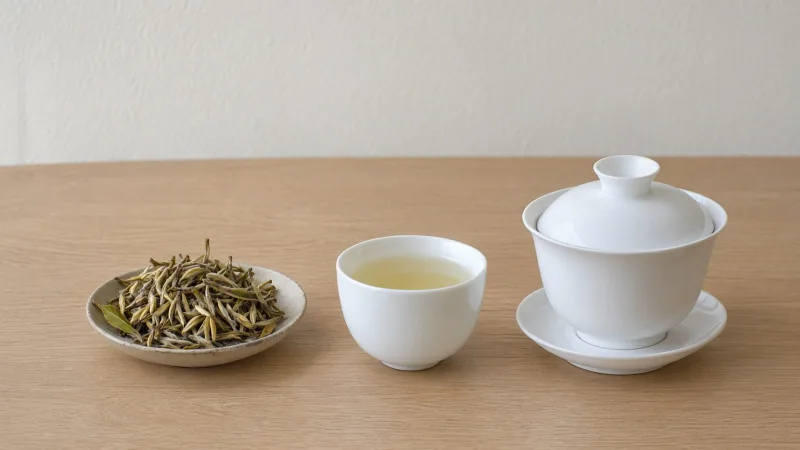
In a gaiwan, short infusions show more clearly how the orchid gives way to sweetness.
4 g of tea per 100 ml, water at 85 °C (185 °F). There is no need to rinse the leaf: the first infusion is the most fragrant. Pour it off after 20 seconds and give each next one 10 seconds more. Keep the lid pushed aside so the buds do not stew. Good leaf gives four or five infusions.
Use soft water: in hard water the orchid is the first thing to go.
Qimen county, in the same prefecture, makes the black tea Qimen (Keemun), called hong cha, "red tea", in China. The mountains are the same, but the leaf is fully oxidized. And in western Anhui, in the Dabie mountains, they pick the yellow tea Huo Shan Huang Ya.
Common questions
How is Huangshan Mao Feng different from Longjing?
Longjing is fired in the wok until done and pressed into flat blades, hence its toasty chestnut note. Mao Feng is only fixed in the wok and then dried over a fire in baskets. The leaf stays almost straight and downy, and the flavor is softer and more floral.
What are the yellow leaves in Mao Feng?
That is yu ye, the fish leaf: the first small leaf at the base of a spring shoot. Top grades keep it, and its golden color next to the bud points to an early picking. It is not a defect or old leaf.
Can Mao Feng be brewed with boiling water?
Top grades are better brewed with water at 80–85 °C: boiling water scalds the bud, and bitterness takes the place of orchid. The larger leaf of ordinary grades tolerates hotter water, up to 90 °C.
-
Huizhou Prefecture Chronicle, quoted from the reference book Zhongguo ming cha zhi (Famous Teas of China). ↩
-
Huangshan Municipal Financial Supervision Bureau, as reported by China Securities Net on April 11, 2023. ↩