Caring for teaware and seasoning a teapot (yang hu) 养壶
Porcelain and glass wash like any other dish. Unglazed clay is different: it soaks up dish soap as readily as it soaks up tea. Yang hu, “raising” a teapot, comes down to daily drying, not ritual.
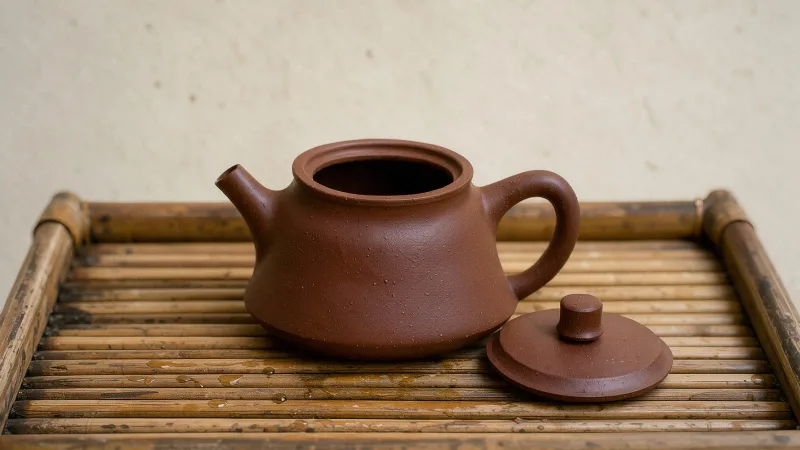
- Unglazed clay:
- water only, no detergent
- Zisha water absorption:
- up to 6.0% under GB/T 10816-2024
- After a session:
- empty the leaf, rinse, dry open
- Rest for a pot:
- a few days after 10–15 days of use
- Repair:
- metal staples (ju ci) or urushi lacquer (kintsugi)
There are two ways to care for teaware. Glaze keeps water out, so you can wash a porcelain gaiwan or a glass fair cup with soap and a sponge. Unglazed clay lets water in: its fine pores soak up everything from tea tannins to lemon dish gel. Most of what follows is about clay.
What absorbs and what does not
China's national standard for zisha allows teapots and cups to absorb up to 6.0% of their weight in water.1 For ceramic that is a lot: some of that water carries smell into the wall, and the next infusion picks it up again. Japanese sellers say the same of Tokoname kyusu: the fine pores of the stoneware draw in tea and detergent alike.
| Ware | Detergent | What to expect |
|---|---|---|
| Yixing teapot, unglazed kyusu | no | odor, mold, uneven patinapatinaA thin, even gloss that unglazed clay builds over years of washing and wiping (包浆, bāojiāng). |
| Porcelain, glazed ceramic, gaiwan | yes | tea scale, chips |
| Crackle glaze | gently | tea stains the cracks, and the color does not wash out |
| Bamboo and wood tray | carefully | mold, glue seams that split |
Crackle sits in the glaze only, and the fired body underneath is sound, so the idea that crackle is unhygienic is a myth. On a low-fired body, though, moisture lingers in the cracks, so dry such cups thoroughly. Cold water on hot ware does not make crackle, either. It just breaks the cup.
A new pot: opening it
Opening a pot (kai hu, 开壶) starts with an inspection. Check for chips, cracks, glued handles and metal fittings before any water touches it, because glue can let go in hot water. After that, opinions split.
The gentlest method is rinsing. Rinse the new pot inside and out four times with warm water, then four times with near-boiling water. Sellers who oppose boiling altogether consider this enough. One step up is a hot soak: an hour with the lid on in a bowl of very hot water.
Boiling is the most common approach: cold water, a cloth on the bottom, pot and lid apart, low heat. The short version takes 5–10 minutes, then as long again with tea. The “traditional” one runs longer: two hours in water that covers the pot, then an hour each with tofu and with cane sugar, and tea at the end. Fans say the gypsum in tofu calms the clay's “fire qi.” There is no evidence for it. Two Western experts warn against boiling. One of them damaged two pots that way, and both point out that a rolling boil shakes the pot, which puts the spout tip and lid rim at risk.
A middle path is to start in cold water, heat slowly and turn off the heat just before the water boils. That leaves the smell of fresh clay, which goes away if you soak the pot for a few hours in brewed tea or spent leaf of the tea you bought it for. One seller points out that a pot you are told to soak in tea before its first use may be too porous, which means poor clay.
Inspect. Rinse four times with warm, then four times with hot water. Soak in spent leaf if you like. Take it out, rinse, and dry with the lid off.
Every day: empty, rinse, dry
The rules are short, and everything else rests on them.
- Empty the leaf at once. Around 1640 Zhou Gaoqi wrote that a pot should be washed as soon as it is empty, and he mocked the belief that tea in a Yixing pot does not turn overnight: “after a few ke the tea is already spoiled.”
- Rinse with hot water, no detergent.
- Leave it open to dry, lid beside it or on its side, until the inside is dry. Close it only when dry. To check, leave a paper napkin inside overnight.
- Avoid pouring water over the pot when there is no need. Hard water leaves a ring of mineral deposits along the lid's edge, and evaporation cools the walls. Choosing water for tea is a topic of its own.
Wet leaves in a closed pot turn to slimy jelly and mold within a couple of days. The belief that leftover leaves “feed” the clay is wrong.
Dry a Tokoname kyusu upside down with the lid off, so no water stands in the filter. In the morning, before the first brew, pour boiling water over the filter for 1–2 minutes to rinse out yesterday's leaf and smell. Peel off the clear film on the spout. It is there only for shipping, and scale and odor collect under it. Once the filter is dry, clean it with a soft brush, and never poke the holes with a toothpick.
Yang hu: how patina forms
The word “raising” (养壶) names a process that mostly happens by itself. Over years of use, unglazed clay takes on a thin, even gloss, the patina, called baojiang (包浆) in Chinese. In Yangxian Minghu Xi Zhou Gaoqi writes that a pot, after long washing and wiping, “gives off a restrained glow on its own.” He calls a sticky, greasy, spotty film monk shinemonk shineA greasy, sticky gloss with spots from uncleaned residue (和尚光, héshang guāng). Zhou Gaoqi called it the lowest kind of shine in the 1640s. and ranks it the lowest kind.
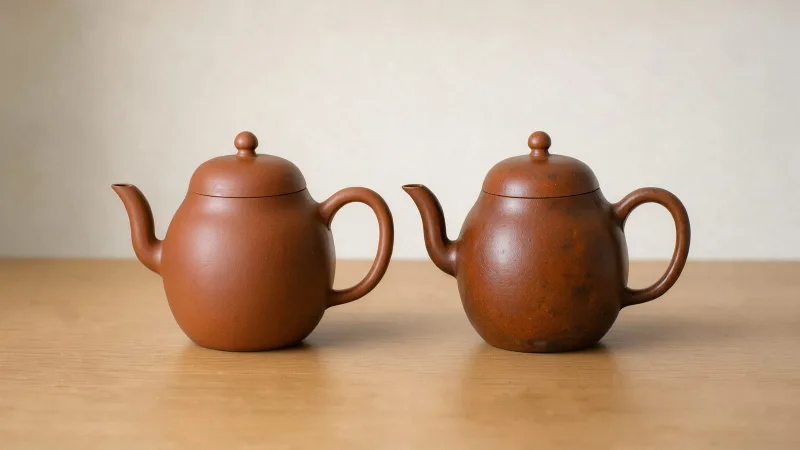
Hence two schools. Followers of “inner raising” keep tea inside the pot and only wipe the outside. Others pour tea over the pot during a session; the Chinese portal Zisha Zhi Jia calls this a mistake in some texts and allows it “lightly” in others. The master Lu Shouchen wipes a hot wet pot with a cloth dampened in cold water, and a dry pot only with a dry cloth, since a wet cloth leaves dull streaks on dry clay. The Western collector MarshalN hardly polishes at all, wary of monk shine. They all agree on one thing: use the pot often and let it dry completely. Don't coat it with wax or oil to speed up patina.
A pot also needs rest. Lu Shouchen suggests that after 10–15 days of daily use you wash the pot, dry it and leave it alone for a few days.
The rule “one pot, one tea” (一壶不侍二茶) is based on the idea that clay holds on to the smell of the previous tea. Zisha Zhi Jia insists on it. Lu Shouchen, MarshalN and the shop Mud and Leaves call it optional: dedicate a pot to a broad family (oolong, puer, black, green) and try different teas within it. Crackle ware darkens faster with dark teas.
Odor, scale, mold
What follows is advice from sellers and hobbyists, not test results. The simple fixes first.
A faint musty smell goes away after a few fills of boiling water: pour in, swirl, pour out. For a foreign smell, brew tea in the pot for 2–3 days and do not drink it. A pot that still smells of plastic or chemicals after cleaning is best retired, since the clay may be fake or contain additives.
Test an old or second-hand pot with boiling water: fill it for 10 seconds, then pour the water into a white cup. Yellow or brown water, or a smell of old tea, cardboard or damp, means it needs a full clean. One English shop recommends oxygen bleach (percarbonate) or wood ash, an 8–12 hour soak and 2–4 cycles in clean water, but rules out chlorine bleach. If the mold smell survives 4–5 cycles, retire the pot. Citric acid and bleach take the patina off along with the mold.
Only some Chinese portals recommend baking soda for zisha. It soaks into the pores just as detergent does, so water and time are the safer choice for Yixing clay.
Kyusu are easier. For routine cleaning, put one in cold water on a cloth, boil it for 5–15 minutes (usually 5) and let it cool in the water. For mold and a sour smell, Japanese sellers recommend a teaspoon of baking soda per saucepan and a gentle simmer of 5–10 minutes, then a second boil in clean water. Opinions on bleach split: one pottery suggests about 1% overnight, others forbid it.
A tea portal claims that scale contains lead, cadmium and arsenic, but cites no original source, so it cannot be treated as fact.
Trays and repairs
Empty the reservoir of a tea tray right after the session, then wipe and dry both sides. Cold tea left in the tank grows a biofilm within days. Laminated bamboo softens from constant damp and splits along the glue seams, and solid wood warps. Oil wood with food-grade oil, and do not pour boiling water on melamine.
In China, broken ware was held together with metal staples, ju ci (锔瓷). The mender drills paired dovetail holes on both sides of the crack, two-thirds of the way through the wall, and sets staples of malleable metal into them. The character 锔 appears in a dictionary of 543, and the earliest known ceramic example with holes for iron staples is a vessel from a tomb dated 699. Staples are irreversible and poorly suited to thin walls. Never boil glued or stapled pieces on the stove; soak them in hot water in a bowl instead.
Japanese repair works differently. The shards are glued with urushi lacquer mixed with flour, and the seam is coated with lacquer and gold, silver or platinum powder. Lacquer repair takes longer, but it does not damage the piece. The word “kintsugi” does not appear in sixteenth-century tea records, and no document supports the legend that shogun Ashikaga Yoshimasa invented it.
Makers consider real urushi food safe once fully cured. Curing takes about a month at 20–25 °C and 70–80% humidity, and the piece should not be used until a month after the repair is finished. Epoxy kits and brass powder are not considered food safe. There is no independent testing of the seam. Wash by hand with a soft sponge, and keep it out of the dishwasher, microwave, oven and open flame.
Common questions
Should I boil a new Yixing teapot with tofu?
No. It is a disputed recipe from sellers and hobbyists with no evidence of benefit, and some experienced drinkers have damaged pots this way: a rolling boil shakes the pot and puts the spout tip and lid rim at risk. Rinsing it four times with warm water and four times with near-boiling water, then drying it with the lid off, is enough.
Can I wash a clay teapot with dish soap?
Not an unglazed one. The porous clay absorbs the smell, and it comes out in the next infusion. Porcelain, glazed ceramic and glass can be washed as usual. If detergent gets into a Japanese kyusu, fill it with hot water and pour it out 3–4 times, then simmer it in clean water if needed.
Is it safe to drink from kintsugi repairs?
It depends on the materials. Makers of real urushi lacquer call a fully cured seam food safe; epoxy kits and brass powder are not, and one US restoration workshop advises against drinking from any repaired ware. No independent testing of the seam was found.
-
GB/T 10816-2024 “Zisha ware,” in force since July 1, 2025, replacing the 2008 edition. It also requires that a filled pot not leak for 24 hours and that the lid stay on when the pot is tilted 70°. ↩