Chaozhou gongfu cha 潮州工夫茶
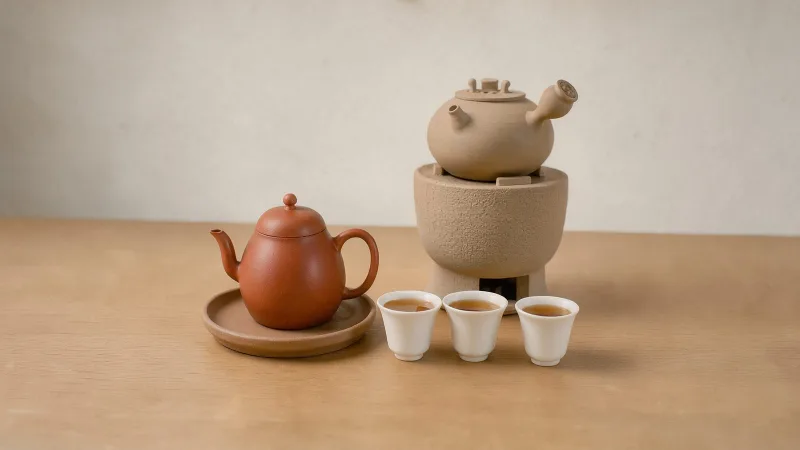
This is how oolong is drunk in Chaoshan, in eastern Guangdong: a tiny pot, three cups with no fair cup, and a charcoal stove. The rite was described in 1801 and has been on a UNESCO list since 2022.
- Homeland:
- Chaoshan, eastern Guangdong
- First account:
- Yu Jiao, 1801
- Set:
- the “four treasures”
- Cups:
- three, 25–35 ml each
- Standard:
- T/CTSS 5-2019, 21 forms
- Heritage:
- China 2008, UNESCO 2022
Everyone in Chaozhou drinks tea, and everyone drinks it the same way: at a low table in a shop, at the market, at home. Three cups are enough for any company, the pot is the size of a walnut, and the water boils on a charcoal stove. Locals say “潮州无茶馆”: Chaozhou has no teahouses, because every shop has a tea table of its own.
For step-by-step brewing, see gongfu cha. The Chaozhou rite has a story of its own: where it came from, what it consists of, how standards fixed it, and why the world heard about it in 2022.
What the record shows
Yu Jiao left the earliest detailed description under the name “工夫茶” in 1801, in his notes Mengchang zazhu (梦厂杂著). He lists a white-clay stove 1.2–1.3 chi high, a Yixing pot, painted cups, a clay kettle, a fan and tongs. Water is brought to the first boil, leaf goes into the pot, hot water goes over the lid, and the tea is sipped in small mouthfuls. On the boats, Yu Jiao writes, people value only Wuyi tea.
Earlier still, the same objects turn up in southern Fujian. A Zhangzhou gazetteer compiled by the winter of 1714 calls for “a Dabin pot, Ruoshen cups, a Dazhuang stove.” The quote comes from the Japanese researcher Liu Changyun and has not been checked against the gazetteer itself. The 1758 tomb of Lan Gouwei in Zhangpu held a pot, four cups stamped “若深珍藏,” a tray and a tin caddy. That is a full gongfu set half a century before Yu Jiao. Chaozhou merchants carried Wuyi oolong from Fujian in the Qianlong and Jiaqing eras, and by 1801 the method had taken shape in Chaozhou.1
The roots are in Fujian, not in the Tang. Chen Xiangbai, a recognized bearer of the tradition, traced gongfu back to Lu Yu and Tang boiled tea. The anthropologist Peter d'Abbs calls this thesis an “invented tradition”: there is no evidence, and Yu Jiao mentions Lu Yu in a single sentence. Official UNESCO and city texts say “since the Song.” Ye Hanzhong, lead author of the local standards, dates the settled form of the rite to no later than the second half of the 18th century.
Today's account of the rite goes back to Weng Huidong's Chaozhou Tea Classic, written in 1957 and left unfinished. Weng was born in 1885 or 1886 and died in 1963 or 1965 (sources disagree). The book covers tea, water, fire, utensils and eight brewing steps. Before 1949 gongfu belonged mostly to officials, scholars and merchants, and to entertainment venues. It became an everyday thing in ordinary homes only in the 1980s.
The four treasures
The set is called “茶器四宝,” the four treasures. The classic list in the literature:
- The Mengchen pot (孟臣罐). A small brewing pot. The name, taken from the Yixing master Hui Mengchen, who lived in the late Ming or early Qing, later came to mean any small pot. A “孟臣” mark on the base indicates a type, not a maker or an age: many generations of potters stamped it.
- Ruoshen cups (若深杯). Thin white cups of 25–35 ml, traditionally three. Nobody knows whether Ruoshen was a man, a shop or an auspicious phrase, and the legend of a Jingdezhen potter who leapt into the kiln is unconfirmed. The literature and the standard more often write “若琛,” Ruochen, a spelling that probably first appears in Zhang Xintai in 1899.
- The Yushu water kettle (玉书碨), also called the sha diao. Its sandy clay can stand a direct flame.
- The Chaoshan stove (潮汕炉). A narrow clay stove with an adjustable draft, fired with hard charcoal, including charcoal from the pits of the black olive (乌榄).
Sources disagree about what makes up the four.2 The standard of the Chinese Tea Society names the pot, the cup, the sha diaosha diaoA flat clay kettle with a side handle, 300–500 ml. It sits directly on the coals, and its lid starts to rattle when the water boils. and the stove, while the 2021 group standards merge the pot and the gaiwan. One antiques dealer says that in some lineages the stove and kettle count as one object and the tea boat is the fourth.
Pots were made in Yixing and in Chaozhou itself, where potters pull them by hand: the shoula technique. Volumes differ between documents: 90–150 ml (the optimum is 120 by T/CTSS and 110 by the 2023 local standard) and 60–160 ml in the group standard. The kettle holds 300–500 ml, and the stove is 12–20 cm across.
Beyond the four treasures there is the rest of the table: a dish for the cups, a saucer under the pot with a loofah pad, three basins for bathing the pot, spare cups and spent leaf, a goose-feather fan, copper tongs and a scoop for the charcoal, and paper on which the leaf is warmed. Weng Huidong counted about 18 items and held that without the full set the tea cannot be called “gongfu.”
What sets the Chaozhou way apart
Five features distinguish the Chaozhou method from the rest of gongfu.
Tight packing. The pot is filled with leaf to 70–80% of its volume. The largest leaves go to the bottom and by the spout, the fines in the middle, and slightly larger leaf on top. The result is the “茶胆,” literally “tea galltea gallA capsule of whole leaves packed around fine crumbs in a tightly filled pot. It keeps the small bits from washing into the liquor and the bitterness from coming out. bladder,” or tea gall for short, a capsule of whole leaves around fine crumbs. Water must not be poured straight into the center, or the capsule “bursts” and the liquor turns bitter.
High pour, low serving. Boiling water is poured high, in a circle along the edge. The tea itself is served low.
No fair cup. The cups stand shoulder to shoulder and the pot travels over them in a circle. First each cup is filled halfway, then to 70–80%, and finally the last drops are shared out evenly: “Guan Gong patrols the city” and “Han Xin counts the troops.” Every drop must be poured out, or the next infusion turns bitter. The liquor does not cool and keeps its layers, and the brewer's hand evens out the strength.
Three cups for any number of guests. Three people drink each infusion and the rest wait. The guest of honor takes a cup first; without one, the three to the brewer's left drink, and on the next round “one leaves, the fourth sits down.” The brewer skips the first infusion.
The smell of the empty cup. The tea is drunk hot, in three sips, drawing in air: “喝, 饮, 品.” Then drinkers smell the empty cup.
The word “gongfu” is written 工夫, not 功夫. In the Chaoshan dialect the characters are pronounced differently, and the first means care.
The 21 forms and the standards
Today the rite is written down. In 2015 the city of Chaozhou approved the regulation “潮州工夫茶艺冲泡技术规程” (lead author Ye Hanzhong), which fixed the “21 forms.” In 2017 the same list of steps was also on the Guangdong cultural center's website. Then came:
- T/CTSS 5-2019 of the Chinese Tea Society, in force from December 21, 2019;
- four group standards for the “four treasures,” from August 20, 2021;
- the local DB4451/T 4-2023, in force from October 30, 2023.
The 2019 standard runs from arranging the cups in a triangle and lighting the stove to a bow to the guests. The key steps:
- The leaf is poured onto paper and warmed over the stove, 10–15 cm above the coals.
- The pot and cups are doused, and one cup is rolled inside another in hot water.
- The leaf is packed to 80% of the volume and covered with water to the brim.
- The foam is scraped off with the lid, and the lid is doused.
- The first infusion goes into the cups to warm them and is poured away.
- A high stream, then a low circling pour, the last drops shared among the cups.
- An open-palm gesture, smelling, three sips, smelling the empty cup, a bow.
The city version gives the steps different names, and Ye Hanzhong's simplified 2025 scheme, “three steps, seven methods,” is built on the same 21 forms. The standard sets grams and seconds: a “concentrated” mode of 8 g per 100 ml, 38 seconds for the first infusion and 22–35 for the next ones; a “mellow” mode of 7 g per 120 ml, 38 seconds, then 15–30. The water is boiling, and the general ratio is 1:12 to 1:16.
Other sources give other numbers. Weng Huidong advises the “second boil,” when the water roars like pines. Chaozhou practitioners recommend water “just under a rolling boil” and, in the strict school, stop at three infusions. Folk verse says “the end comes at the fourth,” while dancong, according to Liu Changyun, lasts more than twenty.
Tea, heritage and variants
The main tea of the rite has changed over the last hundred years. Until the mid-20th century Chaozhou drank Wuyi and Anxi oolongs, which both Yu Jiao and Weng Huidong mention. Early in the 20th century oolong production began on Mount Phoenix, and from the middle of the century Phoenix dancong displaced the northern teas. Tight packing suits large twisted leaf, and practitioners believe the method was devised to get a good liquor out of inexpensive tea.
In 2008 “潮州工夫茶艺” entered the second national list of intangible cultural heritage of China (No. X-107). On November 29, 2022, UNESCO inscribed on its Representative List “Traditional tea processing techniques and associated social practices in China,” 44 national items, Chaozhou gongfu among them. In 2022 Chaozhou counted 2 provincial, 5 city and 26 county bearers of the tradition.
Outside Chaoshan the rite takes several forms. Emigrants took it to Singapore, Malaysia and Thailand: Chaozhou families receive guests exactly this way, and Taiwanese masters single out a separate “Nanyang gongfu.” At provincial competitions the Chaozhou team shows “Lingnan gongfu,” which does have a fair cup. In the 1970s Taiwan reworked the rite into Taiwanese tea arts, or chayi, adding a fair cup and a scent cup, partly under the influence of Japanese sencha-do. The wider story of loose-leaf brewing belongs to the Ming and Qing.
One more correction. The fair cup and the scent cup are sometimes passed off as part of the Chaozhou tradition, but they are not used in Chaozhou. They are Taiwanese innovations.
Common questions
How does Chaozhou gongfu cha differ from ordinary gongfu brewing?
The leaf is packed tightly, about 80% of the vessel, and the tea goes straight into three cups with no fair cup. The circling pour is called “Guan Gong patrols the city.” Taiwanese tea arts added a fair cup and a scent cup, which people in Chaozhou do not recognize.
Why “gongfu” and not “kung fu”?
The characters are 工夫, not 功夫, and in the Chaoshan dialect they are pronounced differently. The word means care and time spent, not martial arts.
Which tea is brewed this way?
Today mostly Phoenix dancong: about 90% of drinkers in Chaozhou brew it. Until the mid-20th century they drank Wuyi and Anxi oolongs. The tradition has no parameters for green or white tea.
-
Liu Changyun, “潮州工夫茶の成立に関する考察,” 2023, doi.org/10.15027/53587. ↩
-
Chinese Tea Society, T/CTSS 5-2019 “潮州工夫茶艺技术规程,” ttbz.org.cn. ↩