Jianshui pottery 建水紫陶
Dark red, black and ivory-white teapots from Jianshui county in Yunnan. Potters throw them on the wheel from five local clays, carve the raw body, inlay it with colored clay and polish it without glaze.

- Place:
- Yunnan, Jianshui county, Wanyao village
- Clay:
- five local clays, red and white bodies
- Shaping:
- by hand on the wheel only
- Firing:
- single firing, 1120–1180 °C
- Decor:
- carving on the raw body, colored inlay, polishing
- Typical size:
- 95–105 ml
Jianshui (建水) lies in southern Yunnan, in the Honghe Hani and Yi Autonomous Prefecture. The potters' village of Wanyao (碗窑) is about 2 km from the county seat. This is where zitaozitaoJianshui “purple pottery” (紫陶): an unglazed body of local clays, thrown on the wheel and polished after firing. (紫陶, “purple pottery”) comes from: pieces with deep color and a smooth, polished surface. Tea ware is a recent line of work here. Historically, Jianshui potters made pipes, vases and steamers.
Zitao differs from a Yixing teapot and its zisha in both raw material and technique. It is a school of its own, yet it gets compared with Yixing all the time, because that comparison is how people choose a pot.
Five clays and a wet-prepared body
The Yunnan provincial standard lists five local clays: purple, white, blue-green, yellow and mottled, called “wuhua” (五花土, “five flowers”).1 They come from deposits near Wanyao. Mineralogists single out two main ones, the mottled clay and a “white clay slurry”. Both are siltstones of quartz, illite and kaolinite; the yellow and purple clays only adjust the iron content and the color.
The red body is two parts mottled clay to one part white. The white body is mostly white clay. The amount of iron decides everything else, from color to density, because iron oxides form a liquid phase during sintering and seal the pores.
The body is prepared wet. Potters soak the clays into a slip and pass it through a 200–300 mesh sieve, repeat this four or five times, then leave the paste to age in the shade for at least three months. Yixing workshops sieve their clay dry. Jianshui needs the wet method because the mottled clay holds hematite lumps larger than 0.4 mm and the white clay has quartz veins. A dry sieve would let them through.
The result is very different from the Yixing body. Zitao particles average 7–9 microns, against about 21 for zisha. The red body's open porosity is about 1.2 percent, compared with 6.7 percent for zisha.2 In practice, a zitao teapot's walls absorb far less than those made of Yixing clay.
From wheel to polish
The standard allows only hand shaping on the potter's wheel. The body is less plastic than Yixing clay, so the shapes are almost always round. Potters throw the body of a teapot on the wheel; the spout and handle are made separately and attached, often by another worker. Slab building is rare. According to the master Bai Jianming, with shrinkage near 30 percent such pieces crack more often, and buyers rarely want them anyway.
Carve and inlay
Jianshui's signature technique is “carve and inlaycarve and inlayThe design is cut into the raw body and filled with clay of another color. After firing and polishing, the inlay sits flush with the surface.” (雕刻填泥). The design is drawn in ink on the raw body with no tonal shading, since the color comes later. The carver cuts each line into a groove with a slanted knife made from an umbrella rib, about 1.5 cm wide. Cut too deep and the body cracks in the kiln; too shallow and the design polishes away.
Next the groove is filled with clay of another color, leveled, pressed in and trimmed. The colored clay shrinks as it dries, so the carver builds it up in several layers and keeps misting the body with water. The finished inlay sits flush with the surface.
One high point of the craft is “broken tablets” (残帖): fragments of calligraphy layered over one another. The scholar Wang Yongqing was the first to decorate zitao this way, in the late Qing. His 1920 vase, 52 cm tall, is in the Yunnan Provincial Museum. The Yuxi museum describes the most complex known piece, with seven layers.
Firing and polishing
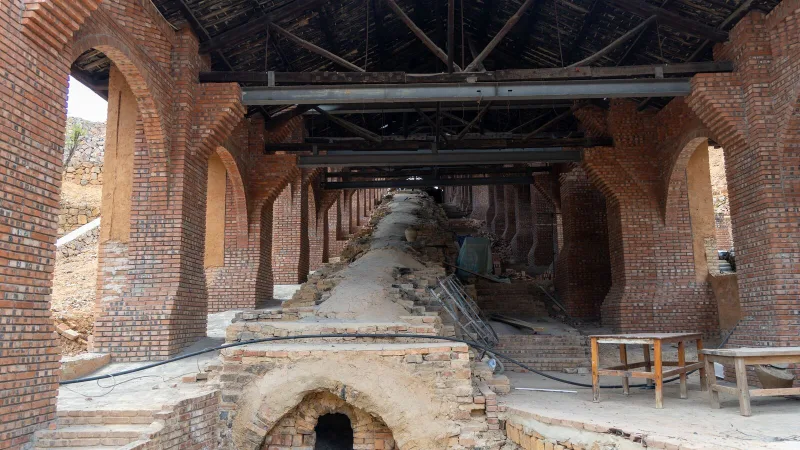
Pieces are fired once, at 1120–1180 °C. Wood-fired dragon kilns dozens of meters long were once the rule. Workshops now use gas and electric kilns, with a cycle of seven to twelve hours. Shrinkage is 15–20 percent. One workshop described by a tea seller takes its gas kiln up to 1100 °C over twelve hours, lets it cool for a day, and loses a fifth of the pieces.
Color depends on the kiln atmosphere. In oxidation, the red body turns dark red, the color of “pig liver”, and the white one comes out ivory. In reduction, when the potter cuts the oxygen from about 900 °C, the iron turns brown and black, and polishing brings out a pure black, red-black or gray-blue tone.
Zitao is polished rather than glazed, and polishing takes the longest. A coarse stone grinds off the fired crust, the “fire skin”, a fine whetstone removes the scratches, and then the surface is rubbed for a long time with small white pebbles and water. The standard recognizes four finishes: mirror, bright, matte and “frosted”. The inside of a teapot is left unpolished.
From opium pipes to teapots
Sources disagree on dates. A regional heritage register traces zitao back to the Daoguang era (1821–1850), while a newspaper feature puts it in the late Qing. Pipes came first. In the Guangxu years (1875–1908) the potter Pan Jinhuai standardized their production, and the old name for the pipes, “bajia dou”, is linked to his “eight operations”. In 1894 the county magistrate brought in master potters, and Jianshui started making vases, teapots and writing sets.
Pottery was fired here even earlier. A 2020 excavation of the kiln site north of Wanyao uncovered three Ming and Qing kilns and more than 300,000 shards, mostly celadon and blue-and-white porcelain. Archaeologists date the first firings to the early Ming, around 1436–1464. The register mentions a Yuan-era dragon kiln, but direct finds from that period are still few.
The leading name of the 20th century is Xiang Fengchun (1895–1964). He reworked an imported steamer into the qiguoqiguoA clay steamer with a hollow tube in the middle. It sits over a pot of boiling water, and the chicken inside cooks in its own steam. as it is known today: lid, body, a hollow tube rising from the base to the throat, and two lion-head handles. The qiguo sits on a pot of boiling water, steam rises through the tube and condenses into broth, and the chicken cooks for two to four hours. Xiang's work was prized for its “three perfections”: shape, painting and polish. In 1933 his qiguo was shown at the Chicago exhibition, and in 1953 he took more than 80 pieces to Beijing, after which Jianshui joined the “four famous ceramics of China”. Sources list the four differently: alongside Yixing and Jianshui come Qinzhou and Rongchang, and sometimes Shiwan.
When the county factory closed, production scattered into family workshops. In 2008 the firing technique was added to the national intangible heritage list, and since 2016 “Jianshui zitao” has been protected as a geographical indication product. Tea sets became the main line only in this century.
Zitao and zisha
The names are misleading. Both materials are unglazed and dark, but they have more differences than similarities.
| Jianshui, zitao | Yixing, zisha | |
|---|---|---|
| Body | levigated, 7–9 microns | sandy, about 21 microns |
| Shaping | on the wheel | slabs and molds |
| Decor | carved raw, colored inlay | carved dry, no inlay |
| After firing | polished | not sanded |
| Surface | smooth, bumpy only in the design zone | rough from the grain |
Yixing has its own clays, zini, zhuni and duanni, and its own way of shaping a pot. Among other southern schools, zitao is worth setting beside the hand-pulled Chaozhou teapots, shoula, and the Qinzhou pottery Nixing.
Which tea to brew
No source gives brewing parameters specifically for a Jianshui pot, so brew it the usual gongfu cha way. The typical size is 95–105 ml, and a good 95 ml pot empties in 4–5 seconds.
The dense body holds heat well, which is why the pot is recommended for ripe pu-erh, aged sheng and hei cha. Sellers report good results with oolongs and black tea. Aromatic oolongs such as Wuyi Ba Xian and Si Ji Chun, as well as Bi Luo Chun and Keemun, come out sharper in zitao, with a pronounced aroma. Green and yellow tea are not recommended.
Young sheng is the open question. In one shop's blind test, sheng brewed in a Jianshui pot came out more aromatic and more bitter than in a Yixing hongni pot. A Chinese pu-erh review recommends zitao for young sheng, while sellers are more cautious. Late infusions turn bitter if left too long, so pour quickly.
People also try zitao for storing pu-erh. Shanghai researchers kept cakes in jars for a week in three cities. In Chengdu, room humidity swung between 35 and 80 percent; inside the zitao jar it stayed at 60–66 percent, as in a glass jar, while in a zisha jar it ranged from 45 to 74 percent. The jar does not hold heat, and the temperature inside follows the room.
Rinse with boiling water, no detergent. Check for loose clay crumbs inside and clean them out with a brush or cloth. Boiling is optional: sellers warn the pot may crack, and a week or two of daily brewing does the same job. One pot, one kind of tea. After that, follow the usual teaware care.
How to choose
For a buyer, the geographical indication mark matters most. Under the standard, water absorption must not exceed 5 percent, sizes must be within ±5 percent, the pot should ring like metal when tapped, and the inlay must lie flush, with no bumps or cracks. In the workshops tea sellers have visited, every pot was thrown on the wheel, with no coils or slabs. Ask the seller whether the pot was thrown.
After that, judge how the pot works rather than how it looks. Check the pour time and whether the strainer holes are clean, and make sure the lid fits snugly. White pots show tea stains clearly. Matte zitao slowly takes on a shine with use.
No account of how zitao is faked turned up in primary sources, so buyers are left to rely on the mark and the seller's honesty.
One trap has nothing to do with pottery. On Japanese sites, the label “建水” (kensui) almost always means the waste-water bowl that takes the rinse water from the tea bowl in chado. It has no connection to the county in Yunnan.
Common questions
How is Jianshui zitao different from Yixing zisha?
In the clay body and the finish. Zisha is sandy, with grains around 21 microns; potters build it from slabs and leave it unsanded after firing. Zitao is levigated to 7–9 microns, thrown on the wheel, carved while raw, inlaid with colored clay and polished. The names sound alike, but the materials are different.
Which tea belongs in a Jianshui teapot?
Most often ripe pu-erh, aged sheng and dark tea (hei cha), since the dense body holds heat well. Aromatic oolongs and black tea also do well. Green and yellow tea are not recommended. Sellers disagree about young sheng: some praise the clear aroma, others warn of bitterness.
Does a new Jianshui teapot need to be boiled?
Not necessarily. Two or three rinses with boiling water and a check for loose clay crumbs inside are usually enough. You can boil it, but the pot may crack. Kai hu is covered in more detail under caring for teaware.
-
Provincial standard DB53/T 559-2019, “Geographical indication product. Jianshui purple pottery”, approved March 1, 2019, in force June 1, 2019, replacing the 2014 edition. Local standards registry. ↩
-
Wang Kun, He Jinlin, Zhang Peng et al., “Clay and humidity-retention properties of Yunnan Jianshui zitao”, Journal of Ceramics 44(1), 2023. PDF. ↩