Rou Gui 肉桂
A tea bush cultivar and the tea made from it, one of the two main rock oolongs of Wuyishan. You know it by its sharp, spicy aroma with a note of cassia bark, the scent that gave the tea its name.

- Province:
- Fujian, Wuyi Mountains
- Group:
- rock oolongs (yan cha)
- Cultivar:
- Rou Gui, provincial cultivar since 1985
- Processing:
- roasting, usually medium
- Dry leaf:
- large, dark, with an oily sheen
- Taste:
- cassia, spice, fruit; quick sweetness
Rou Gui (肉桂, “cassia”, Chinese cinnamon) is a rock oolong from the Wuyi Mountains in northern Fujian. Toward the end of a session its spice turns to sweetness. For the Wuyi cliffs, their hierarchy and charcoal roasting, see Da Hong Pao; what follows is what sets Rou Gui apart from its neighbors.
A cultivar with a cinnamon name
The New Gazetteer of Chong’an County names two birthplaces for the cultivar: Huiyuan Rock and Mazhen Peak in the Wuyi Mountains. Jiang Heng, a 19th-century poet, noted the sharp, “cinnamon” taste of Rou Gui in his verses on Wuyi tea. For a long time it was one of many ming cong, named bushes, and was grown on a small scale.
The cultivar won recognition in the mid-20th century. In the 1940s an experimental garden at a tea institute ranked Rou Gui among the best named bushes, and from the 1960s growers propagated it from cuttings and planted it all over Wuyishan. In 1985 it gained provincial cultivar status, and during the 1980s it grew from a few plots into one of the area’s two main cultivars. Today Rou Gui and Shui Xian cover more of Wuyishan’s tea land than anything else1. The national standard for rock tea lists Rou Gui separately, alongside Da Hong Pao and Shui Xian2.
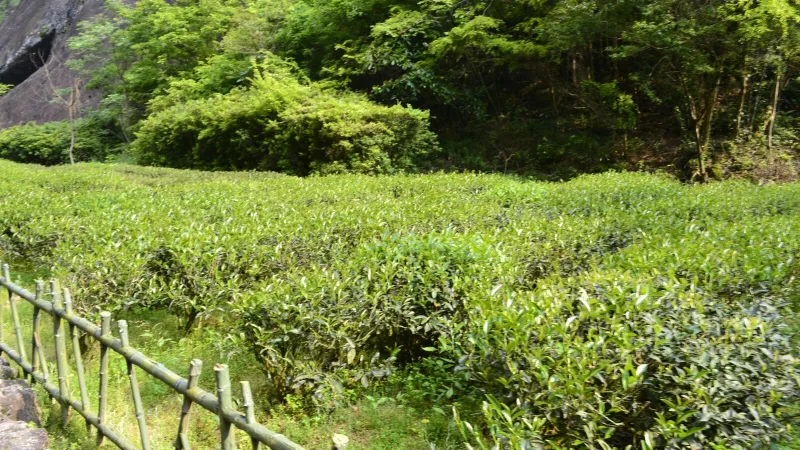
The bush is tall, over 2 m, with long, thick, dark green, glossy leaves. The cultivar yields well and is planted far outside the reserve, so the name on the pack alone does not tell you where the leaf grew.
Aroma and taste
Wuyishan has a saying: “nothing is more fragrant than Rou Gui, nothing is mellower than Shui Xian” (香不过肉桂,醇不过水仙). Rou Gui counts among the high-aroma cultivars. The liquor carries cassia and hot spice, and a good tea adds peach, cream and honey. The taste is dense, with a slight tingle on the tongue, and sweetness returns fast, a few seconds after you swallow.
That sharpness is what makes Rou Gui the backbone of blends. Tea makers who build Da Hong Pao from several cultivars often take it as the base for aroma and add Shui Xian for body. On its own, Rou Gui is sharper and more direct than a blend.
Ma Rou and Niu Rou
Rou Gui prices depend on location more than those of any other Wuyi tea. Connoisseurs know the best plots by name, and two of those names have turned into puns.
Ma RouMa RouRou Gui from Matouyan (“Horse Head Rock”). A pun: 马肉 reads as “horse meat”. grows on Matouyan (“Horse Head Rock”) in the central part of the reserve. Niu RouNiu RouRou Gui from the Niulankeng gorge (“Cow Pen”). A pun: 牛肉 reads as “beef”. is picked in the Niulankeng gorge (“Cow Pen”), one of the “three pits and two streams”. Join the first syllable of the place name with “rou” and you get “horse meat” and “beef”. Niu Rou is considered the peak of the cultivar: the gorge is narrow, sunlight is scarce, and the tea from it comes out deeper and cooler, with a long mineral finish.
Both teas are scarce and in high demand, so most packs with these labels were picked elsewhere. The only way to check the origin is through a seller you trust.
Roasting and rest
Rou Gui gets the same roast as other rock oolongs, most often to medium. A light roast keeps the aroma at its brightest and sharpest. A heavy one hides the spice behind caramel and roasted nuts, but the tea keeps longer. After roasting Rou Gui rests for several months, and it pays to leave a fresh pack sealed for a while: it still holds a lot of fire.
How to brew
Brew Rou Gui gongfu cha style, in a gaiwan or a Yixing teapot. Use water at a full boil and keep the first infusions short, since the sharpness quickly turns bitter. Soft water works best.
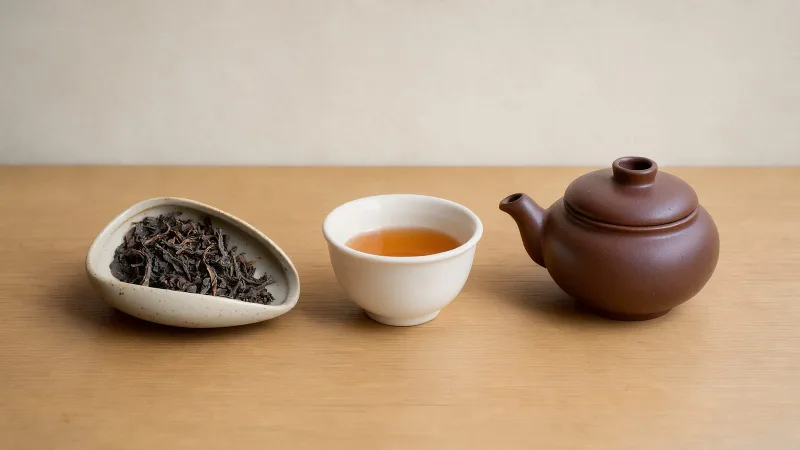
7 g of leaf per 110 ml, water at 100 °C (212 °F). Rinse the leaf for 5 seconds and pour it off. Steep the first infusion for 8–10 seconds, the second for 10, and each one after that 5 seconds longer. A good Rou Gui lasts 6–8 infusions: spice in the first three, sweetness and stone toward the end.
Try it side by side with a Feng Huang Dan Cong of the Rou Gui Xiang type. Both smell of cinnamon, but they are different cultivars from different provinces, and the Guangdong tea has a more floral aroma and a lighter body.
Common questions
Is there cinnamon in Rou Gui?
Only in the name. The spicy aroma comes from the cultivar itself, and roasting strengthens it. 肉桂 is Chinese for cassia, Chinese cinnamon, and the tea is named for the resemblance in scent.
How is Rou Gui different from Shui Xian?
Wuyishan has a saying: nothing is more fragrant than Rou Gui, nothing is mellower than Shui Xian. Rou Gui is sharp and spicy, with a bright, high aroma. Shui Xian has a quieter scent, but its liquor is smooth and thick.
Why does one Rou Gui cost ten times more than another?
Location decides. Rou Gui from the central cliffs of the reserve, above all Ma Rou and Niu Rou, comes in small lots and sells high. The same cultivar from the river flats or neighboring counties costs several times less, though the name on the pack is the same.