How the Leaf Gives Up Flavor: The Physics of Extraction 浸出
Tea does not dissolve the way sugar does: compounds leave a swollen leaf slowly. That slowness decides how hot the water should be, how long to steep, and why tea is brewed in several infusions.
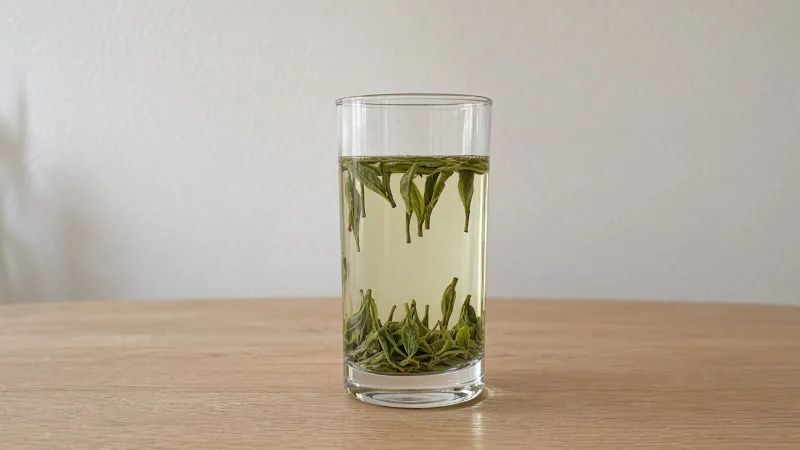
- What happens:
- compounds diffuse from the swollen leaf into the water
- What limits it:
- the path inside the leaf, not stirring outside
- Main lever:
- water temperature
- Fastest to leave:
- amino acids, including theanine
- Slowest to leave:
- galloylated (ester-type) catechins
- ISO 3103 steep time:
- 3–6 min, 2 g of leaf per 100 ml
Drop sugar into water and it vanishes in seconds. Tea is different: the leaf swells and darkens, and the cup takes minutes to gain strength. Flavor compounds sit inside the cells, and until water reaches them and they work their way out, the liquor stays thin.
Chemists have measured brewing in the lab, and their picture explains tips usually given separately: warm the pot, change the temperature, shorten the first infusions.
What happens in the cup
A dry leaf first soaks up water and swells, and only then do dissolved compounds start to flow out in any quantity. In a bed of tea particles, 70–75% of the swelling happens in the first 40–45 seconds. Warmer water means more swelling: the volume of a bed of 2.2 mm particles grew 38% at 60 °C and 64.7% at 80 °C. So every brew has a lag. With hot water the first 15–20 seconds go to wetting and swelling, and at 70 °C it takes more than 22.
After that, compounds move out by diffusiondiffusionThe spontaneous movement of a substance from where there is a lot of it to where there is little. This is how caffeine and theanine travel from leaf to water.. The concentration in the liquor rises fast, then more slowly, and levels off toward an equilibrium that depends on how each compound partitions between leaf and water. Researchers describe this with a first-order equation: the further from equilibrium, the faster extraction runs.
The bottleneck is the path inside the leaf. Caffeine moves through a swollen leaf 96–132 times more slowly than through plain water. That is why stirring loose leaf changes almost nothing: in a rotating-disc experiment at 80 °C, the rate did not depend on how fast the disc turned. Still water outside is enough; everything happens inside the leaf.
Stirring does little. What you control is water temperature, the size and state of the leaf, and how often the water is renewed.
Temperature: the main lever
In the experiments of Spiro and colleagues,1 the rate constant for caffeine leaving green Chun Mee rose 5.6-fold, from 0.21 min⁻¹ at 63 °C to 1.17 at 92 °C. The half-time (how long it takes for half of the eventual yield to come out) fell from about 3.3 minutes to 36 seconds. Black Assam showed a smaller spread: 0.29 at 70 °C and 0.63 at 90 °C.
Temperature matters more for green tea than for black: the activation energy for caffeine extraction is about 62 kJ/mol for green versus 40 for black. Put simply, a green leaf responds more to each degree. That is why green teas turn bitter quickly in boiling water and open up gently in cooler water.
There is a second reason: compounds respond to temperature differently. Galloylated catechins, the most astringent ones, barely come out in cool water, while amino acids and free catechins come out regardless. In a Japanese kyusu test (3 g in 200 ml, 2 minutes), infusions at 20 and 50 °C were rated too weak, and galloylated catechinsgalloylated catechinsCatechins carrying a gallic acid group, also called ester-type. They are the most astringent and leave the leaf more slowly than anything else, especially in cooler water. were hardly extracted at 20 °C. The chemistry of polyphenols explains how astringency differs from bitterness.
This is where the usual temperatures for each type come from: white tea is brewed at 85–90 °C, delicate greens somewhat cooler, while oolongs and dark tea, with their dense leaf, stand up to boiling water.
Leaf size and time
The smaller the leaf, the shorter the path from inside to outside. The rate constant is inversely proportional to the square of the thickness, so a leaf half as thick releases its flavor about four times faster. For black CTC (pellets and broken leaf), the rate rose 2.2-fold when particles shrank from 850–1000 to 500–600 microns.
The standards reflect this. ISO 3103, used for tasting, calls for 2 g of leaf per 100 ml of boiling water: 6 minutes for black, 5 for whole-leaf green, 3 for green fannings, the small broken grade. China's GB/T 23776 gives an oolong rolled into balls 6 minutes and a strip oolong 5, since a tight leaf needs time to open. For a gaiwan, the same standard makes each infusion longer than the last (2, 3 and 5 minutes), because the leaf is gradually spent.
In a tea bag the rate constant is 29% lower than for loose leaf: a packed layer of particles hinders swelling. So in Western brewing a bag, unlike loose leaf, brews faster if you stir or dunk it.
The order compounds leave in
Compounds do not all leave at once. Amino acids, theanine among them, are fastest, caffeine and free catechins follow, and galloylated catechins lag behind. So a short first infusion comes out soft and slightly sweet (theanine and umami), while a long one adds astringency.
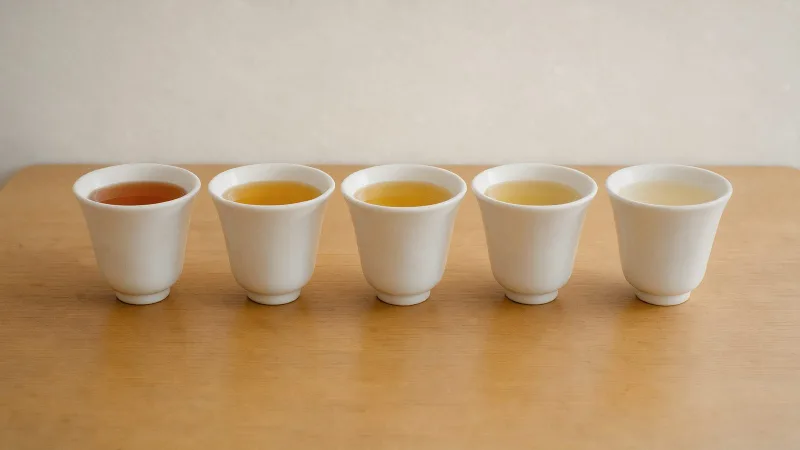
That said, the literature gives no single order. In some studies caffeine outruns polyphenols, in others it keeps pace, depending on the tea, the temperature and the time. Only the extremes are certain: amino acids first, ester catechins last.
This is why several infusions beat one. In one long steep the concentration in the water climbs and the gap between leaf and water closes. Fresh water reopens the gap, and extraction picks up its earlier pace. In an experiment by Yang and colleagues (eight infusions of 30 seconds), the short infusions together yielded more than one long steep of the same total time. On top of that, a leaf that has already swollen lets water through more easily.
The second infusion of green tea is not empty. Across 17 samples it held 96–106% of the first infusion's galloylated catechins, 83% of the caffeine and 58% of the theanine. In Bingdao sheng pu-erh, polyphenols kept coming through all 14 infusions, while caffeine fell 40% after the seventh. Infusions three to seven tasted best.
A common Japanese routine for sencha rests on this: 60 seconds for the first infusion, then 10 each for the second and third. A swollen leaf releases quickly, and waiting longer only adds astringency.
What to do about it
Warm the vessel. Water cools in a pot faster than you would expect. In Akira Hojo's test, boiling water in an unwarmed 100 ml pot dropped to 79 °C in a minute, and in a 300 ml pot to 85. After one 10-second warm-up the readings rose to 81.5 and 89 °C, after two to 89 and 91. A home test, not a lab one, but the order of magnitude is clear. More on preheating the pot.
Pour off on time and completely. Leaf left sitting in a little water keeps releasing compounds. A fair cup makes it easy to empty the brewing vessel in one go. Zhang Yuan, author of the Ming-era Records of Tea, already knew that timing matters: pour too early and “the spirit of the tea has not opened”, too late and “the delicate fragrance has already gone”.
Use fresh water for each infusion. That is how gongfu cha works: plenty of leaf, a small vessel, short infusions. For how much leaf to use, see the leaf ratio guide; for choosing water, the water guide.
High pour. In Chaozhou gongfu cha, boiling water is poured from a height so the stream hits the leaf and helps it open. It is a practitioners' habit; no lab data show that it speeds extraction.
Myths about time and caffeine
“A 30-second rinse removes 80% of the caffeine.” People love this one. In the study by Hicks and colleagues,2 the same leaves were steeped three times for 5 minutes in fresh boiling water. Averaged over six teas, the first infusion released 69% of the caffeine, the second 23%, the third 8% of the three-infusion total. The study took no measurement at 30 seconds; the figure of about 9% came later, as an extrapolation by Nigel Melican. So 80% in half a minute does not follow from these data.
“Cold tea has no caffeine.” It does. In a Japanese experiment at 20 °C, over 70% of the caffeine came out in 20 minutes, and at 5 °C about 36% in the first 10 minutes. How much caffeine ends up in the cup and how cold brew works are covered separately.
“The longer, the more catechins.” In Turkish green tea at 85 °C, epicatechins kept coming out for 3–5 minutes and then declined: with long heating, some catechins convert into their mirror-image forms.
Common questions
Why do several short infusions give more than one long steep?
Compounds leave the leaf while the water holds less of them than the leaf does. In one long steep the concentration in the water climbs and the gap closes. Each fresh pour opens the gap back up to its widest. In a test on bagged tea, the short infusions together yielded more than one long steep of the same total time.
Should you stir tea?
For loose leaf, hardly at all: the rate depends on the path inside the leaf, not on how the water moves outside. For a tea bag, stirring and dunking do help, because a packed layer of particles adds its own resistance.
Does cold water pull caffeine out of tea?
Yes. In a Japanese experiment at 20 °C, over 70% of the caffeine and free catechins came out in 20 minutes, against about 30% of the galloylated catechins. Cold-brewed tea is less astringent but not caffeine-free.