The samovar
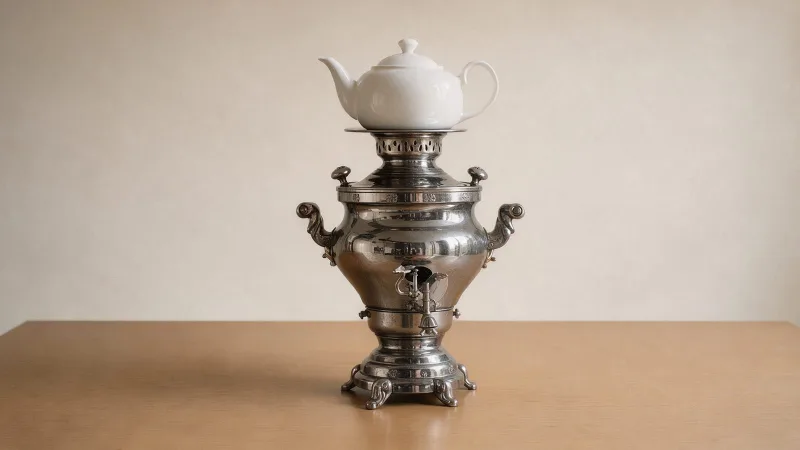
A samovar boils water with a fire tube that stands inside the water itself, so almost all the heat goes to work. It does not brew: the tea concentrate waits in a small pot on top.
- First mention:
- Urals, Irgin works, 1740
- Tula:
- from 1778, the Lisitsyn brothers
- Common sizes:
- 3, 5 and 10 liters
- Metal:
- brass, copper, nickel-plated brass
- Fuel:
- wood chips, pine cones, charcoal
- Electric models:
- mass-produced from 1956
A samovar is a metal tank for water with a fire tube running through its middle. The teapot sits at the top, on the crown above the tube. The design settled in the earliest years of production and barely changed afterward; what changed were the shapes, finishes and taps.
How it works
The body holds the water. A tube, called the jug or chimney, runs along its axis. The fire gratefire grateThe grate at the bottom of the tube. The fuel lies on it, and ash falls through it into the ash-pit. sits at the bottom of the tube, with an ash-pit and a small cleaning hatch below it and, under that, a base on feet. Air reaches the fire through slots in the neck. The crown on top holds the teapot. When lighting it, you fit a chimney extension over the tube to draw the fire and carry off smoke. When the water boils, you swap the extension for a cap, and the fire dies.
The efficiency comes down to simple physics. The fire sits inside the water rather than under a pan, so little heat escapes. Hence a practical rule: the thicker the layer of water around the tube, the longer the boil. A narrow "wine glass" shape boils faster than a wide "ball" of the same volume.
You lift the samovar by its wooden knobs, which stay cool. A tap with a ground plug sits low in the body. Seven trades went into one samovar, and the assembler fitted parts to each wall by hand, so samovars of the same shape from the same factory differ slightly in size.
The inside is coated with food-grade tin, because brass and copper must not touch the water. This coat is called tinningtinningA layer of food-grade tin on the inside wall. It keeps the water away from brass and copper., and it has to be renewed when it wears thin.
Where it comes from
The historian A. G. Kozlov found the earliest known record. On 7 February 1740 the Yekaterinburg customs house received goods seized from people of the Irgin works, owned by the Osokin brothers: six tubs of honey, six sacks of nuts and "a samovar, copper, tinned, weighing 16 pounds, made at the works." It was valued at 4 rubles 80 kopecks.1 On that basis, the historian N. S. Korepanov dates the first samovar to somewhere between September 1738 and February 1740.
According to Tula legend, the samovar was invented there in 1778, but no document supports this. In that year Ivan and Nazar Lisitsyn, sons of the gunsmith Fyodor, petitioned to open a samovar factory. They are the first samovar makers in Tula on record, but by then workshops were already running in Moscow, Suksun and Nizhny Tagil. The anniversary celebrated in 1996 as the birth of the Tula samovar is dated from a 1746 inventory of the Onega monastery, which lists two samovars with no place of manufacture. Tula was attached to them by tradition.
The sbiten vessel, a container for hot honey drink with a compartment for coals, is often named as the ancestor. The samovar museum in Grumant argues that it came later, since sbiten can be cooked in an ordinary pot. The word is most plausibly "sam" (self) plus "varit" (to boil); a Tatar "snabar" (kettle) is a minority guess.
Tula and the shapes
Tula had 8 factories in 1808 and 28 by 1850; museums put the mid-century count anywhere from 50 to about 80. Village craftsmen made the simple parts, and the factories assembled them. Batashev started in 1840 with 13 workers and about 360 samovars a year. By 1885 the heirs made more than 11,000 a year, and by 1915 over 120,000, though other sources give lower figures, so trust the order of magnitude and not the exact numbers.
The shapes run to dozens, and the common ones are easy to learn:
- banka (jar): a plain cylinder, the best seller around 1900, found in taverns and peasant homes;
- ryumka (wine glass): the body narrows toward the bottom;
- vaza (vase): a cone with facets and medallions, the shape of the upper classes;
- shar (ball): potbellied, sold as "Persian" and shipped east;
- egg: narrow top and wide bottom, reversed in the "Easter egg";
- repka (turnip): costlier than the wine glass, a merchant's choice;
- spider: a ball on three tall legs;
- barrel: horizontal, as the Lisitsyns made them.
The small ones form a group of their own: the egoistegoistA small samovar of 1 to 2 liters, made for one person or for the road. samovar of 1 to 2 liters for a single person or the road, and the tête-à-tête with two taps. The common sizes are 3, 5 and 10 liters. The Tula Samovar Museum keeps a buffet samovar of 70 liters, and the one at its entrance holds 260.
Fuel, electricity and kerosene
A charcoal samovar burns wood chips, dry logs of 10 to 15 cm, pine cones and charcoal. Cones are traditional, but sellers warn about the resin; one or two will do for scent. Kerosene is off limits, and the Shtamp factory says so outright. Late nineteenth-century makers also built kerosene and spirit-fired models, which are separate designs.
The electric samovar replaces the tube with a heating element. Series production began in 1956 at the Shtamp plant in Tula. The claim of a first prototype in 1929 rests on a single newspaper note and is doubtful, because Shtamp split off from the cartridge works only in 1937. The designation under the standard GOST 7400-81 encodes capacity, power and voltage: a code such as EST 3.0/1.0-220 means 3 liters and 1.0 kW (the letters are Cyrillic on the nameplate). The same standard requires 3 liters to boil in no more than 21 minutes, 5 liters in 29 and 10 liters in 60. EST models have a thermal cutoff, and ESTZ models also switch off within 2 minutes of vigorous boiling. Combined models run on either charcoal or electricity.
By 1991 Soviet samovars, mostly electric, had been exported to 57 countries.
How to fire a charcoal samovar
Wash a new samovar with hot water, rub a thin film of food-grade oil on the tap plug and its seat, and turn the plug a few times to seat it. Pour out the first boil.
The seams come unsoldered and the tinning is ruined. Shtamp's manual says to fill to three quarters; other sources say up to where the tube narrows, or to the brim. All agree that the tube must be covered by water. Do not douse the fire with water: the cap puts it out.
After that, the routine goes like this. Set the samovar on a nonflammable, level base, preferably outdoors or under a vent. Light kindling, birch bark or paper and drop it into the tube, then add chips a little at a time, never packing the tube to the top, or the fire chokes. Fit the chimney extension. When the water boils, remove the extension and cap the tube. A loose cap lets you regulate the boil.
The only boiling times on record come from one seller's test: 5 liters in 23 minutes, 7 liters in 37. The 7-liter samovar took about two and a half hours to cool. Stand it on a tray, because a coal can drop from the air slots.
The concentrate is made separately, in a pot on the crown, just as in traditional Russian tea drinking. To boil water on a stove or at the office, use an ordinary kettle.
Buying an old one
You buy an antique samovar for its shape and stamp, but in the late nineteenth century a stamp guaranteed little. Each maker applied his own and could change it, and small makers passed themselves off as "successors" to a famous name. Rights to medals passed to heirs, and forging medals was a crime, so makers used blurred imitations or repeated one medal several times. Medals on the body say nothing about quality.
In 1911 the Batashev heirs' partnership warned in an advertising booklet that more than 20 trade licenses for factories named "Batashev" had been taken out in Tula, and that fakes were built of light metal, weighted with lead and fitted with a thick cast-iron grate painted to look like copper. Genuine pieces were stamped on the wall, the lid and the base. Other dealers, however, write that only one stamp was used, on the lid or base, so a missing second stamp is no reason to reject a piece.
Check by hand. A new fake stamp has sharp edges and lighter metal inside the impression, and lies over electroplating. A lid or base in a different metal than the body means mixed parts. A shiny solder joint at the tube betrays repair, since an unrestored one is matte. The tap should sit ground to its seat: Shtamp forbids replacing the plug because it is fitted to its seat individually. A heavy samovar is not a better one.
For drinking, something else matters. The danger in restored samovars is technical, not culinary: tinning calls for pure food-grade tin, and the common 40 to 60 percent solder does not qualify.
Care and storage
Wipe with a soft cloth and clean nickel plating with a special paste. Skip emery and metal tools, and go easy on stamps, because abrasive wears the impression away.
Descale before it builds up. At home, boil 30 g of citric acid in water, leave it for 10 to 12 hours, then rinse. A metal brush or a knife deforms the walls. Old scale goes to a workshop for an acid treatment, and the samovar often needs new tinning afterward.
Before lighting, tip out the ash by turning the samovar tube-down. Before storage, dry it inside and out and rub the tap plug with vegetable oil or animal fat. If water seeps from below, the key sits too high and needs grinding in with paste. If it leaks from the top, the plug is worn and needs replacing.
Beyond Russia
The samovar spread fast. In 1836 the envoy I. V. Vitkevich saw a Russian samovar for sale near Bukhara, and in 1858 the Ignatyev embassy presented one to the emir of Bukhara and the khan of Khiva. Central Asian teahouses served green tea from samovars, and in the Fergana Valley a teahouse is still called a "samovar."
In Iran in 1850 Amir Kabir received silver samovars from the French government and a set from a Russian merchant, then granted a monopoly on making them to a master from Isfahan. The main craft center is Borujerd, where samovars are made of varsho, nickel silver. In Turkey the semaver is made in Amasya and Samsun, and the Vezirköprü type carries a geographical indication. In Kashmir the samovar is used for kahwa and salty nun chai, with the tea and spices going straight into the water around the charcoal tube.
Common questions
Can you brew tea directly in a samovar?
No. A samovar boils water; the tea concentrate (zavarka) is made separately in a pot that sits on the crown at the top. Water from the very first boil in a new samovar is poured out, not drunk.
What do you burn in a charcoal samovar?
Dry wood chips, short logs of 10 to 15 cm, or charcoal. Pine cones are traditional, but sellers advise against resinous wood and cones as the main fuel; one or two are enough for scent. The Shtamp factory forbids kerosene.
How can you tell a genuine antique from a fake?
Check the stamp: sharp edges in the impression, bright metal inside it, or a stamp lying over electroplating all point to a recent copy. A lid or base in a different metal than the body, or a shiny solder joint at the tube, signals repair. Weight proves nothing, since forgers poured lead inside.
-
N. Korepanov, "The Ural samovar: was it the first in Russia?", Nauka i zhizn, nkj.ru/archive/articles/4746 (in Russian). The original interrogation record is held in the State Archive of Sverdlovsk Region (F. 24, Op. 1, D. 903). ↩