Bi Luo Chun 碧螺春
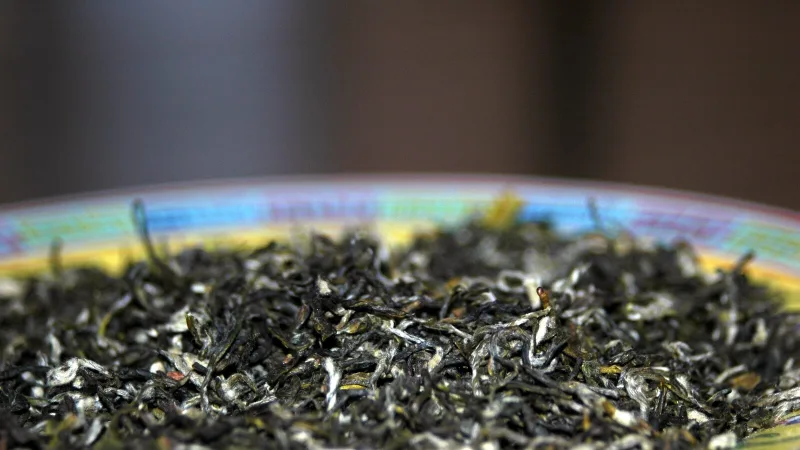
Tight spirals in white down from two hills on Lake Tai near Suzhou. The bushes grow among fruit trees, and the liquor carries notes of flowers and fruit.

- Province:
- Jiangsu, Suzhou, Dongting hills
- Processing:
- fired and rolled in a single wok
- Plucking:
- a bud with one leaf
- Leaf shape:
- tight spiral in white down
- Harvest:
- March 20 – April 20, best before Qingming
- Taste:
- sweet, fresh, flowers and fruit
Bi Luo Chun (碧螺春, "Green Snail Spring") is made on two hills in Lake Tai near Suzhou. The dry tea looks like a handful of tiny gray-green curls dusted with white fluff, each bud and its leaf rolled into a tight spiral. Like Longjing, it is a wok-fired green tea, but it is shaped by a method of its own and tastes different. Where Longjing tastes of chestnut, Bi Luo Chun tastes of flowers and fruit.
Hills on Lake Tai
Dongting is the shared name of two hills. Dongshan, the East Hill, juts into the lake as a peninsula. Xishan, the West Hill, sits on Lake Tai's largest island, now the town of Jinting, linked to the shore by a bridge. Both hills belong to Suzhou's Wuzhong district. The lake softens the winter, mist hangs over the slopes in spring, and the bushes bud early.
Tea has a long history here: Lu Yu's Classic of Tea already lists Dongting mountain among the tea places of Suzhou. Locals called it by a rather crude name, xia sha ren xiang, "so fragrant it frightens you". Qing-era notes say that in 1699, as the Kangxi Emperor was returning from a tour of the south, the governor of Jiangsu, Song Luo, presented him with this tea at Lake Tai1. The emperor praised the taste but found the name vulgar, and gave the tea a new one after its emerald liquor, spiral shape and spring picking.
The name "Dongting Bi Luo Chun" is now protected by a geographical indication standard2. Only leaf picked in two towns, Dongshan and Jinting, qualifies. Their tea gardens cover about two thousand hectares, very little by Chinese standards.
Tea among fruit trees
Dongting gardens look different from the even rows of bushes around Hangzhou. Here the tea grows under fruit trees: loquat, yangmei (Chinese bayberry), mandarins, mei plums, peaches, chestnut. Local chronicles trace this kind of planting back to the Tang dynasty. Suzhou's 2024 regulations make it part of the definition of Dongting tea: the bushes are the main crop, and the trees grow between them.
The canopy gives the bushes partial shade and shelters them from the wind off the lake. In Suzhou people say the roots of the tea and the trees intertwine, and the leaf takes in the scent of blossom and fruit. That is hard to verify. The chemistry of the shoots has been measured, though: with the same fertilizer, leaf from gardens with loquat trees contains more free amino acids than leaf from gardens without trees3. Amino acids give green tea its sweetness and freshness.
The old gardens are planted with a local small-leaf population grown from seed. Its buds are small and uneven in size, which makes sorting slow, but the regulations stick with this population while also allowing approved cultivars.
Picking and the wok
The season lasts about a month, from the spring equinox on March 20 to Guyu on April 20. The most prized tea is ming qianming qian"Before Qingming", the "clear and bright" festival: tea picked before April 4–5. The smallest buds and the highest price., picked before the Qingming festival. Pickers take a bud with a barely opened leaf, 1.6–2 cm long. A kilogram of top-grade dry tea takes about 140,000 such shoots.
The day runs to a fixed schedule. Picking lasts from five to nine in the morning, and until midday the leaf is sorted by hand, with large and damaged shoots pulled out along with the small first leaf at the base. Sorting a kilogram of fresh leaf takes two to four hours, and the leaf withers in the meantime. Firing starts at three in the afternoon. Whatever was picked that morning has to reach the wok the same day.
Everything happens in one wok, from start to finish, without a break. First comes sha qingsha qingFixation: the fresh leaf is heated briefly; the heat destroys the enzymes, and the leaf stops oxidizing.: the wok is heated to 200 °C, and the leaf is tossed and turned with both hands for three to five minutes. Then the wok cools, and the master rolls the leaf right in it, squeezing it by the handful. Once the leaf is two-thirds dry, the wok is kept at 50–60 °C for the key step. The tea is rubbed between the palms into several clumps, shaken loose and squeezed again. This forms the spiral and brings the down up on the buds. Finally the leaf is spread on mulberry-bark paper over the barely warm wok to dry through.
The whole process takes about forty minutes. In Suzhou they sum it up this way: the hands never leave the tea, and the tea never leaves the wok. Longjing, by contrast, is fired twice with a rest in between, and pressed against the wall rather than balled up.
Bi Luo Chun from elsewhere
Outside Dongting the name is not protected. Bi Luo Chun is made in Zhejiang, Sichuan, Guizhou and Taiwan, in the Sanxia area. The leaf there is larger and more uneven, with less down, and the taste leans toward nuts rather than fruit. It is decent tea for the price, just a different tea.
Trouble starts when such leaf is passed off as Dongting tea. Early southern cultivars bud several weeks before the local bushes, and the first spring batch "from Lake Tai" often comes from the south. Genuine Bi Luo Chun has a small, tightly curled bud, thick down and a sweet, fruity scent. In water it sinks quickly and opens into even, pale green shoots.
How to brew
With its dense spiral and heavy down, Bi Luo Chun is brewed shang tou fashang tou faTop-down brewing: water goes into the glass first, then the tea. Used for the most tender, dense buds. style: water first, then tea. Pour water onto the leaf and the stream knocks the down loose; it floats up and clouds the liquor. Leaf scattered over water soaks through on its own and sinks within a minute or two.
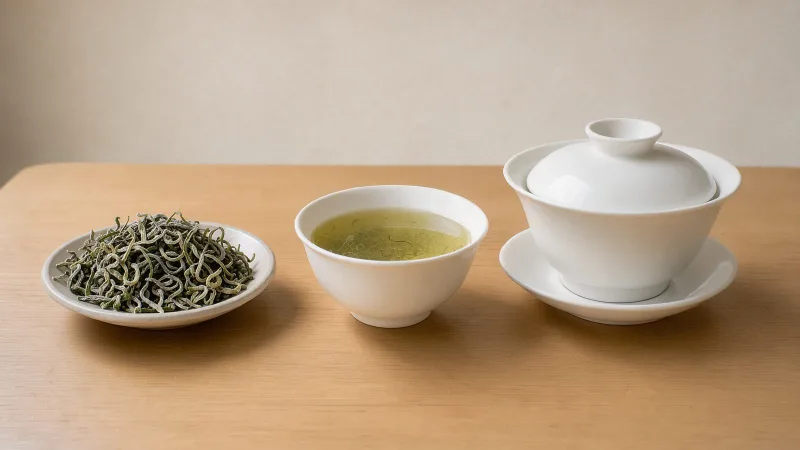
Pour 150 ml of water at 75–80 °C (167–176 °F) into a warmed glass. Scatter 3 g of tea on top and do not stir. After a minute the spirals sink, and a minute later the liquor is ready. Leave a third at the bottom and top up with water at the same temperature. The leaf gives three infusions, and by the third the flavor is noticeably lighter.
In a gaiwan keep the same order, water and then leaf, but use more tea and pour off sooner. Leave the lid ajar so the buds do not stew.
Soft water brings out the fruity note; in hard water it disappears. Store the pack sealed in the fridge and finish it within the year of picking, since over a warm summer the aroma fades.
Softer and more floral is Huangshan Mao Feng from neighboring Anhui: its leaf is barely rolled and is dried over a fire in baskets.
Common questions
Why is Bi Luo Chun liquor cloudy?
Down from the buds spreads through the water. That is normal for young leaf: the smaller the bud, the more down it carries. To stir up less of it, pour the water first and add the tea on top.
How is Bi Luo Chun different from Longjing?
Both are fired in a wok. Longjing is pressed against the wall into flat blades with a chestnut aroma. Bi Luo Chun is rubbed between the palms into clumps, so the bud curls into a downy spiral, and the flavor is fruity and floral.
How do I recognize Bi Luo Chun from Dongting?
By the small, tightly curled bud in thick down and the sweet, fruity aroma. Large, uneven leaf with a nutty taste usually comes from other provinces. It is safer to buy from a seller who names the hill and the picking date.
-
The story is retold in the Qing collection Ye shi da guan and in Suzhou chronicles; the date is the 38th year of the Kangxi reign (1699). ↩
-
GB/T 18957-2008, "Product of geographical indication: Dongting (Shan) Bi Luo Chun tea"; Suzhou regulations on the protection of Dongting Bi Luo Chun, in force since September 1, 2024. ↩
-
Effects of Fertilization on Yield and Quality of Biluochun Tea Cultivated in Different Tea-fruit Intercropping Plantations, Chinese Agricultural Science Bulletin, 2018. ↩