Da Hong Pao 大红袍
The best-known rock oolong of Wuyishan. It grows among the cliffs of northern Fujian, and a charcoal roast gives it a warm, dense taste with a long mineral finish.

- Province:
- Fujian, Wuyi Mountains
- Group:
- rock oolongs (yan cha)
- Oxidation:
- medium
- Processing:
- charcoal roasting
- Dry leaf:
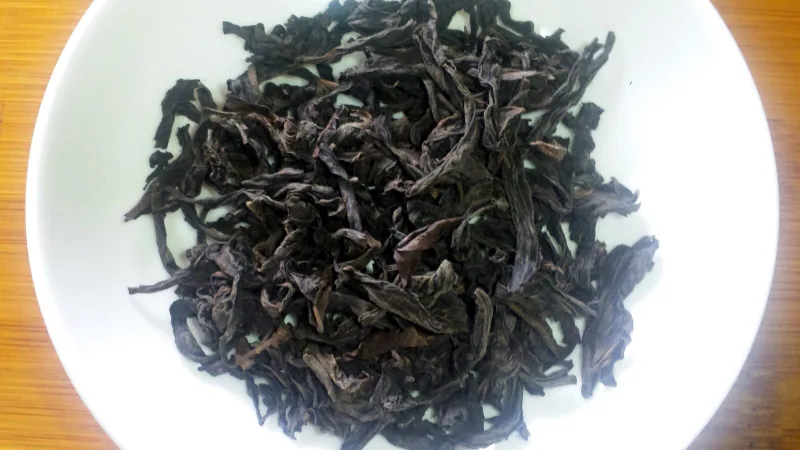
- large, dark, twisted lengthwise
- Taste:
- roasted nuts, dried fruit, mineral finish
Da Hong Pao (“Big Red Robe”) is the best-known tea of the Wuyi Mountains in northern Fujian. By processing it is a medium-oxidized oolong; by origin it belongs to yan chayan chaRock tea: oolongs from the Wuyi Mountains, where the bushes grow in ravines between cliffs, on stony soil., the rock teas. The bushes grow in narrow ravines, their roots reaching into cracks in red sandstone.
The name on the pack says little about what is inside. Producers put it on tea from the central cliffs of the reserve and on cheap blends from the flats by the river.
Wuyi rock tea
The Wuyi Mountains have been a UNESCO World Heritage Site since 1999. By the accepted account, the first black tea, Zheng Shan Xiao Zhong, also came from deep in these mountains, from the village of Tongmu. Tea here grows between cliffs. The ravine walls shelter the bushes from wind, direct sun reaches them only briefly, and water seeps over the rock all the time. Leaf from this soil brews a dense liquor with a mineral finish. Wuyishan locals call it yan yunyan yunRock rhyme: the dense mineral aftertaste by which Wuyi growers recognize tea from the central cliffs., “rock rhyme”, and use it to tell rock tea from tea grown on the flats.
Within the area, not all sites are equal. Zheng yan (“true rock”) is the central part of the reserve, above all the “three pits and two streams”. The slopes around the edges are called ban yan, and tea from the fields along the Jiuqu Stream is zhou cha. Their prices differ several times over, though all three can carry the same name on the pack.
The mother bushes
The best-known legend tells of a scholar who passed the imperial examinations and, in gratitude to the monks, covered their tea bushes with his red robe. The story is a legend, but the bushes are real.
Six old plants stand on a stone terrace against a sheer wall in the Jiulongke gorge, and the characters 大红袍 are carved into the cliff above them. Their tea was picked literally by the gram and sold at auction. Plucking stopped in 2006, and the bushes are now protected.
What is sold under the name
In the second half of the 20th century, growers took cuttings from the mother bushes and planted them across Wuyishan. Tea from these bushes sells as single-cultivar Da Hong Pao, sometimes under the name Qi Dan.
Most packs labeled Da Hong Pao hold a blend of Wuyi cultivars, most often built on Rou Gui and Shui Xian. The tea maker assembles the flavor from several lots, and a good blend costs more than a weak single-cultivar tea. Where the leaf grew matters more than the cultivar: a rock-grown blend is usually more interesting than a single cultivar from the flats.
Charcoal roasting
After the usual oolong steps (withering, shaking, partial oxidation, fixation, rolling) the leaf is dried and then roasted. The classic method is over charcoal, tan beitan beiCharcoal roasting: the leaf is roasted in bamboo baskets over smoldering wood charcoal banked with ash.. Workers set bamboo baskets over pits of smoldering charcoal and bank the coals with ash so the heat stays even and gentle. Roasting takes several rounds, with breaks of days or weeks between them.
The tea maker matches the degree of fire to the leaf. A light roast keeps flowers and fruit, a medium one gives roasted nuts and dried fruit, and a heavy one pushes the taste toward caramel and charcoal. Da Hong Pao is most often sold at a medium roast.
Freshly roasted tea is harsh and bitter and smells of charcoal. Makers seal it and let it rest for a few months until the fire leaves the leaf. A well-roasted rock oolong keeps for years, and aged Da Hong Pao is prized in its own right.
How to brew
This tea wants plenty of leaf and the short infusions of gongfu cha. A 100–120 ml gaiwan works, or a Yixing teapot: in clay the water cools more slowly between infusions than in porcelain. Use soft water; hard water dulls the mineral note.
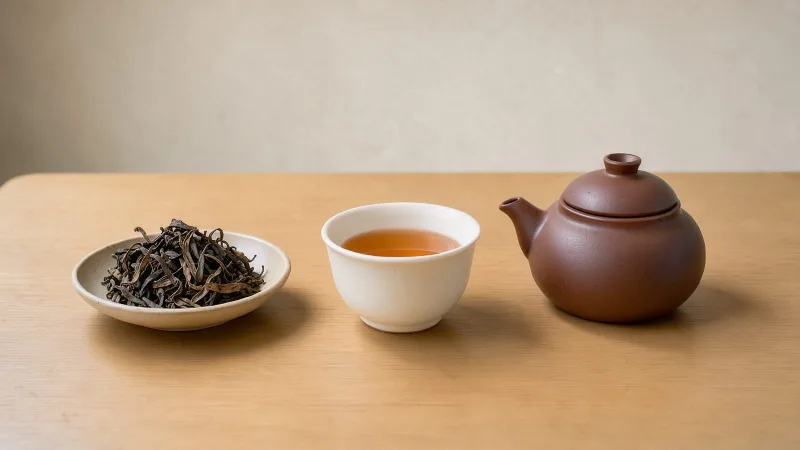
7 g of leaf per 110 ml, water at 95–100 °C (203–212 °F). Pour off the first infusion after 5 seconds; it warms and wakes the leaf. Then 10, 15, 20 seconds, each infusion a little longer. Good leaf lasts 6–8 infusions, and by the end the liquor keeps its sweetness and the taste of stone.
Modern light Tie Guan Yin from Anxi and Da Hong Pao are the two poles of Fujian oolong, the floral south and the roasted north. If you taste both in one session, start with the lighter one.
Common questions
Can you buy tea from the Da Hong Pao mother bushes?
Plucking the six old bushes in the Jiulongke gorge stopped in 2006, and they are now protected. What is sold under the name comes from bushes grown from their cuttings, or is a blend of Wuyi cultivars.
Why does fresh Da Hong Pao taste bitter and smell of charcoal?
After roasting, “fire” stays in the leaf: a sharp bitterness and a charcoal smell. It fades with rest. After a few months in a closed container the taste comes together, so give a fresh pack time to settle.
How many times can you steep Da Hong Pao?
A 110 ml gaiwan with 7 g of leaf gives 6–8 infusions. The first ones last 10–15 seconds, and each one after that runs a few seconds longer.