Tea types 茶
All tea is picked from one plant. The type depends on what happens to the leaf after picking.
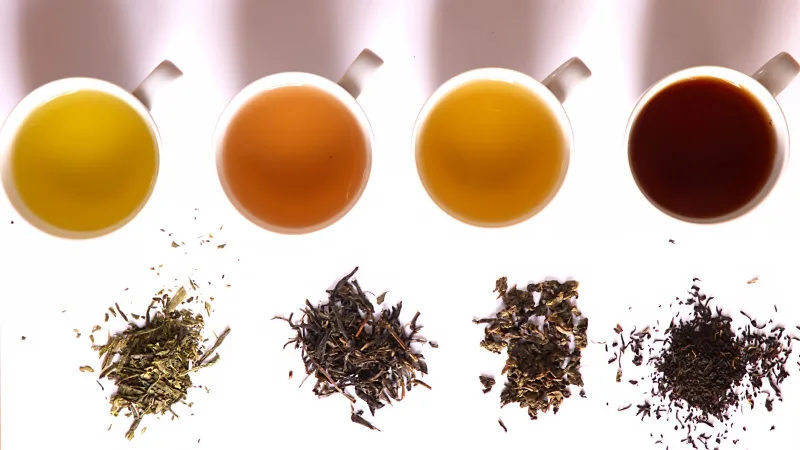
- Plant:
- tea bush, Camellia sinensis
- Types:
- six
- Basis:
- leaf processing and degree of oxidation
- System by:
- Chen Chuan, 1979
Fresh green Longjing and aged pu-erh are leaves of the same species, the tea bush Camellia sinensis. Chinese tea scientists divide tea into six types (六大茶类) by processing. Chen Chuan, a professor at Anhui Agricultural College, proposed the system in 1979, and this whole site is organized around it.
Oxidation and fixation
Once picked, a leaf wilts, and its own enzymes oxidize the polyphenols. The leaf darkens, and the scent shifts from grass toward fruit and honey. The tea maker decides when to stop it. Heating the leaf briefly in a wok, with steam or with hot air, destroys the enzymes, and oxidation goes no further. This step is fixation, sha qingsha qingFixation: a brief heating of fresh leaf. The heat destroys the enzymes and stops oxidation. (杀青) in Chinese, literally "kill-green."
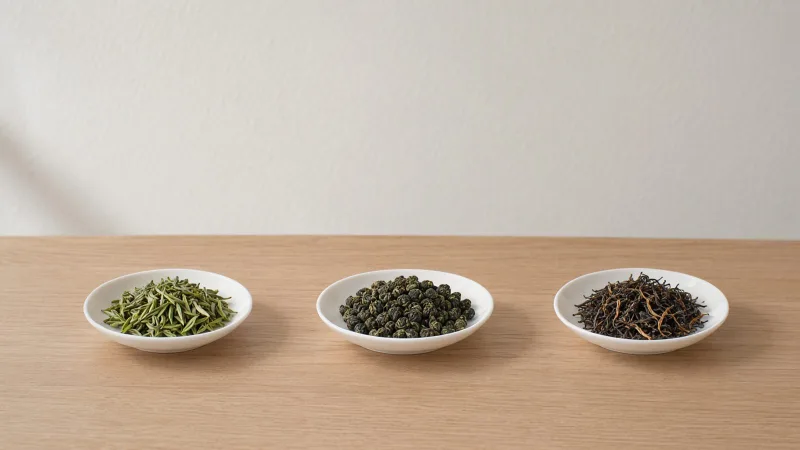
The earlier the fixation, the greener the tea. Green tea is fixed almost at once; oolong is shaken for hours first. Black tea is never fixed at all and oxidizes fully. In China it is called hong cha, "red tea," named for the color of the liquor.
The six types
| Type | Key step | Oxidation | Example |
|---|---|---|---|
| Green | fixation right after picking | minimal | Longjing |
| White | long withering, no fixation | light | Bai Hao Yin Zhen |
| Yellow | sealed yellowing after fixation | light | Jun Shan Yin Zhen |
| Oolong | shaking, then fixation | partial | Tie Guan Yin |
| Black | rolling and oxidation, no fixation | full | Dian Hong |
| Dark | wet piling after fixation | microbial fermentation | Pu-erh |

Dark tea and fermentation
In five of the types, color and flavor come from the leaf's own enzymes. In dark tea, microorganisms do that work. Makers moisten the leaf and heap it into a pile (wo duiwo duiWet piling: moistened leaf is heaped and covered so that microorganisms can ferment it., 渥堆). The pile heats up, and fungi and bacteria transform the leaf over anything from a few hours to two months, depending on the tea. That is why this site keeps the word "fermentation" for dark tea and says "oxidation" for the rest. Chinese texts use one word for both processes, 发酵.
Type and brewing
The type tells you the water temperature. Green and yellow teas take water at 75–85 °C, while oolong and dark teas take it at a full boil. Brewing in short infusions in a small vessel is the gongfu cha method. Gaiwans, teapots and fair cups have their own Teaware section.
Rooibos, hibiscus and fireweed are brewed like tea but come from other plants, so they fall outside this classification.
-
 Green tea
绿茶
Green tea is fixed with heat right after picking, so the leaf never oxidizes. Pan-firing, baking and steaming, the main provinces, brewing and storage.
-
 White tea
白茶
White tea is only withered and dried, never fixed or rolled. Its Fujian home, four types from Bai Hao Yin Zhen to Shou Mei, aging and how to brew it.
-
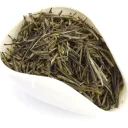 Yellow tea
黄茶
After fixation the warm leaf is covered and slowly turns yellow. How Jun Shan Yin Zhen and Meng Ding Huang Ya are made and how to brew them.
-
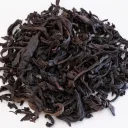 Oolong
乌龙茶
Partly oxidized tea between green and black. Shaking the leaf, roasting, and four schools: North and South Fujian, Guangdong, Taiwan.
Tie Guan Yin · Da Hong Pao · Feng Huang Dan Cong · Rou Gui · Dong Ding
-
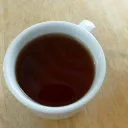 Black tea
红茶
Black tea, or hong cha: fully oxidized leaf that China calls red tea. Why the name differs, its birthplace in the Wuyi Mountains, three groups, brewing.
-
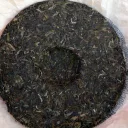 Dark tea
黑茶
Dark tea (hei cha) is fermented by microbes in a wet pile after processing. Pu-erh, Hunan bricks, Liu Bao, pressing, aging and how to brew it.