Dong Ding 凍頂烏龍
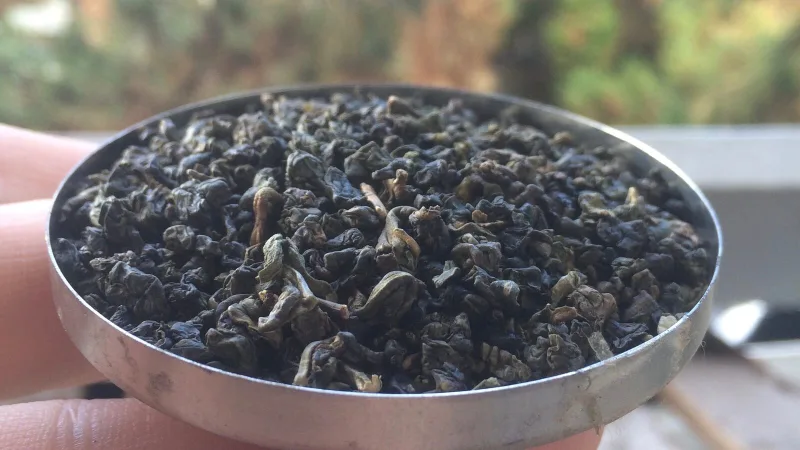
The classic oolong of Taiwan. Farmers in Lugu Township roll leaf from its low hills into tight half-balls and roast it. The cup tastes of honey and roasted nuts, with a long sweet finish.

- Region:
- Taiwan, Nantou County, Lugu Township
- Garden altitude:
- about 700–1000 m
- Cultivar:
- usually Qing Xin Oolong (青心烏龍)
- Leaf shape:
- tight half-balls
- Oxidation and roast:
- medium oxidation, medium to heavy roast
- Taste:
- honey, roasted nuts, baked fruit
Dong Ding oolong (凍頂烏龍, “Frozen Summit oolong”) grows in Nantou County, in the very center of the island. The liquor is golden amber. In the 1980s this oolong was served in nearly every teahouse in Taiwan. Then mountain oolongs became fashionable, and today the name Dong Ding covers two different teas.
Frozen Summit
Dongding is a mountain in Lugu Township, by Qilin Lake. It is not a tall one; the tea gardens around it reach about 1000 m. The tea’s historic heartland is the three villages of Yonglong, Fenghuang and Zhangya. The village of Fenghuang shares only its name with the Guangdong mountains where dan cong grows.
The best-known legend dates the first tea here to 1855. Lin Fengchi, a scholar from Lugu, passed an examination in Fujian and brought back 36 Qing Xin Oolong seedlings from the Wuyi Mountains, and twelve of them went into the ground on Dongding’s slopes1. Other accounts exist, and no documents from that time have been found. Lugu borrowed its processing from southern Fujian, the home of Tie Guan Yin, with the same emphasis on rolling and roasting the leaf.
For a long time Lugu tea sold in modest amounts. That changed in the 1970s, when the area was designated a zone for top-grade tea, and in 1976 the local farmers’ association held the first Dong Ding competition. Competitions now run every spring and winter and draw thousands of samples; the best lots fetch several times the usual price.
Rolling and roasting
Pickers take one bud with two or three leaves. The main harvests are in spring and winter. The leaf is withered in the sun and indoors, shaken, fixed with heat and rolled. Then comes tuan routuan rouCloth rolling: the warm leaf is wrapped in cloth, pulled into a tight ball and rolled, then unwrapped and rolled again. This is how the leaf curls into a half-ball., the step that makes Dong Ding recognizable at a glance. Workers wrap the warm leaf in cloth, and a machine squeezes it into a tight ball and rolls it. They break the ball apart, dry the leaf a little and wrap it again, repeating the cycle many times until the leaf curls into a half-ball. In Anxi a similar technique is called bao rou.
Next comes the roast, bei huo, in an electric oven or over charcoal, sometimes in several rounds. Competition lots are roasted over longan-wood charcoal. Roasting takes away the green taste, adds notes of nuts, caramel and honey, and helps the tea keep for years. Old-style Dong Ding was more oxidized than today’s, and after roasting it brewed up orange-red. In the late 1970s people in Taiwan began calling such tea hong shuihong shui“Red water”: a roasted oolong with an orange-red liquor. In the late 1970s Taiwan began using the name for old-style Dong Ding., “red water”.
Dong Ding and mountain oolongs
In the 1980s new gardens were planted higher up: on Alishan and Lishan, at Shanlinxi next door to Lugu, and later on Dayuling. This gave rise to gao shangao shanHigh mountain tea: Taiwanese oolongs from gardens above 1000 m. They are lightly oxidized and barely roasted., high mountain tea from gardens above 1000 m. Up there it is colder and the leaf grows more slowly. The tea is made light: little oxidation, almost no roast, a floral aroma and a pale, creamy liquor.
The gao shan craze hit Lugu hard. Many farmers started making Dong Ding green, modeled on mountain oolongs, and in some families the roasting skill died out with the older generation. That is why the market now has two kinds of Dong Ding:
- green: light oxidation, a light roast or none, flowers and cream like gao shan, only simpler and cheaper;
- traditional: heavier oxidation, a medium or heavy roast, brown leaf, amber liquor, a taste of honey, nuts and baked fruit.
Ask the seller how heavily it is roasted. Traditional Dong Ding sits between fresh Tie Guan Yin and Wuyi Da Hong Pao: denser and warmer than the first, lighter and softer than the second.
How to brew
Brew Dong Ding gongfu cha style. Green Dong Ding is easiest in a porcelain gaiwan, while the roasted kind opens up well in a Yixing teapot, which holds heat longer. The half-balls unfurl slowly, so Dong Ding’s first infusions run longer than those of twisted-leaf oolongs.
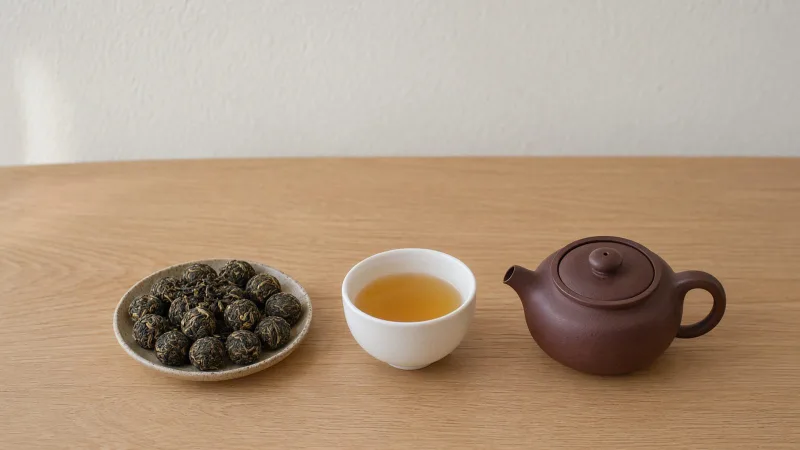
6 g of leaf per 100 ml, water at 95 °C (203 °F); for a heavy roast use water at a full boil. Rinse the leaf and drain at once. Steep the first infusion for 30 seconds, the second for 20, since by then the balls have opened. After that, add 5–10 seconds per infusion. A good Dong Ding gives 6–8 infusions, and the last ones still carry honey and sweetness.
The spent leaf of traditional Dong Ding is whole, with a reddish rim along the edge, as in any medium-oxidized oolong.
Common questions
Is Dong Ding a gao shan mountain oolong?
Dong Ding grows lower: the Lugu gardens lie mostly at 700–1000 m, while Taiwan reserves the name mountain oolong for tea from 1000 m and up. They are processed differently too: Dong Ding is oxidized further and roasted, while gao shan is kept green and floral.
Why is one Dong Ding green and another dark?
Since the 1980s many Lugu farmers have made their tea in a green style modeled on mountain oolongs: light oxidation, almost no roast. Traditional Dong Ding is more oxidized and roasted, with brown leaf and an amber liquor. A good package lists the roast level.
Where does real Dong Ding grow?
The historic center is the villages of Yonglong, Fenghuang and Zhangya in Lugu Township, Nantou County. Today the name also refers to a processing style, so tea from elsewhere in Taiwan, and even from abroad, is sold as Dong Ding.
-
The Lugu Township administration gives 1855, though its own chronology also mentions 1831. Another account has the Su family growing tea on Dongding as early as the 18th century. ↩