Polyphenols: catechins, theaflavins, astringency 茶多酚
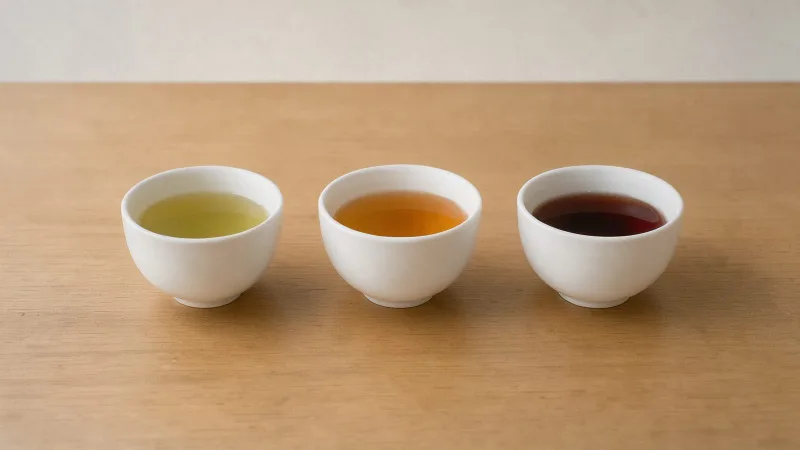
Astringency, the color of the liquor and the haze in a cooled cup all come from one family of compounds. Oxidation reshapes them in the leaf, and the way you brew shifts the taste.
- Share of the leaf:
- 18–36% of dry weight
- Main group:
- catechins, 70–80% of polyphenols
- Most abundant:
- EGCG (epigallocatechin gallate)
- Oxidation products:
- theaflavins and thearubigins
- What they give:
- astringency, bitterness, liquor color
- Analysis standard:
- ISO 14502-1:2005
If tea leaves your tongue feeling dry, black tea brews orange-red, or iced tea clouds over in the fridge, polyphenols are almost always the reason. They make up 18–36% of the leaf's dry weight,1 more than any other group of compounds. Caffeine and theanine, by comparison, account for a few percent each.
Catechins: what's in the green leaf
Catechins form the core of tea polyphenols, 70–80% of the total. There are eight main ones, and they differ in two ways: whether the molecule carries a gallic acid group, and how the carbon atoms C2 and C3 are oriented (cis or trans). The most abundant, most astringent and most studied is EGCG, epigallocatechin gallate.
In practice, one distinction matters. The catechins with gallic acid, EGCG and ECG, are the galloylated catechinsgalloylated catechinsCatechins with a gallic acid group in the molecule (EGCG, ECG). They bind salivary proteins most strongly and account for most of the astringency. (also called ester catechins). They are more astringent and more bitter than the rest, while EGC and EC, which lack gallic acid, are noticeably milder. So the astringency of a brew follows the share of gallates, not the catechin total. Japanese taste-sensor studies back this up: gallate catechins predict the astringency of green tea better than total catechins do.
Catechins make up about 20% of the dry weight of green tea. In one laboratory comparison of six teas, one of each type, EGCG varied almost fifteenfold (mg per gram of dry leaf):
| Sample | EGCG | Caffeine |
|---|---|---|
| White, Gongmei | 6.01 | 27.47 |
| Green, Dianqing | 50.78 | 41.46 |
| Oolong, Fenghuang Shuixian | 36.70 | 34.77 |
| Black, Yichang Gongfu | 3.80 | 41.63 |
| Dark, Fuzhuan | 10.89 | 27.08 |
These are single samples, not norms for a type, and the spread within a type is wide. Still, the picture is clear. Green tea keeps its catechins nearly intact, because the heat of fixation kills the enzymes before oxidation can start. Black tea has almost no EGCG left but plenty of caffeine: its catechins have turned into other compounds.
Astringency: what happens in the mouth
In the classic model, polyphenols bind to proline-rich proteins in saliva, first as soluble complexes, then as aggregates. The saliva film loses its lubrication, mucosa drags against mucosa, and you feel dryness and puckering. The more gallic groups, the stronger the bond: ECG and EGCG grip salivary protein roughly 5–8 times more readily than EGC and EC.
A precipitate isn't required, though. EC and EGC are astringent even though they form only soluble complexes with saliva. The leaf's flavonol glycosides add a different, “velvety” astringency and make the bitterness of caffeine more pronounced.
In the cup, green and white tea turn more astringent and bitter as water temperature and steep time go up: hot water draws out the galloylated catechins in particular. If a green tea has turned harsh, lower the temperature and shorten the steep. Temperature also sets how fast the leaf gives up its flavor.
What oxidation does to catechins
Rolling bruises the leaf, and the enzyme polyphenol oxidase reaches the catechins and oxidizes them. Pairs of catechins combine into orange theaflavinstheaflavinsOrange pigments formed when catechins oxidize. They give black tea liquor its brightness and briskness., four main compounds: TF1, TF2a, TF2b and TF3. Deeper oxidation produces thearubigins, a brown, poorly characterized mixture that makes up 60–70% of the dry matter of black tea liquor.
Finished black tea contains 0.3–1.5% theaflavins by dry weight. Published figures vary because some researchers count per leaf and others per dry matter of the liquor, where the share is higher. Even so, theaflavins do much of the work in the cup. They bring brightness, the golden rim at the edge of the cup (the Chinese call it 金圈, “golden ring”) and the briskness that makes tea taste fresh and lively rather than flat. In India they are used to judge grades and prices. Thearubigins outweigh theaflavins 9 to 30 times, yet they show no correlation with taster scores, and a very high TR/TF ratio signals over-oxidation.
One caveat: another school, working with taste recombination, found that the taste of black tea liquor depends on caffeine, flavonol glycosides, catechin and EGCG, and that theaflavins play only a secondary role. The question is still open, and it changes little at the table: the color and freshness of black tea track oxidation, and getting the degree right matters.
In the other types:
- Oolong is partly oxidized, so its liquor contains both catechins and their dimerization products, theasinensins and oolongtheanins. Lightly oxidized oolongs have more of the former, heavily oxidized ones more theaflavins. In the table above, Fenghuang Shuixian comes close to green tea in EGCG.
- White tea loses part of its catechins during withering, so its liquor has fewer than green tea.
- Dark teas, above all shou pu-erh, go through microbial post-fermentation: catechins drop and the brown pigment theabrownin builds up. The liquor is dark and soft, with little astringency. In Chinese grading of black teas, a dull cup without a “gathering” astringency is blamed on the same theabrownins.
In the pot: what you can change
The polyphenols in your cup depend on how you brew as well as on the leaf.
Temperature. One study compared green tea steeped for about an hour in a fridge at 10 °C with a hot brew at 80 °C for 2 minutes. The cold brew yielded roughly a fifth of the EGCG, about half the caffeine and about 70% of the EGC. Hardly any theanine was lost. So cold brew makes a different drink: soft and sweetish rather than drying.2
Time while hot. Catechins are fragile. At 40 °C and below there was no epimerization in 20 minutes, but in a hot brew EGCG converts to its epimer GCG and breaks down. In one experiment, after an hour at 80 °C, 38.4% of the EGCG remained in distilled water and 1.4% in mineral water. So don't leave green tea sitting in a hot flask for hours; pour it off into a fair cup.
Water. The harder and more alkaline the water, the faster catechins oxidize and rearrange: at pH 8, epimerization of EC runs about 50 times faster than at pH 5. Higher mineral content also lowers catechin extraction. Green and white tea do best with soft water.
Lemon. Acid stabilizes EGCG: about 95% survives in any water (a test on a single green tea).
Amount of leaf. A higher leaf ratio and a longer steep mean more polyphenols and harsher astringency.
Why cooled tea turns cloudy
Brew strong black tea and put it in the fridge, and it will go cloudy. This is called tea creamtea creamThe haze in a cooled strong brew: polyphenols and caffeine stick together into insoluble complexes. in English, 冷后浑 in Chinese and “creaming down” in Japanese. Neither the cup nor poor leaf is to blame. Theaflavins assemble into nanoclusters, caffeine fills the gaps, and the molecules stick together; calcium makes it worse. Studies differ on what the sediment is made of: in one Assam tea, thearubigins dominated the colored components (about 86%) and theaflavins made up about 12%.
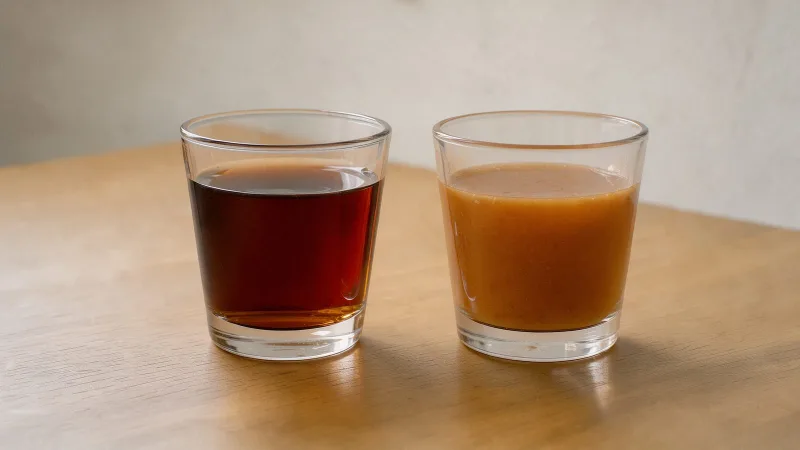
In a test by America's Test Kitchen, 6 g of leaf per cup (about 240 ml) at 88 °C for 4 minutes made a cloudy brew, 4 g a slightly cloudy one and 2 g a clear one. Overnight cold brew, at room temperature or up to 43 °C, stayed clear even after boiling and cooling again. Fast or slow chilling, sugar and distilled water did not get rid of the haze.
If a brew has clouded, warm it slightly and the complexes dissolve, or dilute it with ice water. Don't acidify it: sediment in black tea liquor peaks around pH 4.
What this means when choosing tea
In green and white tea, strong astringency more often comes from hot water or a long steep than from bad leaf. In black tea the key marker is theaflavins: in Indian grading their share tracks price, brightness and briskness, and according to Roberts a tea with good liquor color has at least 0.75%. You can't measure that at home, but you can see and taste what matters: a bright, clear cup with a golden rim and a fresh taste. Chinese assessors put a dull liquor without “gathering” astringency down to theabrownins.
Laboratories measure polyphenols to a standard. Under ISO 14502-1:2005, the leaf is extracted with 70% methanol at 70 °C, twice for 10 minutes, and absorbance is read at 765 nm. The Chinese GB/T 8313-2018 builds on the same method.
Common questions
Are there tannins in tea?
According to the UK Tea Advisory Panel, most tea polyphenols are not tannins in the strict sense, and tea contains only small amounts of tannin-type compounds. “Tea tannin” is a historical term: in 1935 it referred to epicatechin gallate. Chinese reviews still call 茶多酚 by the name 茶单宁, “tea tannin,” so the dispute is largely about words.
Why does cooled tea turn cloudy, and is it safe to drink?
It is tea cream: theaflavins, thearubigins and caffeine from the brew itself stick together. Dirty cups and bad leaf have nothing to do with it. Warm the cloudy tea slightly and the complexes dissolve again, or dilute it.
What is the difference between astringency and bitterness?
Astringency is dryness and tightness in the mouth: saliva loses its lubrication and friction rises. Bitterness is a taste. Catechins cause both, the galloylated ones more strongly, and caffeine adds a bitterness of its own.
-
Review of Chinese studies on tea taste compounds, Food Research and Development, 2017: polyphenols 18–36%, catechins 70–80% of the total. Source. ↩
-
Data from Japan's Ministry of Agriculture (MAFF/NARO) and Monobe's 2021 review (Kagaku to Seibutsu, 59(10)); at 0.5 °C about 80% of theanine is extracted. Source. ↩