How much tea, how long 投茶量
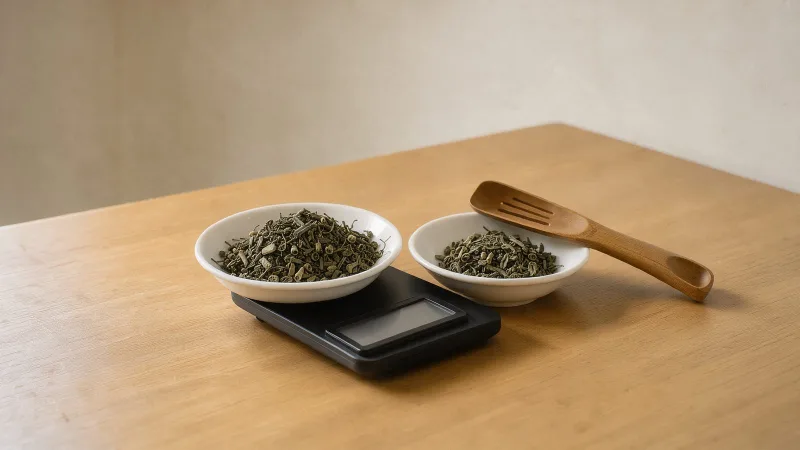
Leaf doseleaf doseThe mass of dry leaf put into the vessel for a given volume of water. Measured in grams on a scale, not in spoons., water volume and steeping time only work as a set. Change one and the others shift: more leaf means a shorter steep, a bigger cup means more tea.
- ISO 3103 reference:
- 2 g per 100 ml, 5–6 minutes
- GB/T 23776 reference:
- 3 or 5 g, 1:50
- Western cup:
- 2–3 g per 6 oz, 3–5 minutes
- Wuyi oolong:
- 5–15 g per 110 ml, 10–45 seconds
- Chaozhou gongfu:
- 1:12–1:16, up to 80% of the pot
Ask ten tea drinkers how much leaf to use and you get ten answers, from a couple of grams in a mug to half a gaiwan. All of them are right, because each names only one of three quantities: the mass of dry leaf, the volume of water and the contact time. Temperature is a separate subject that belongs with water. The other three are tightly linked, which is why standards specify them only as a set and, when two liquors are compared, require the same leaf mass, water volume, vessel and time.
The reference point: 1:50
Tasters need a liquor they can repeat, so standards pin the numbers down. ISO 3103 (2019 edition) calls for 2 g of tea per 100 ml of boiling water. For the large tasting pot that means 5.6 g in about 285 ml, for the small one 2.8 g in about 140 ml, weighed to within 2%. Black tea steeps for 6 minutes, whole-leaf green for 5, fannings for 3. The Russian GOST ISO 3103-2013 follows the older 1980 edition: the same 2 g per 100 cm³ and 6 minutes, but 5.7 g for the large pot1.
China's GB/T 23776-2018 also uses 1:50, that is, 3 or 5 g of leaf in 150 or 250 ml. Steeping time depends on the type:
| Tea | Dose and water | Time |
|---|---|---|
| Green | 1:50 | 4 min |
| Black, white, yellow, strip oolong | 1:50 | 5 min |
| Ball-rolled oolong | 1:50 | 6 min |
| Oolong in a gaiwan | 5 g in 110 ml | 2, 3 and 5 min, three steeps |
| Loose dark tea | 1:50 | 2 min + 5 min |
| Pressed dark tea | 1:50 | 2–5 min + 5–8 min |
Under this standard dark tea is steeped twice, with color judged from the first liquor and taste and aroma from the second. The long steep doubles as a test, since it exposes flaws in the raw material.
These numbers are for comparing teas, not for drinking. A 1:50 liquor steeped for six minutes is too strong for a breakfast cup. As a yardstick it is handy, though: you can see how far your own leaf doseleaf doseThe mass of dry leaf put into the vessel for a given volume of water. Measured in grams on a scale, not in spoons. sits above or below it.
The Western cup
Everyday guidance is gentler. The US shop Tea Trekker suggests 2–3 g per 6 oz of water and admits that this dose can fill anywhere from one teaspoon to three tablespoons. The UK Tea & Infusions Association measures by volume: one rounded teaspoon of loose tea or one tea bag per cup. It recommends 3–4 minutes for black tea, 4–5 for Lapsang Souchong, 2–2.5 for sencha and 3–5 for oolong.
Chinese household guidance for brewing in a glass puts green, black and yellow tea at 1:50, white at around 1:20–1:25, oolong at around 1:15, and dark tea and pu-erh at 1:30–1:50. Steep for 2–3 minutes and top up the glass once two thirds of it is gone. That gives about three infusions, four or five for oolong, and nine or ten for some.
Teapots and tea bags are covered under Western brewing.
Gongfu: lots of leaf, seconds of time
In gongfu cha the arithmetic flips. You use several times more leaf, and steeps shrink from minutes to seconds.
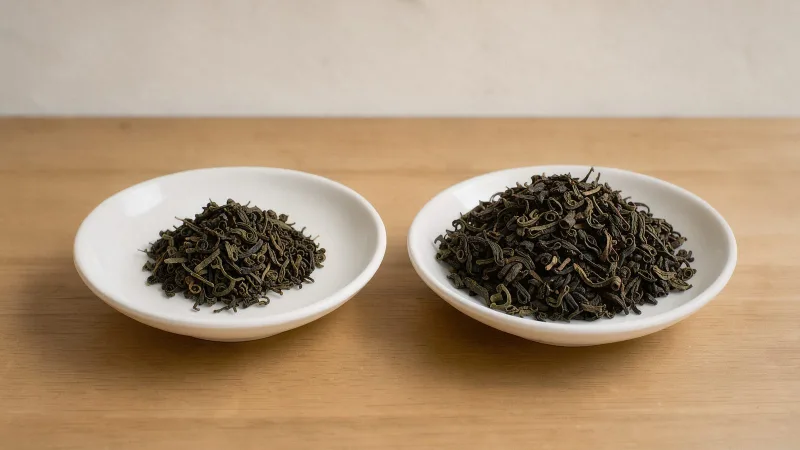
The Wuyi standard DB35/T 1545-2015 allows 5–15 g in 110 ml, from 1:7 to 1:22. A dose of 5 g at 20/30/45 seconds gives a light liquor, and so does 8 g at 10/15/20. Both 8 g at 20/30/45 and 10 g at 10/15/20 come out medium, while 10 g at 20/30/45 and 12 g at 10/15/20 come out strong. The three numbers are the times of the first three steeps, and from the fourth on each steep gets longer. Pouring in and decanting are not counted.
In Chaozhou the regulation T/CTSS 5-2019 sets 1:12–1:16: 8 g in 100 ml for the strong traditional style or 7 g in 120 ml for the soft one. After the rinse the first steep lasts 38 seconds, then 22–35 seconds each (15–30 in the soft style). Pots hold 90–150 ml, ideally 120. The leaf fills about 80% of the pot, but local practice is more precise. Tightly rolled Fujian oolongs go in at about 60%, straight Phoenix Dan Cong nearly to the brim, and the more broken leaf in the pack, the smaller the dose.
The Guizhou "fast pour" method falls in between: 1:25–1:38, 4–6 g in 150 ml, boiling water, 10–40 seconds a steep, no rinse.
Use a 100–120 ml gaiwan and a scale. Put in 6–7 g of ball-rolled oolong, 4–5 g of strip oolong or black tea, or 3–4 g of green. Water at 95–100°C (203–212°F), lower for green. Steep the first round 10–15 seconds and each following one 5–10 seconds longer. If it comes out too strong, take out a gram of leaf rather than cutting a second. If it is too weak, do the opposite.
Vendor advice varies widely, from 3–3.5 g per 100 ml to 6.7 g, and one seller gives a Taiwanese oolong 50 seconds for the first steep where another gives 25. That comes down to taste, not error, and no neutral source settles it.
Why a spoon is a poor measure
The same weight of leaf can take up very different volumes. A tablespoon of white tea buds weighs no more than 2 g, a tablespoon of ball-rolled oolong 6–7 g. A 3 g dose might fit in a teaspoon or fill three tablespoons. Even within one type the difference shows: large leaf weighs little for its volume, while chopped and small leaf packs tight. The difference comes down to bulk densitybulk densityHow much a given volume of leaf weighs. Loose buds have a low one, tightly rolled balls a high one., which is why "a spoon per cup" works only for a tea you already know.
A scale with 0.1 g steps is cheap. GB/T 23776 calls for exactly that, and ISO allows a 2% margin. Weigh the dose once and note it down with the gaiwan volume and the time. Next time you can repeat the brew exactly and taste what changed.
Infusions: how the leaf releases flavor
The same leaf can be steeped many times because its compounds come out at different rates. Research from Taiwan's Ministry of Agriculture found that about two thirds of the amino acids and caffeine leave in the first steep, while catechins are slower, with half in the first and roughly a third in the second. That is why early steeps taste sweet and fragrant and astringency builds later.
Tightly rolled oolongs such as Dong Ding and Tie Guan Yin release their soluble matter slowly, and after the eighth steep about 10% is still in the leaf. Longjing and Baozhong release about 90% within four or five steeps. Staying power is a poor measure of quality, though. Longjing has no less soluble matter in total; it simply releases it faster.
White tea behaves differently. When black and white tea are made from the same raw material, black yields 16.10% soluble solids in its first steep and white 6.87%. By the fifth steep white overtakes black (3.12% against 2.85%). White tea is not rolled, and rolling affects how quickly the leaf releases what it holds.
In practice, make each steep longer than the last: Taiwanese guidance suggests 10–20 seconds more per round to keep the strength even. Decant completely, because water left in the leaf over-steeps it and spoils the next round. Japanese guidance says to pour out every last drop. And the first steep is not always the strongest: with sheng pu-erh steeped for four minutes at a time, extraction peaks in the second.
Adjusting
Adjust strength with the dose first, then with time. Extra seconds pull out bitterness and astringency, while an extra gram of leaf adds everything at once and keeps the taste balanced.
When you compare someone else's seconds with yours, check how they were counted. In Guizhou the clock starts when the pour begins; in Wuyi, pouring in and decanting don't count. So "twenty seconds" in two sources means two different lengths of time in the water.
When you change vessels, scale the leaf: twice the volume takes twice the leaf, and the time stays the same. Preheating and rinsing also change the result. Work out the dose for your own oolong in your own gaiwan, write it down and repeat it.
Common questions
How much tea should I use per cup?
For a Western cup of 6–8 oz, use 2–3 g of leaf and steep 3–5 minutes. The ISO tasting standard calls for 2 g per 100 ml, which is stronger than everyday practice. Gongfu brewing uses far more: 5–15 g per 110 ml under the Wuyi standard.
Can I measure tea with a spoon?
Only roughly. A spoon of loose white tea buds weighs about 2 g, a spoon of tightly rolled oolong balls 6–7 g, three times as much. A cheap kitchen scale with 0.1 g steps settles the question for good.
How many times can I steep the same leaf?
It depends on the tea and the method. In a Western cup, green, black, white and yellow teas usually give about three steeps and oolong 4–5. In gongfu brewing, a tightly rolled oolong holds up for eight infusions or more.
-
ISO 3103:2019, Tea – Preparation of liquor for use in sensory tests, iso.org/standard/73224.html; GOST ISO 3103-2013, allgosts.ru. ↩