Teapot anatomy: spout, lid, handle and filter 茶壶结构
The spout, filter, vented lid and handle decide whether a teapot pours in one clean stream or dribbles down its side. What each part does and how to test it before buying.
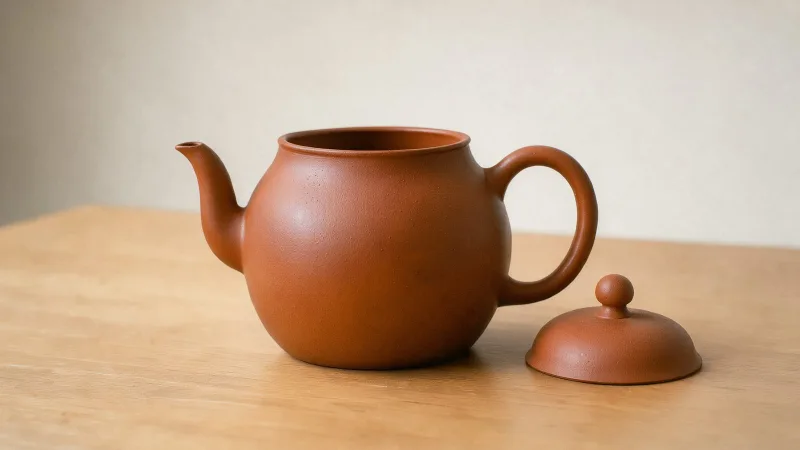
- Parts:
- body, mouth, lid, spout, filter, handle, base
- Spout:
- straight, or with 1–3 bends
- Filter:
- single hole, net, ball
- Size for gongfu cha:
- 90–150 ml (Chaozhou)
- Three points:
- height difference under 2 mm
Two teapots of the same size can pour very differently. One cuts the stream off cleanly. The other sputters, drags a drop down the spout and leaks from under the lid. The difference almost always comes down to a few details: how the spout is made, how many holes the filter has, how the lid sits in the mouth, and how high the base of the spout is attached. Anyone can spot them once they know where to look.
What a teapot is made of
The body (壶身, húshēn) holds the water and leaf. The lid sits in the mouth (壶口). The stream comes out of the spout (流, or 壶嘴), and a filter (出水孔) is built into the wall at its base. The handle (把) is for grip and balance, and the base or foot ring (底, 圈足) keeps the pot steady.
The lid (壶盖) has parts of its own. The flange (子口) sits inside the mouth and keeps the lid from falling out when the pot tilts. The knob on top is for lifting it, and the vent hole in the knob (气孔) lets air in as liquor goes out. Yixing zisha makers distinguish four lid fits: overlapping, inset flush with the rim, cut-off (continuing the line of the body) and cap.
All of this applies to any spouted pot, from a Yixing teapot to a porcelain one. A gaiwan does the same job without a spout: you pour through the gap under the lid.
The spout and dribbling
Spouts are either straight or curved. A short, thick straight spout is called a "cannon", a long thin one a "sword". Curved spouts have one, two or three bends. The Hong Kong workshop Ming Hu ranks them like this: for pouring force, straight beats one bend, one beats two and two beats three, while for a clean cut-offclean cut-offThe moment the stream breaks off cleanly, with no drop crawling down the spout and onto the table. the order is reversed. They see the single bend as a compromise between force and cut-off.
Flow rate depends on the inner diameter at the narrowest point of the spout. Every bend adds resistance, and how long the stream holds together depends on how smooth the inner wall is and how much the spout tapers. The height of the spout root matters too. The closer it is to the bottom, the stronger the pour and the less water escapes from under the lid. With a higher root you have to tilt the pot further, and the lid is more likely to leak.
Short straight spouts, like those on the shi piao and de zhong shapes, tend to dribble: stop pouring halfway and the liquid clings to the wall and creeps down. Chinese writers call this 流涎, "drooling".
The argument over spout shape goes back a long way. Li Yu, in Xian qing ou ji, wrote that one bend is already cause for worry and two make the pot useless: in water the leaf opens into large plates and jams the bend, while a straight channel is easy to clear.1 Modern sellers see a trade-off instead: a bend costs some force but gives a cleaner cut-off. If the liquor goes straight into a fair cup and a few drops do not matter, a straight spout is fine.
The filter at the base of the spout
The filter keeps leaf out of the spout. There are four main designs.
- Single hole. The widest opening and the strongest pour. Small leaf clogs the spout.
- Net. Usually 7, 9 or 14 holes, sometimes 17 or 21. Holds back most of the leaf, but opened leaf can cover the holes.
- Pressed net. The wall is pushed inward and holes are punched in the bulges. More area, a faster pour, and it takes handwork.
- Ball filter. A glued-in half sphere with many small holes. The most area and the best filtration, but harder to clean, and it takes up room in a small pot.
What counts is total area. As long as the open holes add up to more than the cross-section of the spout outlet, partial clogging does not slow the pour. That is why a net with few holes struggles with teas whose leaf opens up a lot, and why a ball keeps pouring even when part of it is covered.
Ming and Qing pots had a single hole, and the net came into use in the late Qing. In Yixing the ball filterball filterA perforated half sphere attached to the inside wall at the base of the spout. appeared in the 1970s on pots made for export to Japan. The chronicle of the Yixing Zisha Factory dates the change to 1970, and by 1975–1977 the ball was the standard filter on export pots. Hence the view in China that a ball means a cheap pot. That is not accurate. Balls turn up on good semi-handmade pots, and handmade and pressed balls are among the best designs for pouring. Still, balls are often molded and sold to potters ready-made, so a ball may be of different clay than the body. If a pot sold as fully handmade has one, ask the seller to explain.
The lid and vent hole
As liquor leaves the pot, air has to come in. That is why the ISO 3103 tasting pot has a loose-fitting lid with a small hole, and why on a good pot the hole in the knob is neither glazed over nor too narrow. If it is, the pour comes in jerks.
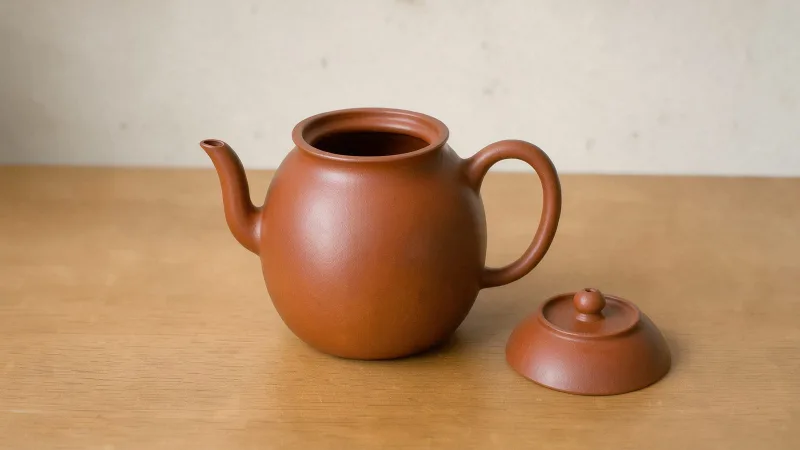
Chinese makers describe a good mouth and lid pair with four characters: 紧、直、通、转.
- Tight. The lid comes off easily but barely wobbles. Articles from Zisha Zhi Jia cite about 0.5 mm of clearance for good zisha and 1–3 mm for porcelain.2 No measurements back the figure up, so treat it as a rule of thumb. With zero clearance, the first stray bit of leaf will jam the lid.
- Deep and straight. The flange is deep and even, so the lid stays put at a steep tilt. China's national standard for zisha, GB/T 10816-2024, requires that the lid not fall out at a tilt of 70°.
- Turns freely. A round lid rotates without catching.
- Fits in any position. On square and ribbed shapes, the ribs of the lid line up with the ribs of the body.
On a new pot the lid has not yet worn in against the mouth and may leak. This usually goes away.
The handle
The type of handle determines how the pot sits in your hand and where its weight goes as you pour.
- Back handle, opposite the spout. The most common type in China and on European teapots.
- Side handle, at 90° to the spout. The main type in Japan, where a handle at 85–90° to the spout is considered comfortable. You pour one-handed, holding the lid down with your thumb.
- Overhead handle, over the lid. A rigid one is fired with the body and is technically hard to make. A detachable one goes on after firing and can be metal, rattan or bamboo.
- No handle, the Japanese hohin: for gyokuro and sencha brewed with cooled water, when the body does not get hot.
The Chaozhou standard describes the grip: thumb and middle finger on the handle, ring finger supporting it from below, index finger resting lightly on the knob. A finger goes on the vent hole only to test the lid. Take it off when you pour, or the pour will stop.
Size
For gongfu cha, pot size is tightly specified. Chaozhou standards (T/CTSS 5-2019 and DB4451/T 4-2023) give 90–150 ml with cups of 25–35 ml, and an optimum of 110–120 ml. A 2021 group standard widens the range to 60–160 ml. At home, gongfu cha is usually brewed in a 100–200 ml teapot or a 100–150 ml gaiwan.
Old advice agrees. Feng Kebin wrote around 1642 that a teapot is prized for being small, and Zhou Gaoqi, in Yang xian ming hu xi, called for a small, shallow pot with a domed lid. The reason is practical. In a small pot the aroma does not dissipate.
Why a teapot drips
Physicists have studied this since the 1950s. Markus Reiner coined the term "teapot effect" in 1956 and showed that coating the spout with paraffin does not cure it, so adhesion alone is not the answer. In 1957 Joseph Keller offered a hydrodynamic explanation, and in 1999 Jean-Marc Vanden-Broeck and Keller won an Ig Nobel Prize for calculating a non-dripping spout.
Later work brought in the inertia of the stream. In 2010 Duez and colleagues showed how much wettability matters: the thicker the spout rim, the more easily liquid runs along it, and only a superhydrophobic coating stops dripping completely. In 2021 Scheichl, Bowles and Pasias published a complete theory. In it, the contact angle and the shape of the rim matter most, while gravity only sets the direction, and the effect would happen on the Moon too.3
In practice, three things follow. A sharp spout rim beats a thick one. A decisive stop beats a slow trickle. And tilting the pot to nearly 90° pushes all the water against the lid, so almost any pot will leak there. Tilt gradually.
How to test a teapot before buying
- Take off the lid and turn the pot upside down: the tip of the spout, the rim of the mouth and the top of the handle should lie in one plane. The Chaozhou standard allows less than 2 mm.
- Put the lid on and check that it sits evenly, turns without catching and lifts off with one finger.
- Fill the pot with water and tilt it: the lid should not fall out, and nothing should leak from under it.
- Fill the pot and pour the water out. The stream should be whole, follow the axis of the spout and cut off without dribbling.
- Cover the vent hole with a finger mid-tilt: the pour should stop.
The "three pointsthree pointsTurn the pot upside down and the tip of the spout, the rim of the mouth and the top of the handle should lie in one plane. In Chinese, san shan qi." rule is practical. If the spout sits lower than the mouth, water will run into the spout before the pot is full. If it sits higher, water will come out from under the lid before it comes out of the spout. The handle does not need to line up for the pot to work, and a handmade pot does not have to match to a fraction of a millimeter.
Once you own the pot, look after it the way you would any teaware. And if you do not need a teapot at all, only a way to separate leaf from liquor, a strainer or infuser will do.
Common questions
Why does a teapot lid have a tiny hole?
As liquor leaves the pot, air has to get in to replace it. Without the hole the pour sputters or stops. Cover the hole with a finger and the stream stops, which is a good way to check how snugly the lid fits the mouth. It is no way to pour, though: the steam will burn your finger.
Why does a teapot drip, and can it be fixed?
It comes down to wetting and flow speed. A fast stream breaks cleanly off a sharp spout rim. Off a thick rim, or in a slow pour, the liquid clings and runs down. Only a superhydrophobic coating stops dripping completely, and ordinary teaware has none. A smooth tilt, a decisive stop and a pot that is not filled to the brim all help.
Which filter is best: single hole, net or ball?
A single hole pours with the most force, but small leaf clogs it. A net holds back most of the leaf. A ball has a large surface and keeps the pour going even when some holes are blocked. A ball does not mean a bad pot, but on a pot sold as fully handmade it is worth asking the seller about.