Tea in Europe and Russia
Tea reached Europe by sea and Russia overland through Mongolia. Nearly everywhere people drink it black and seldom plain, adding milk, cream, sugar or jam.
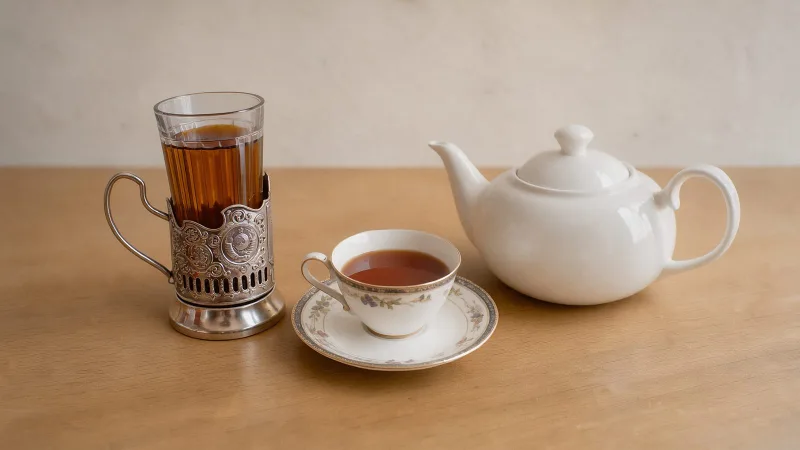
Tea came to Russia from Mongolia in 1616–1638 as a diplomatic gift and later through Kyakhta, but it became widely drunk only in the second half of the 19th century. Russians drink it in two steps: they pour a strong concentrate from a small pot into the bottom of the cup and top it up with boiling water from the samovar. On weekdays they bite off a piece of sugar rather than stirring it in. Since the 1880s Russia has had home-grown tea, from Georgia and the Krasnodar region.
Britain first met tea in the London coffeehouses of the 1650s. While the duty stood at 119 %, legal tea went to those who could pay, and smugglers supplied everyone else. In 1784 the duty fell to 12.5 %, and tea became an everyday drink. Britons now get through about 100 million cups a day, nearly all from tea bags and nearly all with milk.
The Dutch East India Company landed the first cargo of tea in continental Europe in 1610, and the Dutch spread the word too: thee, Tee and thé go back to Southern Min te, while Polish herbata comes from Latin herba thea. East Frisians in northwest Germany still keep a ritual of their own: about 10 g of Assam per liter, a lump of rock candy, cream and three cups in a row.
-
 Russian tea
 drinking: tea from Mongolia and Kyakhta, zavarka diluted with hot water, the samovar, the glass in a holder, sugar in the teeth, Soviet tea.
-
 Britain and Ireland
Tea in Britain: from the London coffeehouses of the 1650s to the mug and tea bag. Duties, Assam, afternoon tea and high tea, milk first or last, Irish tea.
-
 Continental Europe
Tea in Europe: the Dutch from 1610, the East Frisian ceremony with rock candy and cream, Paris salons, Czech tea rooms and Swedish tea ships.