Yue and Longquan celadons 青瓷
Traces of iron and a firing starved of air turn the glaze green. Lu Yu ranked Yue bowls first for tea in the eighth century, and from the Southern Song on, Longquan potters laid the glaze on as thick as jade. Both are still made today.
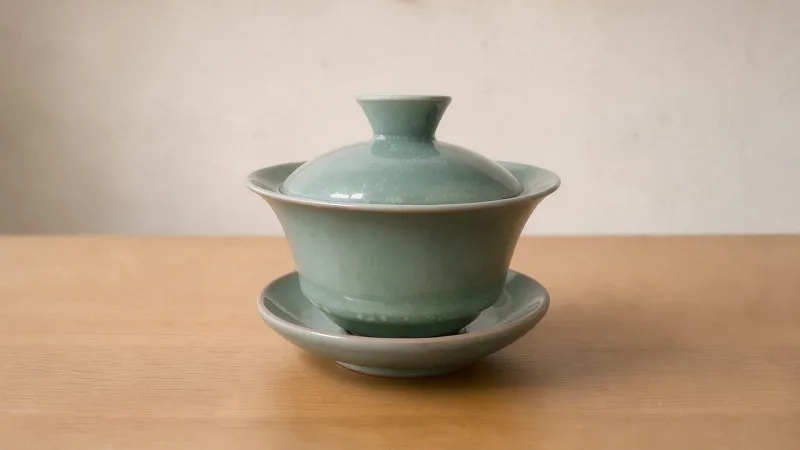
- Made in:
- Zhejiang: Yue around Shanglinhu near Cixi, Longquan in the southwest
- Yue peak:
- Tang and Five Dynasties, mise ware from 847
- Longquan peak:
- Southern Song to Yuan, exported from the late Northern Song
- Longquan glaze:
- plum green about 1260–1300 °C, powder green about 1200–1260 °C
- Ware standard:
- GB/T 10813.1-2015: water absorption 1.0% at most
- Status:
- Longquan firing on the UNESCO list, 2009
A Tang Yue bowl held “half a sheng or less”, and it was used for boiled tea. A Longquan bowl shipped to Japan in the thirteenth century is taller and heavier, with a glaze as thick as jade. Both were fired in Zhejiang, and both carry a green glaze colored by iron.
Where the green comes from
Celadon is ware with a glaze tinted by traces of iron and fired in a reduction atmosphere, meaning with too little oxygen. The body can be stoneware or porcelain-like, and the Chinese standard for everyday ware defines celadon the same way. The color comes from the kiln, not from a pigment.1
For a cup this means three things. The color sits in the glaze itself and will not wear off. Water absorption for such ware is at most 1.0%, so the body is dense. And the green background changes how the liquor looks, as Lu Yu noted long ago.
The Western name comes from Céladon, a shepherd in Honoré d’Urfé’s novel L’Astrée, who wore ribbons of that color.
Yue: the bowls Lu Yu ranked first
The Yue kilns stood in the northeast of Zhejiang, around Shaoxing and Ningbo, and later centered on Lake Shanglinhu near Cixi. Mature celadon was fired there as early as the Eastern Han, but under the Six Dynasties it was mostly burial ware. Yue came back as tableware for the living in the eighth century.
In the Classic of Tea, Lu Yu ranks bowls in this order: Yuezhou first, then Dingzhou, Wuzhou, Yuezhou (岳州, a different city), Shouzhou and Hongzhou. To those who put white Xing above Yue he gives three answers. Xing is like silver, Yue like jade. Xing is like snow, Yue like ice. In a white bowl tea turns reddish, in a green one it turns green. A yellow Shouzhou bowl, he says, makes the liquor purple, a brown Hongzhou bowl makes it black. He judged white Xing, Shouzhou and Hongzhou unfit for tea. These were the bowls for Tang boiled tea.
Lu Yu describes the ou (瓯) bowl this way: the rim is not turned out, the base is turned and shallow, and it holds “half a sheng or less”. No reliable source converts that to milliliters, so no figure is given here. A typical mid-Tang bowl in the Palace Museum has a flared rim, slanting walls and a wide ring foot in the shape of a jade disc (玉璧底). It is 3.5 cm tall, 14.4 cm across the mouth and 6.6 cm across the foot. Early dated bowls of this shape come from tombs of 794 and 801.
Mise, the “secret color”
The name “Yue kilns” first appears in a poem by Lu Guimeng, who died around 881: “Autumn wind and dew have opened the Yue kilns, stealing the emerald of a thousand peaks.” He also wrote of the “secret color”, misemise“Secret color” (秘色): the top grade of Yue, with a whiter, thinner body and a sky-blue glaze. Fired in porcelain saggars..
In 1987, the underground chamber of the pagoda at Famen Temple in Shaanxi yielded 14 pieces of green Yue. The chamber was sealed in 874. The stone inventory lists seven bowls and six dishes as mise, while the fourteenth piece, an octagonal water vessel, never made it into the list. That is why books give both 13 and 14.2
The kiln that made such pieces was excavated at Shanglinhu only recently. Work at Housiao (October 2015 to January 2017, about 1,100 m²) showed that mise firing began around the Dazhong era (847–859), peaked around the Zhonghe era (881–885), and ran at least until the middle of the Five Dynasties. The kiln waste included saggarssaggarsClosed ceramic boxes in which a piece sits in the kiln. They shield the glaze from ash and flame. marked with the character guan (官, official).
Mise differs from ordinary Yue in a whiter, thinner body, an even glossy glaze of sky blue (天青) and firing in porcelain saggars. The gaps between them were sealed with the same glaze, which kept a strongly reducing atmosphere inside. There is no secret glaze: X-ray fluorescence of Housiao shards found no difference in composition between mise glaze and ordinary Yue of the same period. The color is credited to careful choice of raw materials and to the saggars.
Later, under the kings of Wuyue (907–960), Yue counted as official ware: mise went to the Song as tribute, which helped the kingdom stay independent until 978. In the Northern Song, northern kilns pushed Yue out. Some scholars date the decline to around the eleventh century, others to the middle of the Northern Song.
Longquan: glaze like jade
Longquan lies in the southwest of Zhejiang. Celadon was made there from the Northern Song, at first as a gray body under a pale grayish glaze. In the Southern Song, when the political center moved south, potters switched to better clay: the body turned white, sometimes black, and the glaze grew thicker.
Three changes made the difference. Iron-rich zijintu (紫金土, “purple-gold” clay) went into the body. Lime glaze gave way to lime-alkali glaze. Pieces were bisque fired and then glazed in several layers. The result was two classic colors:
- Powder green (fenqing, 粉青): a matte, pastel blue-green glaze, slightly less transparent; fired at about 1200–1260 °C.
- Plum green (meiziqing, 梅子青): deeper and more transparent; fired at about 1260–1300 °C.
The UNESCO register gives a higher figure, flame up to 1310 °C, and the Chinese heritage register gives a bisque firing near 800 °C and a glaze firing near 1200 °C. The numbers do not conflict. They describe different things: the flame, glazes of different grades, a modern process.
Shapes often copied ancient bronzes, but tea wares were made too: bowls, some with a lobed rim. In the Yuan, pieces grew larger, with applied and carved decoration; in the early Ming, court kilns worked at Longquan; and in the late Ming production gave way to Jingdezhen. In the Song, Longquan had famous neighbors in the Ru and Guan kilns. The Ge kiln, attributed to the Zhang brothers, is closely tied to black-bodied Longquan celadon, but whether they are one and the same is still debated.
Bowls prized in Japan
In Japan, Longquan bowls were treasured imports. The benchmark is the bowl called Bakōhan in the Tokyo National Museum: 9.6 cm tall, 15.4 cm across the mouth, 4.5 cm across the foot, thirteenth century. It belonged to the shogun Ashikaga Yoshimasa (ruled 1449–1473). When it cracked, it was sent to China for a replacement, but no equal could be found, and the bowl came back with the crack stitched shut by clamps. The Japanese sort Longquan celadon by period: kinuta seiji (bright blue-green powder green of the Southern Song), Tenryūji seiji (blue-green Yuan, often large) and shichikan seiji (emerald green of the early Ming). For how such bowls entered the Japanese tea ritual, see chawan.
Longquan traveled far. The Sinan ship, sailing from Ningbo to Japan in 1323, carried 12,377 green-glazed pieces, of which only 7 were Korean and 18 Guan type. The rest were Longquan.
Which tea to drink from celadon
Lu Yu chose Yue for green boiled tea. Song whisked tea called for other bowls. In the Record of Tea, Cai Xiang recommends black Jian bowls and says tea masters do not use the bluish-white ones in tea contests. So “the Song drank from celadon” does not apply to whisked tea.
Today celadon is chosen for green and yellow-green liquors, since the green glaze sets off the color of the tea. For the shape and size of small cups, see tea cups. The sources give no brewing parameters specific to celadon, so use the grams and degrees for your own tea.
How to choose
Today’s Longquan follows patterns revived in 1959. On Zhou Enlai’s instruction, a group of eight masters, among them Li Huaide and his pupil Xu Chaoxing, restored Di ware (by October 1959) and Ge ware (in 1963). Xu Chaoxing became a national bearer of the tradition in 2007. Longquan firing went onto the UNESCO list in 2009, and the name “Longquan celadon” has been protected as a geographical indication since 2003. The group standard T/LSZX 0023-2026 came out on April 3, 2026. A wood-fired dragon kiln in the village of Sitou fires a batch of more than a thousand pieces in about 30 hours, but for tighter temperature control gas and electric kilns are used more and more.
What to check when buying:
- Labeling and origin. The local market regulator warns outright about pieces made of imported clay and with a “chemical” glaze.
- Water absorption. Under GB/T 10813.1-2015, everyday celadon absorbs at most 1.0%; thermal shock is one drop from 160 °C into 20 °C water without cracking; lead and cadmium stay within GB 12651.
- Sound. An intact cup rings; a rattle gives away a through crack.
- The foot. It shows where the glaze stops, and so what you are looking at.
Crackle runs only through the glaze and stops where the glaze stops. A line that runs into the unglazed foot is a crack in the body. A cup with cracklecrackleA net of fine cracks in the glaze (开片). It forms on cooling, when the glaze shrinks more than the body. inside darkens from the first brew: the staining is irreversible, bleach only weakens it, and abrasives ruin the glaze. The compromise is crackle outside and smooth glaze inside.
Care and myths
On a well-fired body the crackle does not reach the porous paste, so wash celadon like any other ware, dry it thoroughly and do not leave wet leaf in it. Use a microwave or oven only if the piece is marked for it. Thermal shock causes new fine cracks.
Two legends are worth knowing, if only to disbelieve them. The first: Ge crackle appeared when a jealous brother splashed water into the kiln. In fact crackle comes from the recipe: the glaze shrinks more than the body as it cools, while cold water on hot ware breaks it rather than making an even net. The second: the Zhang brothers, Zhang Shengyi and Zhang Shenger, founded the Ge and Di kilns. The story is first recorded in the Jiajing era, in the sixteenth century, and Song sources do not mention a Ge kiln.
Common questions
How is celadon different from ordinary porcelain?
In the glaze and the firing. Celadon glaze contains iron, and the kiln is kept short of oxygen, which turns the glaze green instead of leaving it colorless. The body can be stoneware or porcelain-like. That is how the Chinese standard defines it.
What tea should I brew in a celadon cup?
Lu Yu chose Yue for the green boiled tea of the Tang, because green, he said, adds to the tea. Today celadon is recommended for green and yellow-green liquors. The sources give no brewing parameters specific to celadon, so use the usual ones for your tea.
Is crackle on a cup a defect?
No, as long as the lines stay in the glaze and stop where it stops. A line that runs into the unglazed foot is a crack in the body. A cup with crackle inside darkens with tea over time, so decide whether you want that patina before you buy.
-
Definition: GB/T 10813.1-2015, Celadon ware, Part 1: Everyday ware: guifanku.com. ↩
-
Famen chamber inventory and the octagonal vessel: TheValue, 2016; Housiao excavation report: ncha.gov.cn. ↩