Water kettles 煮水壶
A water kettle only heats water; the tea is brewed in another vessel. A clay boiler on charcoal, a glass flask, a steel stovetop kettle, an electric one with temperature control: each behaves differently with tea.
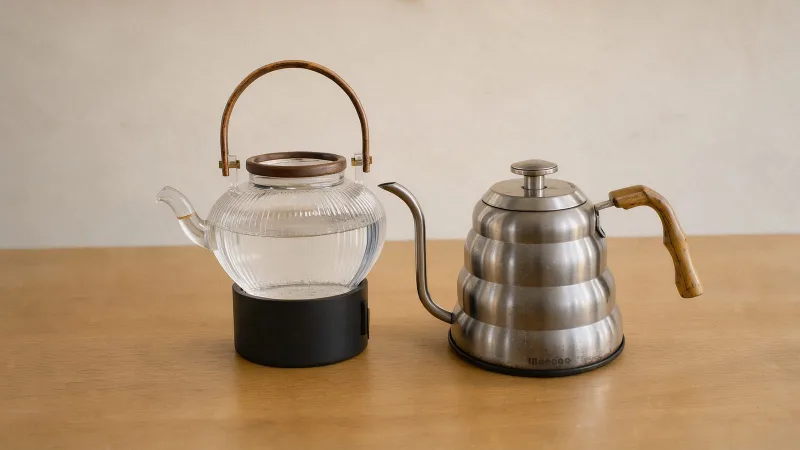
- Job:
- bring water to the right temperature
- Types:
- clay, glass, steel, electric
- Chaozhou shadiao:
- 250–500 ml by the 2021 standard
- Electric gooseneck:
- about 27–40 fl oz (0.8–1.2 l)
- Set-temperature accuracy:
- most models miss by 2–5 °F (1–3 °C)
A water kettle does one job: it heats water. The tea is brewed in another vessel, a gaiwan or a teapot. In a Chaozhou set you can see the split at once: water boils in a clay shadiaoshadiaoThe Chaozhou clay water boiler (砂铫): thin-walled, unglazed, with a hollow side handle. It is only for heating water; tea is not brewed in it., and the tea steeps in a small Mengchen pot (孟臣罐). Don't confuse the two, even though English texts often call both a "teapot".
Kettles are made of clay, glass or steel, or run off the mains, and only some of their differences matter for tea.
The Chaozhou clay shadiao
The classic boiler of gongfu cha is made from a ceramic body mixed with quartz or river sand. The clay is red or white, more often red. Everything depends on the thin wall: a small batch of water boils quickly in it, and the boiler cools quickly once it is off the heat. The handle sits at the side and is hollow. When the water boils, steam lifts the lid and it rattles against the neck. A tea host listens for that rattle to know when to pour.
Sources disagree on volume. The 2021 Chaozhou group standard says 250–500 ml, a 2024 field study 300–500 ml, a popular article "no more than 250 ml", and the TeaHQ reference 200–600 ml. If you need one number, remember 250–500 ml. Next to it sit a brewing pot of 60–160 ml and cups of 25–35 ml.1 It is small because water used to be boiled fresh for every infusion or every other one.
The boiler sits on a clay brazier (泥炉) with a firebox sized to its base. Charcoal from Chinese olive stones is thought the best fuel; in Taiwan, longan charcoal takes its place. When Chaozhou gongfu cha entered China's intangible heritage list in 2008, three of its listed steps concerned the water: filling the shadiao, boiling on olive charcoal, and pouring with the boiler lifted high.
Only put a shadiao on the fire when it is dry. A wet body cracks on a strong flame, and a cracked boiler is finished. Traditional underfired pieces are made for charcoal and weaken over time until they start to seep. For gas or an electric hob, buy one made from a heat-resistant body; Chaozhou potters now make boilers from newer mixes. Before buying, fill it with water and check the spout. The standard calls for a steady stream and no drip once you stop pouring.
The Japanese bofura
White braziers and side-handled boilers reached Japan in the early 19th century and are still the most common utensils of sencha-do. The Japanese call the boiler ボーフラ (bofura). Bofura are always unglazed ceramic, never porcelain, with a side handle for the brazier (涼炉) or a top handle for a hanging stove. Pieces brought from China in the Bunsei years (1818–1830) are prized above all, for their very thin walls and a sheen unusual in unglazed ceramic. Japanese copies are thicker and heavier.
Sencha-do practitioners avoid metal boilers, saying metal "breaks the flavor". That is the traditional view, not a measurement.
Glass kettles
Heatproof glass is made from quartz sand, borax, boric acid and alumina. It expands little when heated, so it survives temperature swings, but it is not tempered and breaks on impact as easily as ordinary glass. Makers state the allowed temperature difference. Hario uses 120 °C for boiling water, microwave and oven, 150 °C for open flame, and 400 °C for "super heatproof" glass.
In China glass kettles come in two kinds. Some are all glass and sit on an infrared ceramic hob (电陶炉). Others are electric: a glass flask on a steel base, joined with a silicone gasket. The main reason to choose glass is that you can watch the water boil. For glass beyond kettles, see glass teaware.
Steel stovetop kettles
Stainless steel is a family of alloys. Ferritic grades such as 430 are magnetic; annealed austenitic 304 and 316 are barely magnetic at all. So an "18/10" or "304" stamp does not tell you whether a kettle works on induction. What matters is the outer surface of the base, which sometimes has a magnetic layer bonded to it. The simple test is a magnet, which should hold firmly across the whole base. Even that is no guarantee, since the hob still has to recognize the diameter of the magnetic zone.
Electric kettles
Most people own one of these. In China and in tea houses, water is mostly heated in steel electric kettles or glass flasks. Current runs through a heating element, either a coil in the water or a flat element under the base.
All a plain boil-only kettle has to do is shut off on time. Steam travels up a channel, often in the handle, to a bimetallic disc, which snaps and breaks the circuit. The disc reacts to steam, not to the number 100 °C, so the kettle shuts off even in the mountains. The first automatic kettle with a steam cutoff, the Russell Hobbs K1, came out in 1955 (The Independent says 1956). Before it, an electric kettle could boil dry and start a fire.
For tea, models with temperature selection are more interesting. What to check:
- Accuracy. In an America's Test Kitchen test, most models undershot by 2–5 °F, roughly 1–3 °C. Only one hit the target or missed by 1 °F. These kettles have a single sensor at the base of the flask, while the water heats unevenly from place to place. Readings are consistent from one boil to the next but not exact. Set it a degree or two high, or check with a thermometer.
- Hold. A good keep-warm mode holds the set temperature for at least 30 minutes, up to an hour on some models. The best model in the test stayed within 1 °F for the full 30 minutes. On two of the four models tested, the mode needs its own button, and if you don't press it right away you have to heat the water again.
- Spout. A thin curved gooseneckgooseneckA thin, curved spout on an electric or stovetop kettle. It pours a slow, precise stream that is easy to aim at the leaf. spout pours a slow, precise stream. Spouts with a steep upward curve work better, because water doesn't slosh out when you tilt the kettle. The analog thermometers on the lids of simple models are inaccurate.
- Size. Gooseneck models hold roughly 0.8–1.2 l. That is a lot for one gongfu session, but you never have to refill midway.
Choosing a kettle
Choose by the tea, not by the material.
The Chaozhou set was built for oolongs, above all Phoenix dancong, which are brewed with boiling water, fresh for each infusion, a little at a time. Green, white and yellow tea need water below boiling, and that is where a kettle with temperature control helps. Water for tea gives the temperature for each type. For puer and dark oolongs, any kettle that reaches a full boil will do.
People often say that water in a glass or steel kettle never reaches 100 °C, while in a clay one it does. Chinese tea articles give 93–97 °C for glass and steel. But the boiling point depends on pressure and impurities, not on the vessel. The real difference is how fast the vessel cools once it leaves the heat.
Altitude matters too. Water boils about 0.5 °C lower for every 150 m of climb, so at 1,500 m it boils at around 95 °C.
Limescale, nickel and care
When hard water is heated, calcium and magnesium carbonates come out of it: the water turns cloudy and a crust builds up on the bottom. Tefal advises descaling at least once a month, more often with hard water. There are two ways:
- pour in 0.5 l of 8% table vinegar and leave it for an hour without heating;
- boil 0.5 l of water, add 25 g of citric acid and leave it for 15 minutes.
Then rinse five or six times. Don't scour the heating element with an abrasive. For other teaware, see teaware care.
In kettles with an exposed nickel-plated coil, descaling with citric acid raised nickel in the water as much as 50-fold, to 640 µg/l in Helmers' experiment. The EU limit for drinking water is 20 µg/l, and it took five boils to get back below it. Kettles with a steel element release very little nickel: a Polish check of 48 kettles found a maximum of 2.8 µg/l. So after descaling, pour away the water from the first few boils, and don't leave water standing in the kettle. In a Scottish study, nickel rose within 0–30 minutes of standing.
Let a clay boiler dry fully between sessions; neglected unglazed ceramic can make the water smell. With glass, wipe drops off the outside before heating, don't add cold water to a hot flask, don't heat it empty, and keep the flame low and centered on the burner. Superheated water can boil up suddenly and spill; in Japanese this is called 突沸.
Many people worry that water boiled too long turns poisonous. In a test with tap water, neither repeated nor prolonged boiling spoiled it, provided the source water met the standards. Evaporation changes only the concentration of dissolved solids.
Common questions
Do I need a kettle with temperature control?
For green, white and yellow tea, yes: they are brewed below boiling, and cooling water by eye is awkward. For puer and dark oolongs, any kettle that brings water to a full boil is enough.
Is water really softer from a clay kettle?
There is no evidence for it. The TeaHQ reference found no source for the claim, and potter Petr Novak describes the opposite: cheap underfired boilers can leave a clay taste. In Chaozhou and Japan such water is traditionally thought softer, but nobody has measured it independently.
Can a glass kettle go on a gas burner?
Only if the label says the glass is rated for open flame. Glass sold for boiling water only must not go on a flame at all. Go by the marking on that specific kettle, not by the word "heatproof".
-
The China Tea Science Society standard T/CTSS 5-2019 gives other figures: shadiao 300–500 ml, brewing pot 90–150 ml, cups 25–35 ml. The text of the 2021 standard was not available directly, so its figures come from the press: Chaozhou Daily, 2021. ↩