Water for tea 水
Tea liquor is more than 99% water, so the salts and temperature of that water noticeably change the flavor. For tea, use soft water low in minerals, heated only as hot as the leaf needs.

- Total dissolved solids:
- up to 150 mg/l, lower for green
- Hardness:
- low, up to 100 mg/l CaCO₃
- Temperature:
- 75–100 °C by tea type
- Chlorine:
- a problem from 0.5 mg/l
- Source:
- filtered or bottled water
In China they say "water is the mother of tea." Good leaf brewed in hard water loses to average leaf brewed in soft water: the liquor darkens, the aroma goes dull, and a film forms on the surface. So when the tea doesn't taste right, check the water first, then the leaf, and only then your own hand.
What in the water affects tea
Not every number on a water report matters for tea. The ones that do are hardnesshardnessThe amount of calcium and magnesium salts in water. Russia measures it in mg-eq/l, Britain and China in mg/l as CaCO₃., alkalinity, total dissolved solidstotal dissolved solidsThe sum of salts dissolved in water, in mg/l. Bottled water labels list it as TDS, dry residue or fixed residue., iron and chlorine.
Hardness is calcium and magnesium. The harder the water, the fewer catechins reach the liquor, and the darker and heavier the tea. Green tea is the most sensitive: Chinese tasting panels found that Longjing tasted best in purified water and in slightly acidic spring water low in calcium and magnesium. Black tea suffers from too much magnesium. In one experiment, sweetness and umami dropped at 16 mg/l, and the best cup came at 4 mg/l. Dark tea is the least sensitive to water composition.
Alkalinity (bicarbonate) pushes the liquor slightly alkaline, which speeds up polyphenol oxidation. Green tea darkens, and black tea turns bitter. Above pH 7 the aroma suffers.
Iron and manganese bring a metallic taste and turn the liquor blackish brown. Chlorine becomes a problem from 0.5 mg/l because of its smell. At about 200 mg/l, table salt already tastes salty.
How many minerals you want
There is no single number, and the guidelines disagree:
- the Tea Research Institute of the Chinese Academy of Agricultural Sciences: total dissolved solids below 50 mg/l;
- the Chinese standard for "tea water" T/CTSS 32-2021: conductivity of 10–100 µS/cm, calcium no more than 12 mg/l, magnesium no more than 8;
- the US Tea Association, as relayed by Barista Hustle: 50–150 ppm and hardness around 80 ppm.
The first two agree, and the third is two to three times looser. In practice, the more delicate the tea, the closer you stay to the low end. Just don't go to zero, because fully demineralized water makes an insipid cup.
It is not wax from the leaf. The film comes from the water's chemistry and forms only when calcium (or magnesium) and bicarbonate are both present. In distilled water, or in water without calcium or without bicarbonate, it does not appear. Cloudiness in cooled tea is another story. It is a precipitate of caffeine and flavanols, and calcium and magnesium make it worse.
Tap, bottle, filter
Judge tap water by its smell and by your kettle. White scale on the walls means hard water. Russian drinking water rules allow up to 7 mg-eq/l, about 350 mg/l CaCO₃. That is a sanitary ceiling, not a target for tea: water like that is four times harder than water at 84 mg/l.
What each treatment does, and what it leaves alone:
| Method | What it changes | What it does not change |
|---|---|---|
| Boiling | removes temporary hardness (scale) | permanent hardness, chloraminechloramineA compound of chlorine and ammonia that some water utilities use as a disinfectant. Boiling or letting the water stand barely removes it. |
| Standing | free chlorine escapes over a few days | chloramine |
| Pitcher with charcoal and resin | chlorine, carbonate hardness, copper, lead | permanent hardness |
| Charcoal-only filter | chlorine and taste | calcium and magnesium |
| Reverse osmosis | removes 92–99% of minerals | chloramine |
| Osmosis with a remineralizer | puts calcium and bicarbonate back | none |
Japanese producers advise boiling tap water for several minutes to drive off the chlorine smell, then letting it cool to the temperature you need. That won't deal with chloramine, which takes activated charcoal and a long contact time. Magnetic "softeners" do not soften water.
On a bottle, read the dry residue. In the EU, "very low mineral content" means no more than 50 mg/l, and "low" up to 500. If the label says "contains calcium" (over 150 mg/l), "contains magnesium" (over 50) or "contains bicarbonate" (over 600), skip it for tea. A "for tea" claim without composition figures guarantees nothing.
Change filter cartridges on schedule. A BRITA MAXTRA+ cartridge, for example, is rated for 100 l at a carbonate hardness of 10–12 °dH and for no more than four weeks, and its capacity drops in harder water. Scale in the kettle spoils water too. It is temporary hardness that has settled out, so descale the kettle now and then.
Temperature by type
The more delicate the leaf and the lighter the oxidation, the cooler the water. Boiling water scalds the young buds of green tea, while the dense leaf of a rock oolong or of pressed pu-erh needs all the heat it can get to open up. The reason is chemical: amino acids (theanine) dissolve even in warm water, while the bitter galloylated catechins dissolve in noticeable amounts only above 70–80 °C.
| Type | Water | Keep in mind |
|---|---|---|
| Green | 75–85 °C | at 100 °C the leaf scalds and the liquor turns bitter |
| Yellow | 80–85 °C | like green, a couple of degrees hotter |
| White | 85–90 °C | for buds such as Bai Hao Yin Zhen, sources give anywhere from 80 to 90 °C and above |
| Oolong | 90–100 °C | rolled oolongs are fine at 90–95 °C, Da Hong Pao takes boiling water |
| Black | 90–95 °C | small broken leaf is brewed closer to 90 °C |
| Dark | 95–100 °C | pu-erh needs a full boil |
Japanese teas go lower still: gyokuro is brewed at 40–60 °C, top-grade sencha at 70 °C and ordinary sencha at 90 °C, while bancha and hojicha take boiling water. To cool the water, pour it into a yuzamashi (a cooling bowl) or into the cups. Each transfer takes off 5–10 °C.
The table gives the temperature of the water in the kettle; in the teapot it is lower. In Hojo Akira's test, boiling water poured into cold clay pots was down to 79 °C after a minute in a 100 ml pot, 83 °C in a 140 ml pot and 85 °C in a 300 ml pot. After two preheats, the small and large pots held 89 and 91 °C. That is why you warm the teaware first and only then work out how much leaf to use and how long to steep it.
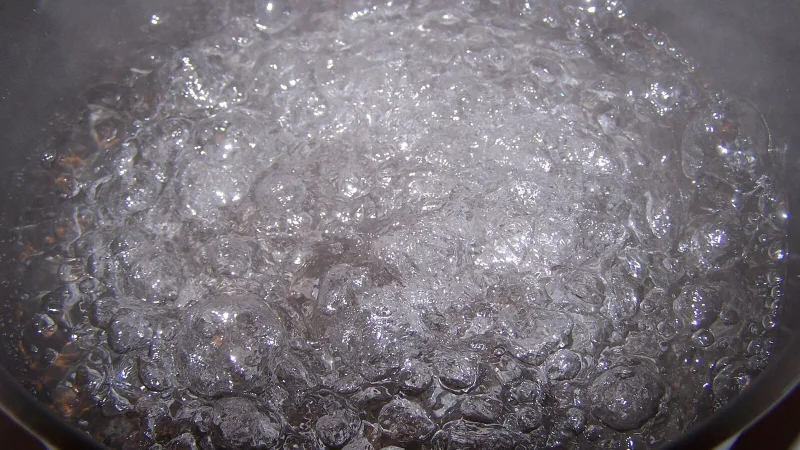
At around 70–80 °C (158–176 °F), small bubbles appear on the bottom. By 85–90 °C they rise in strings along the sides, and at 100 °C the whole surface churns. It is a rough guide. For green tea, a thermometer or a kettle with temperature control is more reliable.
At altitude the boiling point drops by about 1 °C for every 300 m. At 1,500–1,800 m it boils at 95 °C, at 4,800 m at 84 °C. In the mountains, that matters for oolongs and pu-erh, which need a full boil. At sea level, weather shifts the boiling point by only ±1 °C, too little to affect flavor.
Should you reboil water?
The common belief is that reboiled water "loses oxygen" and makes tea flat. America's Test Kitchen put this to the test, comparing tea made with freshly boiled and reboiled water (three repeats each), and found no difference in flavor. The first boil already drives off so much dissolved gas that a second one changes little. Joe Schwarcz of McGill University also ran the numbers on "concentrated harmful substances": after boiling off half the water, the fluoride content differs by about 10%, which is negligible.
That does not make endless boiling a good idea. Repeated boiling and cooling leaves a suspension of carbonates, concentrates permanent hardness and builds up traces of iron and copper, and the taste can change. Fill the kettle with fresh water and take it off as soon as it boils or reaches the temperature you need. Pour out whatever is left after the session. In gongfu cha, the water for a dozen infusions is reheated briefly, without letting it boil on.
Lu Yu's three boils
Lu Yu described how to boil water for tea in The Classic of Tea, written around 760. In his day the tea itself was boiled: ground leaf went into boiling water in a cauldron. Lu Yu distinguished three stages. At the first, the bubbles look like fish eyes and the water makes a faint sound; this was when you added salt. At the second, the water at the edges wells up like a spring and bubbles rise like strings of pearls; then you scooped out a ladle of water and put in the tea. At the third, the water heaves in waves. Past that point, Lu Yu says, the water "grows old" and is no longer fit for tea. In the same chapter he ranks mountain water above river water, and river water above well water1.
Writers of other eras differ on details: for Cai Xiang, "crab eyes" already mean overboiled water, while Lu Yu's "fish eyes" only open the scale. But the habit of watching the bubbles lived on, even if a thermometer in the kettle now often stands in for them.
Common questions
Can you brew tea with tap water?
If the water is soft and does not smell of chlorine, yes. If it smells of chlorine and your kettle scales up, you need a filter. A pitcher with charcoal and ion-exchange resin removes chlorine and some hardness, but not all chloramine and not permanent hardness.
Is distilled water good for tea?
Better not. The WHO describes fully demineralized water as insipid and flat, and tea made with it tastes empty. Opinions differ: some Chinese experts accept purified water, while ISO 3103 allows distilled water only as an exception. Water with low but not zero mineral content is the safer choice.
Does reboiled water spoil tea?
In a blind test by America's Test Kitchen, nobody found a difference in flavor. Still, repeated boiling leaves sediment and scale in the kettle and concentrates the salts, so fresh water is the better habit.
-
Lu Yu, The Classic of Tea (茶经), 8th century, chapter five. ↩